











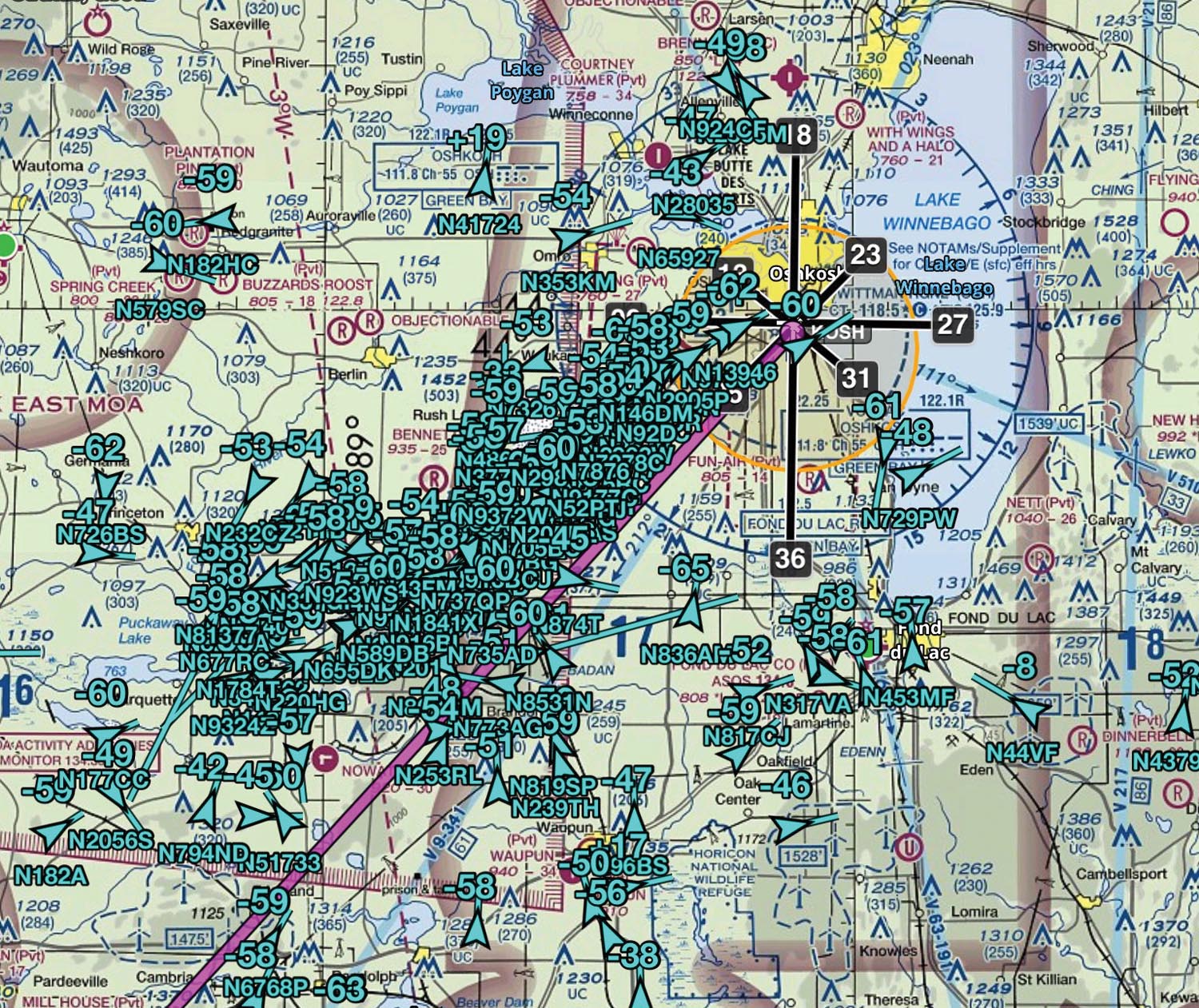


Air Show Arrivals
I have enjoyed your magazine for many years. Your airshow arrival article (April 2024) reminded me of a 2015 experience I had in Salinas, Calif., when I attended an AOPA fly-in there.
I flew in IFR, because I had recently obtained the rating. The coastal stratus at 1000 feet was still burning off, and it simplified the high-traffic conditions. By the time the show completed, around four p.m., the marine stratus layer had returned. I filed and got in line for takeoff with the other 100 or so planes, most of whom planned to scud-run out of the area VFR. I finally got to the number one position for departure and was told to pull to the side and await ATC clearance.

After about 20 minutes of waiting, I decided to scud-run like everyone else, called tower and canceled IFR and then took off. Fortunately, I had to scud-run for only a few miles before encountering true VFR and a happy ending.
This was not a particularly big show. So, my advice, if IFR conditions prevail at departure time at a big show, wait the weather out or be prepared for a very long clearance wait.
—Ron Hamburger, Via email
You’re not the first to have scud-running stories to tell following an air show.
A long-time pilot-friend tells the tale of flying a vintage, VFR-only Bonanza to Oshkosh, only to have a couple of extra days tacked on to the end of his trip against his will, waiting for weather to improve, before he could depart. The worst-case scenario is when the scud doesn’t clear up and one heads off toward rising terrain or obstacles. Let’s be careful out there, huh?
Is A VOR System Required?
I appreciated the article on the MON network plans (“The Minimum Operational Network Of Navaids,” March 2024), as it has been largely absent from the aviation periodicals that I read. One question still remains for me: Am I required to have an installed and operational VOR system to be legal to file IFR?
I know of several owners (particularly in the kitplane world) who are proud to have no more VOR equipment in the aircraft but routinely fly IFR.
—Allan W. Martin, Via email
Good question. The basic answer comes from FAR 91.205, Powered civil aircraft with standard category U.S. airworthiness certificates: Instrument and equipment requirements. It states that covered aircraft must carry “Two-way radio communication and navigation equipment suitable for the route to be flown.”
That can be interpreted to mean a comm radio and radar vectors from ATC for navigation, but we’d guess the likelihood of long-term success with such a scheme is low.
Since FAR 91.205 applies to aircraft “with standard category U.S. airworthiness certificates,” it doesn’t apply to experimentals. Unless, that is, according to the Experimental Aircraft Association, EAA, the aircraft’s operating limitations include something similar to the following text: “After completion of phase I flight testing, unless appropriately equipped for night and/or instrument flight in accordance with §91.205, this aircraft is to be operated under VFR, day only.”
The EAA has several other thoughts on equipping experimental aircraft for IFR.
‘Water, Water Everywhere’
In the subject article, the author writes:
“While instability has nothing to do with water, it’s worth a reminder that it depends on how quickly air cools with a rise in altitude. Air that is cooling too quickly will tend to seek its proper, higher level, if disturbed.”
There are two common misconceptions here. First of all, the free (dry) atmosphere cannot have a statically unstable lapse rate. The steepest it can be is dry adiabatic, which is neutrally stable. Secondly, moist air is inherently more unstable than dry air. If a parcel of moist air is forced to rise, it will cool at the dry adiabatic lapse rate until it reaches its saturation point and condensation begins. It will then cool at the lower, moist adiabatic lapse rate making it more likely to become warmer than the surrounding atmosphere and continue rising on its own.
—Steve Lehr, CFI, Retired Air Force Meteorologist
Send your thoughts, comments or questions to avsafetymag@gmail.com
