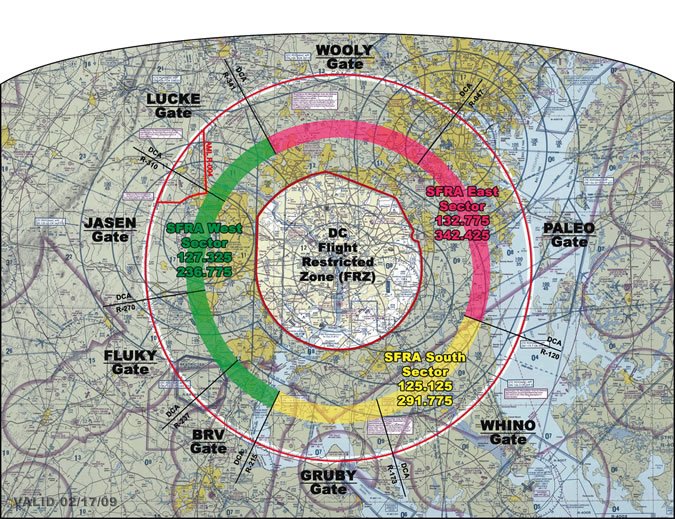
I vividly remember my first VFR flight into the Washington, D.C., Special Flight Rules Area (SFRA, previously the D.C. ADIZ). Arriving into Leesburg, Va., I ducked under the Dulles Class B airspace and entered the downwind behind another aircraft. Thats when I heard the voice: Watch your altitude. I figured Potomac Approach somehow smelled fresh blood and would have a SWAT team greeting me on landing.
Pilots flying VFR or IFR in the D.C. SFRA must strictly adhere to specific procedures, particularly by maintaining their assigned squawk code and never squawking 1200 until explicitly instructed by ATC, as this is a common violation.
VFR flights into or out of the SFRA require a special flight plan filed as an IFR plan with a VFR altitude tag, and pilots must obtain a specific clearance and transponder code from Potomac Approach/Clearance prior to entry or departure.
Navigating the SFRA demands high situational awareness due to complex Class B airspace, strict speed limits (e.g., 180 knots within SFRA), and the presence of the no-fly Flight Restricted Zone (FRZ) immediately surrounding D.C.
I vividly remember my first VFR flight into the Washington, D.C., Special Flight Rules Area (SFRA, previously the D.C. ADIZ). Arriving into Leesburg, Va., I ducked under the Dulles Class B airspace and entered the downwind behind another aircraft. That’s when I heard the voice: “Watch your altitude.”
CREATE A FREE ACCOUNT
Sign up to keep reading
Create a free account to continue. Already a member? Sign in below.