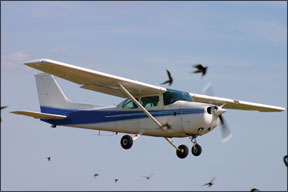
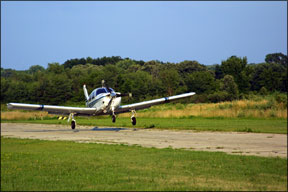
As we practice our license to learn, some hazards demand our frequent attention: Traffic, weather and terrain are the top three. They present varying levels of predictability, and a huge amount of brain power and economic investment has been poured into keeping pilots out of the teeth of these hazards. But what about the less predictable living hazards that share the airport-and sky-with us? Plenty of critters live on and around airports, and as for sharing the sky with birds, well, they got there first. Sometime in the 1980s, a Japan Airlines-bound ab initio student at Napa Airport, Calif., (APC) had a rough time understanding the tower controllers by-the-book NOTAM. She warned, “Aircraft in the vicinity, be aware of large waterborne fowl in and around the airport environment.” After several futile rounds of the hapless student pilot requesting that she say again, she finally bellowed, “Birds! We have birds on the runway!” Birds in the aviating environment are far from the cute critters alighting on Cinderellas hand. A brown pelican, for instance, can pack a punch, weighing up to six pounds (and lets hope you never encounter the 33-pound Dalmatian pelican). Turkey vultures weigh up to 10 pounds; however, the mass generated by a closure rate greater than your en route cruising speed can be incredibly destructive. Size doesnt always matter: The tiny starling is a feathered bullet, with a body 27 percent more dense than the herring gull.