











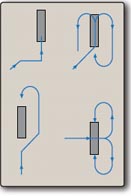
In the August 2006 article, “Five Ways to Better NPAs,” the author made an error by confusing straight-in approaches with straight-in landings. In the highlighted box called “Defining the Non-Precision Approach” the writer defined a straight-in approach as “a procedure where the final approach course is aligned to within 15 degrees of the runway heading….” This is incorrect; a straight-in approach is one in which there is no procedure turn. 288
Safer Trainers
In the August 2006 article, "Five Ways to Better NPAs," the author made an error by confusing straight-in approaches with straight-in landings. In the highlighted box called "Defining the Non-Precision Approach" the writer defined a straight-in approach as "a procedure where the final approach course is aligned to within 15 degrees of the runway heading...." This is incorrect; a straight-in approach is one in which there is no procedure turn. …

Key Takeaways:
- An August 2006 article incorrectly defined a "straight-in approach"; a straight-in approach means no procedure turn, while a "straight-in landing" requires the final approach course to be within 30 degrees of the runway heading.
- Glider piloting, while engine-free, demands intense concentration on micrometeorology and precise control, requiring significant focus and attentiveness.
- Low-powered airplanes can safely undertake cross-country flights through high terrain, provided pilots are thoroughly prepared, understand density altitude, and follow appropriate mountain flying procedures.
Key takeaways sponsored by Aviator Pro | Start Your Training ->
See a mistake? Contact us.

