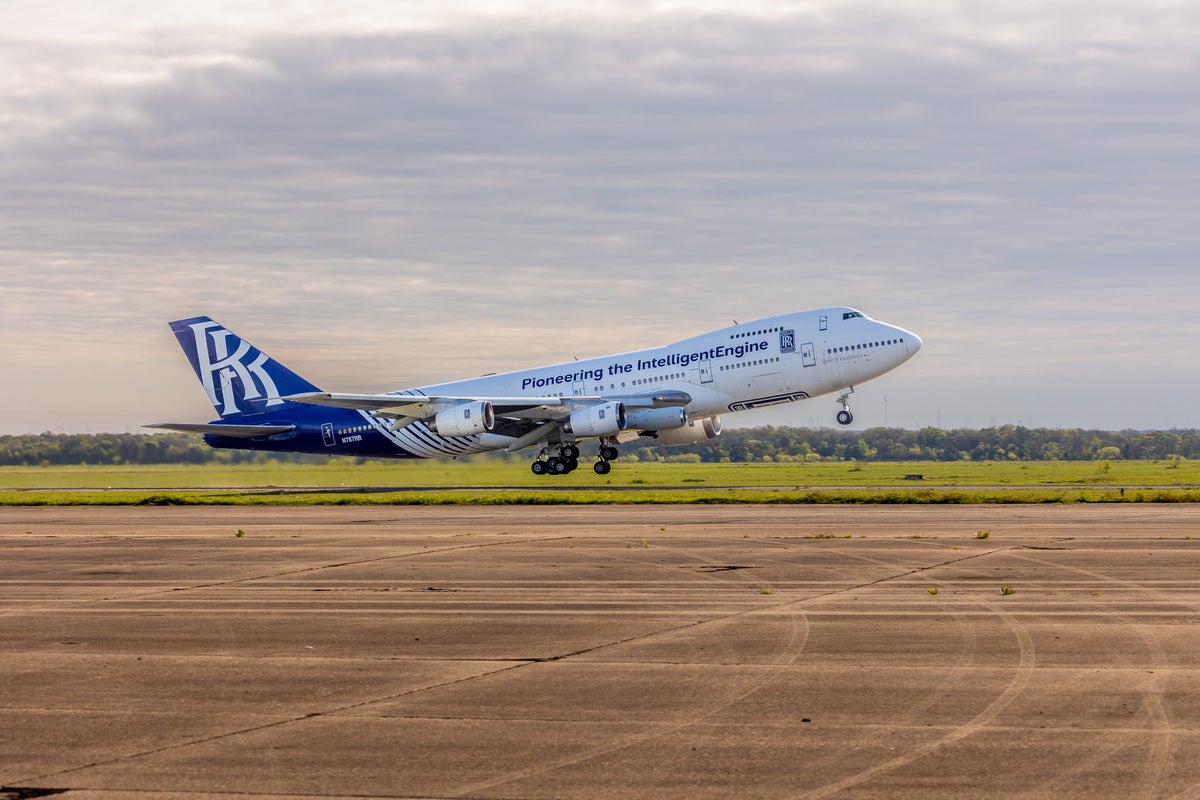
Rolls-Royce’s Boeing 747-200 flying test bed [Credit: Rolls-Royce]
Key Takeaways:
Rolls-Royce is retiring its Boeing 747-200 "Flying Test Bed" (FTB) aircraft after 20 years of service and over 2,000 hours of flight testing.
The specially modified aircraft, capable of flying with five engines, was crucial in the development and testing of engines like the Trent 1000 and Pearl 10X.
The FTB played a significant role in advancing sustainable aviation fuel (SAF) technology, including a landmark flight in 2021 that demonstrated a Trent 1000 engine running on 100 percent SAF.
Rolls-Royce will continue its engine innovation and testing using a combination of new flying test beds, ground testing, and advanced digital modeling.
Aircraft engine manufacturer Rolls-Royce is retiring a Boeing 747-200 test aircraft after 20 years in service.
The company said the aircraft, known as the “Flying Test Bed” (FTB) and registered as N787RR, flew its last assignment in July. It had been in service since 2005 and played a role in the development of engines like the Trent 1000 and Pearl 10X.
CREATE A FREE ACCOUNT
Sign up to keep reading
Create a free account to continue. Already a member? Sign in below.
Zach Vasile is a writer and editor covering news in all aspects of aviation. He has reported for and contributed to the Manchester Journal Inquirer, the Hartford Business Journal, the Charlotte Observer, and the Washington Examiner, with his area of focus being the intersection of business and government policy.