











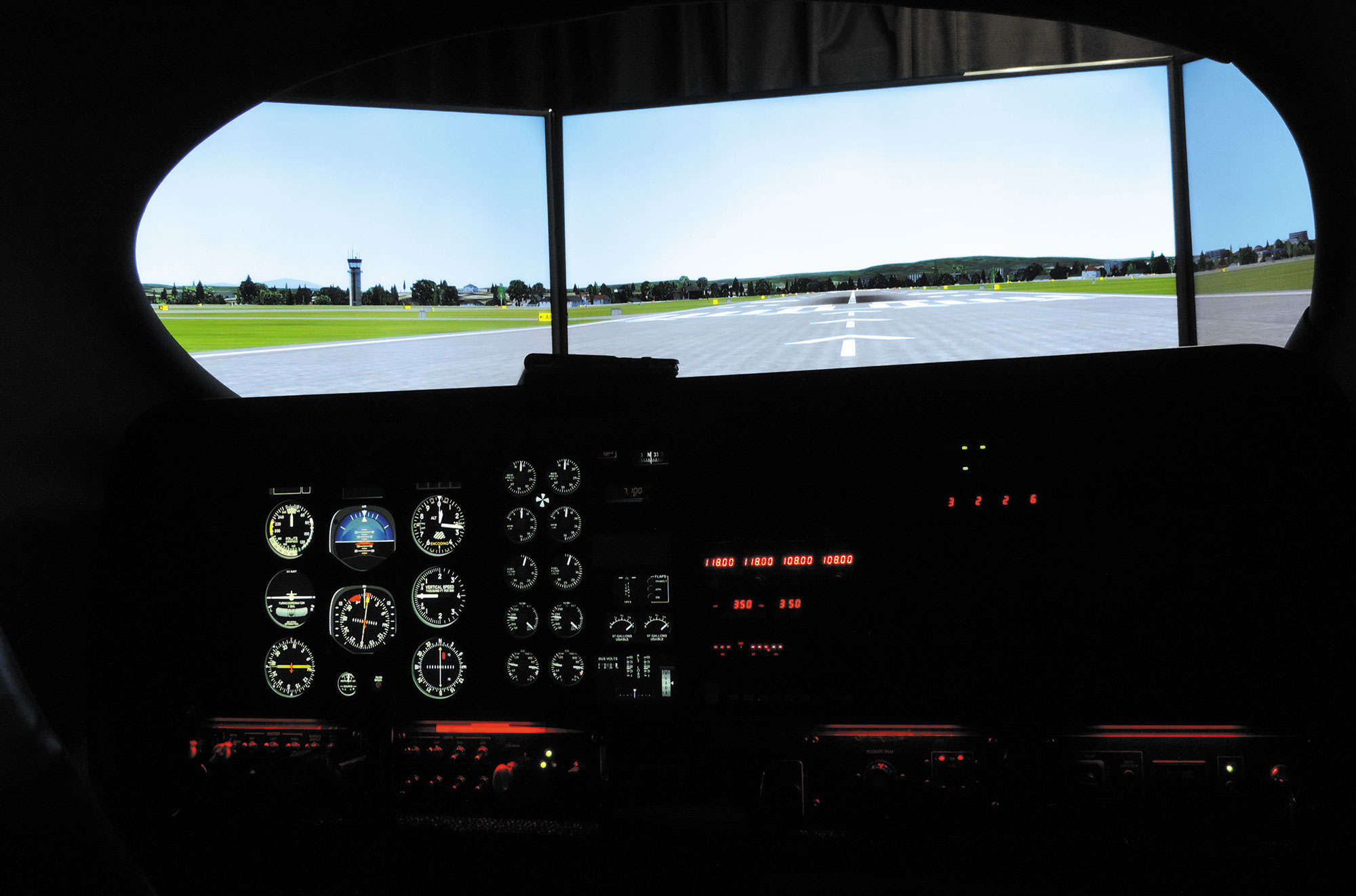


Frequently in this publication we stress flying simulators for proficiency (and often for legality). While we treat sims as an accepted part of any routine training regimen, not everyone is on board with that sentiment. For those of us who are believers, we find it difficult to accept that there are some out there who don’t like sims.
The biggest argument against using sims is that they’re not realistic—they don’t fly like the real thing. That’s absolutely true, but in the sense that a Tailorcraft doesn’t fly like a Mooney. The control feel is different and one has more sensitive controls than the other. I’d argue, though, that the differences, while undesirable if you fly a Mooney, are still largely overcome by the advantages.

Before we move on to the advantages, let’s further discuss the difference in “feel.” In a sim, like in a real airplane, if you turn the control to the right or the left, the simulated airplane indeed turns to the right or left. Similarly, if you push forward, the houses get bigger and if you pull back they get smaller (until they get bigger again, of course). What’s different is the force and amount of deflection required.
It’s rare—perhaps impossible—that a sim will have controls whose required force and amount of deflection required to get the job done replicate the airplane. All of us sim believers echo that non-believer criticism. But, does that invalidate the training value? I’d say it doesn’t.
Sure, if your goal is primary training, that “feel” difference can make transition to a real airplane a bit difficult. But all the other principles learned in the sim will still apply to how they make the houses look.
When I trained in Level D sims at the airline, we had an expression: “If you can fly the airplane it doesn’t mean you can fly the sim. But, if you can fly the sim, you can fly the airplane.” That refers largely to the feel of the sim versus the feel of the airplane. Yes, they’re different and you’ll struggle going from airplane to sim, but usually (and inexplicably) the transition from sim to airplane is easier.
The next big argument about sims not being realistic is a big one for me. A sim that you might afford to purchase for yourself will not likely have the same avionics or even the same switch placement as your airplane. That’s a realistic concern. If that is a problem, you can still practice approaches and maneuvers in the sim, but then go get some buttonology work in your actual airplane. Or, if you have the technical expertise, you can spend tens of thousands of dollars and years building your own sim that comes closer to your actual panel.
Now, on to the oft-touted advantages of a sim. It’s a better classroom because you can hear and talk freely. It’s cheaper, usually under $100/hour. You can precisely control the weather. The sim can be paused to discuss something immediately. You can position the sim at any location, even right at the FAF for approach after approach in just a few minutes. You can do things in a sim that are unsafe in an airplane.
The list goes on, but really racks up advantages for the sim. I’m a believer, even a crusader. If you’re not, at least give it a try. Perhaps you’ll like it.
