













Can You Get There?
Here’s the basic question: If no arrival from your inbound direction is published for your destination airport but one is published for a nearby airport, can you file and fly that arrival even though it is not charted to serve your destination?
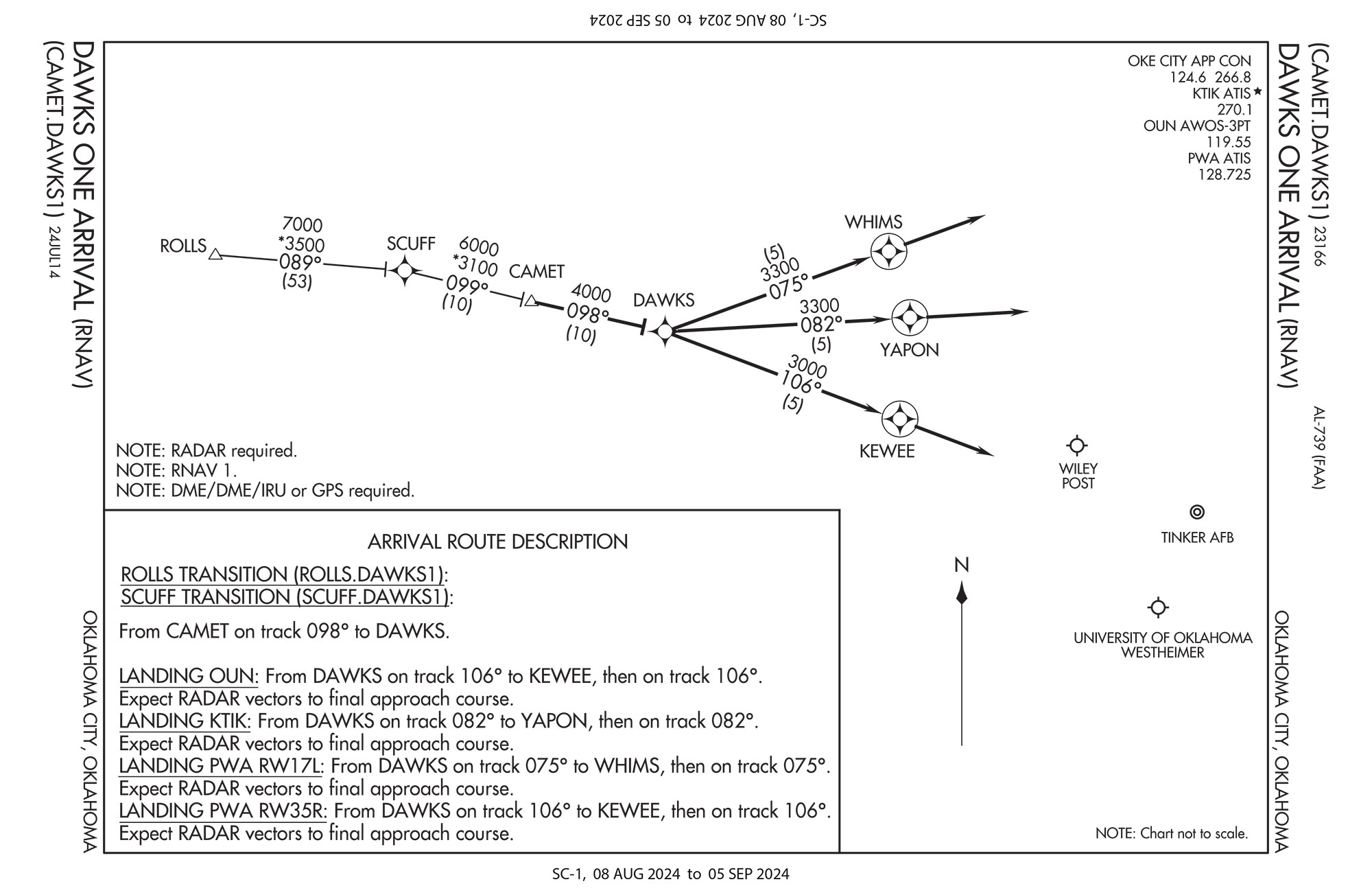
As an example, in Oklahoma City no arrival is published from the west for Sundance (KHSD). However, one is published for Wiley Post (KPWA) which is only five miles away. It is the DAWKS1 and serves KPWA after starting at ROLLS. I realize you can always ask a controller for vectors to your actual destination but since that destination (KHSD) is not served by this arrival, is that an acceptable plan?

A related question is more problematic… Say you were coming from the west on a cleared route to KHSD with no arrival specified. Can the controller then assign you an arrival that is not published for KHSD but is published for other airports nearby, like KPWA? You might have a heck of a time locating the arrival in that situation, but of course, a question to the controller would clarify it. Would a controller ever do this?
The opposite situation happens fairly often—when you are inbound and not on an arrival, but the controller sends you to an arrival that serves your destination. That I understand.
—Bill Marvel, Grand Junction, Colorado
It’s common for an arrival to serve more than one airport, but the airports served are depicted on the chart and the procedure is listed under each airport served. So, if KHSD isn’t served by the arrival, you shouldn’t file it—if you did it’d likely be rejected—nor should/will ATC assign it.
For example, the DAWKS ONE arrival does not depict KHSD and is not listed as a KHSD procedure. However, the GULLI THREE does serve and depict many OKC airports including KHSD (from a different direction) and is listed as a procedure available under KHSD.
Our resident controller, Elim Hawkins adds: No you can’t. You can shoot an approach to one airport, cancel IFR, and land at another airport, though. If there is no transition to your destination airport, just file direct or to a point close to the airport then direct.
Good Sim Challenge
Ryan and Jeff’s May 2024 Sim Challenge, “Proficient Currency,” was an outstanding exercise. I had just recently upgraded to X-Plane 12, and their efforts made for the perfect shake-down training day. There were so many important nuances and gotchas to this challenge, and I will be keeping this one in my library to revisit again. Please pass on my gratitude for their extra effort this month and tell them that I look forward to the next one.
—Clayton Wilson, Houston, Texas
Clayton, thanks for your kind words, which we’ve passed along to Ryan and Jeff.
Circle On a Straight-In?
In your May 2024 issue, the second paragraph of the response to the Readback letter entitled “Circling NA at Night Confusion,” it says “…nor can you use the circling minimums to land on Runway 28.” Why would you circle to 28 on the RNAV (GPS) RWY 28? Is there ever a case where one would fly that approach to 28 and then elect to circle to that same runway rather than simply landing straight in? If one had to break off the approach, wouldn’t one just fly the missed? What might cause a pilot to choose the circle-to-land 28 rather than the straight-in?
—Frank Arrison, Doylestown, Pennsylvania
Circling to 28 from a Runway 28 approach is an oddball situation. You might consider that on a straight-in, but you break out too close to the runway to make it straight in. You might then choose a close-in 360 or similar maneuver to land on 28. Since the straight-in and circling mins are the same, this is not completely illogical.
We suspect the real reason for the circling prohibition, though, is so some “clever” pilot doesn’t try to beat the system by claiming to use the circling mins and landing on 28, whether straight in or not.
As noted previously, there’s likely an unlit obstacle that makes Runway 28 ill-advised at night. But, since a circle to Runway 10 doesn’t have that obstacle, they didn’t simply note the entire approach as, “NA at night.”
We read ’em all and try to answer most e-mail, but it can take a month or more. Please be sure to include your full name and location for publication. Contact us at Frank@IFR-Magazine.com.


