











On Top…Of What, Where?
Thanks for Joe Shelton’s article on VFR-on-top operations in the August, 2013 issue. Your information was excellent and quite helpful.
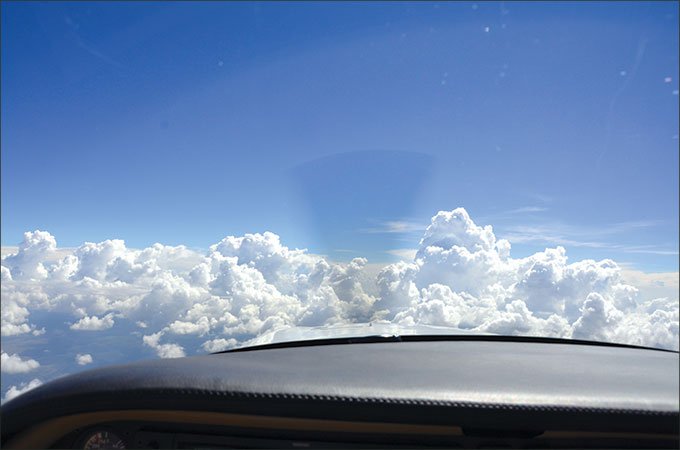
I have found VFR-on-top very useful out here in the mountainous western U.S., where MEA’s are high and some bumpy cumulus buildups make flying uncomfortable or even impossible at IFR altitudes in my aircraft.
When in these conditions, I’m often under a scattered or broken cumulus layer, requesting VFR-on-top. I then have used hemispheric altitudes and assigned routing, but these are often below MEA’s, which are often governed by terrain well away from my route. My question concerns the legality of flying in good VFR conditions but below the MEA while VFR-on-top. I am easily able to avoid terrain with approved heading changes in visual conditions, so am comfortable doing this. What are your interpretations?
Readback: October 2013

Key Takeaways:
- VFR-on-top operations lack explicit minimum altitude regulations beyond hemispheric rules, placing ultimate responsibility for terrain separation on the pilot, who should still consider IFR minimums for safety despite regulatory silence.
- For non-precision approaches, obstacle clearance is guaranteed only to the MDA (Minimum Descent Altitude); the VDA (Vertical Descent Angle) is a mathematical construct and does not guarantee obstacle clearance below the MDA, where descent is visual.
- The interpretation of holding pattern leg lengths, especially for Holds in Lieu of Procedure Turns, is ambiguous; while some guidance suggests depicted lengths are maximums, official handbooks and AIM recommend flying specified lengths, making clarification with ATC advisable.
Key takeaways sponsored by Aviator Pro | Start Your Training ->
See a mistake? Contact us.

