













Engine Failure Proficiency
I read with interest your March Remarks, “Staying Proficient.” As a CFI, one of the things I enjoy doing is teaching at regional safety seminars put on by one of the major type-owner groups. One almost-universal weakness I find among these single-engine pilots is a lack of an ability to properly and safely handle a (simulated, but most likely also real) engine failure.
I’ve given the causes of this a lot of thought and I can only come up with the obvious: These are low-probability events for which it is difficult to realistically train. Most in-airplane simulated engine failures are caused by the instructor simply pulling the power or possibly even pulling the mixture. These are obvious causes that obviate the need for realistic troubleshooting. A braver instructor might surreptitiously switch off the fuel, but that has its own risks. So, I believe that most in-airplane simulations of an engine failure lack sufficient realism and they certainly can’t trigger the life-or-death struggle of an actual engine failure with its potential catastrophic results.

All that said, we do end up with some valuable discussions and even demonstrations of the low-altitude turn-back to the runway, the so-called impossible turn. In some instances it is quite possible. In others, well, not so much. It’s good to determine where impossible turns to possible, then to practical.
What about using a simulator? First off, we don’t use a sim in these traveling safety seminars—doing so is largely impractical. But in formal recurrent training, in a sim we can cause an engine failure without telegraphing the cause to the pilot. This requires organized troubleshooting by the pilot and that is transferable to the aircraft. The sim can also be effective in exploring the turn back to the runway on departure. Where the simulator suffers, though, is in finding and lining up a suitable landing site, especially with outside visuals often limited and rarely exceeding even 90 degrees, much less 180. This can be only somewhat mitigated by using a moving map for situational awareness.
I’ve found that there are differing opinions among instructors on the effectiveness of using a simulator for engine-failure training. That might come from the broad range of simulator capabilities, where some are better for this training than others, and might relate directly to the quality and width of outside visuals.
I’ll add that regardless of engine-failure training, one good outcome of these safety seminars is that the attendees increasingly understand the need for recurrent training, not only in emergencies but also with the basics. That’s certainly a good thing.
—Sal Cruz, Watsonville, California
More On Those #$%& Codes
After reading the Flight Plan Codes article in your May issue, I decided to see how close to correct I was filing. Surprisingly, I wasn’t too far off. But, in Block 18 I’d also been filing a PBN code of O2. Reading the info, shouldn’t O2 also be in that block: PBN/B2C2D2O2S1? But it wasn’t discussed in the article…
—Monty Watson, Salinas, California
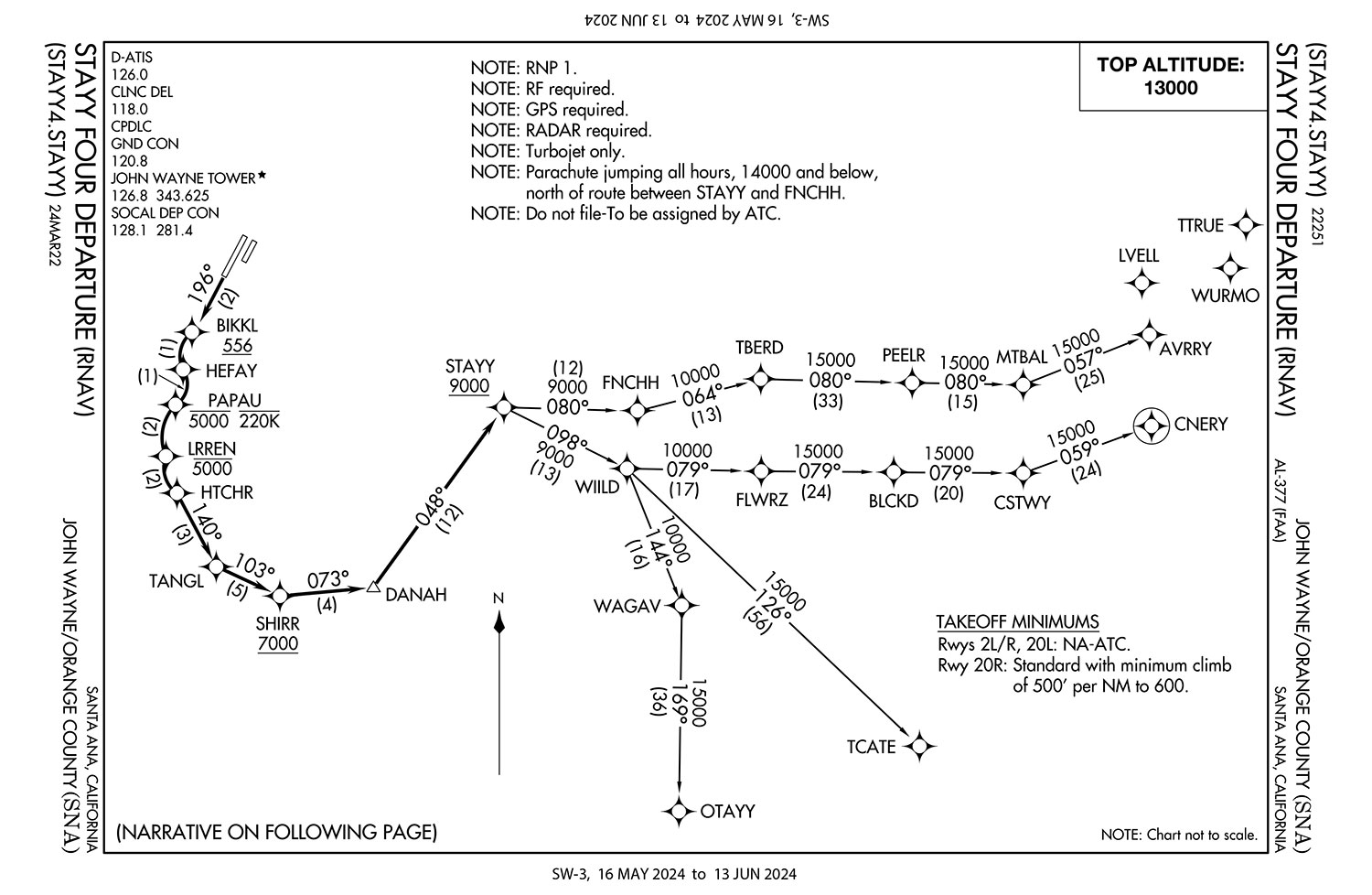
Let’s separate the technically correct from practicality. O2 says you can fly RNP 1 SIDs and STARs. But, in the U.S. there are none of those for pistons today and only a couple for jets, one of which is on the facing page. But, yes, with a modern navigator it’s quite likely you have the technical ability to fly a SID requiring RNP 1, so you could file O2 as one of the PBN qualifiers in Box 18.
That’s the same idea, by the way, as the Block 10 Y code saying you can communicate with 8.33 kHz spacing, which is not used in the U.S. But, if your com can do it, you’re perfectly proper to include that code.
Note that in both cases, the final authority is the AFM Avionics Supplement for Part 91. (Usually additional approval is needed for operations under Parts 91K, 121, and 135.) For example, the supplement for Garmin’s GTN navigator says you can fly RNP 1, but only if you have other capabilities such as an autopilot with flight director capable of following the navigator on a radius-to-fix (ARINC-424 RF) leg.
—Luca Bencini-Tibo
Lost Com Thoughts
I read Elaine Kauh’s article in the March 2024 issue of IFR magazine and appreciate her insight and contribution to an important subject. I found the discussion of the topic “leave clearance limit” particularly interesting, considering the fact that there have been several legal interpretations that have attempted to clarify the language of §91.185 with specific reference to the situation that occurs when the clearance limit is not a fix from which an approach begins.
Ms. Kauh references this situation in her article, but leaves the reader with the impression that flying to the airport and holding there when early is what we should do. The language of §91.185 states (paraphrasing) if the clearance limit is not a fix from which an approach begins—it’s the airport in most cases—leave the clearance limit when you get there and proceed to a fix from which an approach begins. A literal interpretation of the foregoing as Ms. Kauh states, would lead one to believe that we should proceed to the airport and hold there until the EFC or ETA time. The problem with this is that without the navigational guidance of GPS (never assumed) how would one navigate to the airport or even hold there?
The most recent FAA legal interpretation on this matter (Van West 2018) provides some clarity. In relevant part the interpretation states “We have previously explained that when a pilot flies an IFR flight plan, an estimated time of arrival at the destination is part of the flight plan (Tuuri 2011). If during the flight the aircraft loses radio communication, the clearance limit of the aircraft is the destination. If the aircraft arrives early at its clearance limit, the pilot should hold at the approach fix and commence descent and approach as close as possible to the estimated time of arrival.”
It therefore seems clear that the FAA does not intend to have us holding over an airport but rather proceeding to a fix from which the approach begins and holding there if necessary to meet the leave-clearance-limit time requirement of §91.185.
—Dave Simpson, San Diego, California
I did review that LOI while writing this Clinic and it does cite a previous interpretation that if arriving at the clearance limit early, hold over an IAF until the ETA. I could have more correctly rephrased that in the Clinic to say “have you holding over an initial approach fix until your ETA then proceeding onto the approach.” It is the traditional way, see below.
But the LOI uses “should” and not “must.” I’m not sure it’s ever prohibited to hold over the airport if you are early. If you need to determine how to reach another IAF or approach due to stormy weather, or if you choose not to attempt an approach there for safety reasons and need to divert to the alternate, you could probably hold at one of many IAFs at a given airport and then proceed to the alternate.
But that might not always be as predictable or as safe as remaining over the airport itself in changing weather. Or, what if the ceiling is gradually improving to near visual conditions and you determine, given the nature of your equipment problem, that it’s safer to remain over the airport and descend in visual conditions than to fly an approach and re-enter IMC. These actions might not follow the procedure outlined in the reg, but they present situations that require the PIC to make decisions for safety.
In regards to an aircraft not equipped with GPS to fly direct to the airport if desired, that is actually what the interpretation addresses—the old way of navigating. In those circumstances, we still teach pilots to file to an IAF as part of their route, or a VOR at or near the airport as a place to hold in case of lost coms. In either case, this reg has always had gray areas that can’t cover every real situation … so using that as the go-to plan along with being as predictable as possible if you need to make a change can provide the necessary safety nets given today’s better equipment redundancy.
Finally, I’ll add that most lost-com events in real IMC should be considered an emergency and under emergency authority the pilot should do what he or she thinks is the safest, regardless of what nuance might—or might not—exist in the regs. The AIM even advises this.
—Elaine Kauh
We read ’em all and try to answer most e-mail, but it can take a month or more. Please be sure to include your full name and location. Contact us at Frank@IFR-Magazine.com.

