













How Do Ya Spell That?
In Elaine Kauh’s article, “Plans Change,” in the January issue of IFR Magazine, there is an error in the route that Elaine lists for the flight: “You play defensive and file to go around all of that while including outbound, enroute and inbound checkpoints: RANDO DLL HERMNN WEASL.”
The waypoint listed as “HERMNN” is problematic on two points. First, it is a six (not five) letter name, and the HERMN waypoint is actually in Berkeley County, SC. What she meant was the HRMNN waypoint that is along T354 near Lacrosse, WI.

It is a minor point that may puzzle some of your readers. Elaine is an excellent writer, and I am always amazed at her thoroughness.
Thanks for your excellent publication.
—Victor Vogel, Location withheld from e-mail
Oops. You’re right, Victor. Yeah, as much as we try to get everything just right sometimes goofs like that slip through. Good catch. Thanks for pointing it out.
We Love Edge-Case Questions
Great article by Mac Lawler on “Training for Fairytales” in January. It got me thinking and I have two questions:
1. Can you fly a contact approach out of a cruise clearance? I think yes, as long as the airport has an IAP and weather reporting, and Mac’s article seems to support this by saying you can fly “any” approach off a cruise clearance.
2. How would you do a missed approach if given a cruise clearance? I think the procedure would be a climb to the local MSA, using your own terrain and obstacle clearance, and contact ATC, but I can’t find a definitive answer.
—Mark Helmericks, Anchorage, Alaska
Thanks for the note, Mark. Good questions. Your questions seeded some interesting discussions internally before we came up with answers we were happy with.
We’d be quite reluctant to fly a contact approach from a cruise clearance. We can’t find anything definitive about this, but the references all refer to a “published” instrument approach. Thus, a contact approach might not qualify. Note, though, that a published IAP at the destination is not a requirement for a cruise clearance, but is for a contact approach. Makes you think a bit, eh?
We think it is unlikely for ATC to issue a cruise clearance if the weather at the destination is such that a miss is even a consideration. So, without explicit missed instructions, you’re on your own.
If there is a published IAP, we’d do our best to try to follow the missed procedure that most closely matched our position. If there isn’t a suitable published IAP and you’re in IMC, consider a circle over the airport.
In either case you could contact ATC as soon as practical—they’re probably not expecting you to miss.
Mark, one more consideration came up as we discussed this. Yes, a cruise clearance includes an implicit approach clearance of the pilot’s choice. However, a contact approach must be explicitly requested by a pilot, and can never be even suggested much less assigned by ATC without that request. Although this reasoning is a bit convoluted, since the typical cruise clearance contains neither the pilot’s request for a contact approach nor ATC’s clearance for one, the safe conclusion is that it’s not included in the cruise clearance.
Keep It Short and Simple
I know I have been told that ATC is only allowed to give two instructions per transmission. (e.g. Turn left heading 270. Climb and maintain 10,000.) Can anyone help me find the reference in the 7110.65? I have downloaded all 729 pages but don’t know where to start.
—Roy Zesch, San Angelo, Texas
We looked and couldn’t find anything either, Roy. So, we consulted our newest resident controller, Mac Lawler, who responded:
I didn’t find any specific recommendation or regulation about breaking up clearances, but I did find a small section that may be the source of this misconception.
In the 7110.65 go to 4-2-1, Clearance Items. It appears to be specifically for the U.S. Air Force. The section states that, in a single transmission, controllers shouldn’t issue more than one of the listed items in concurrence with an altitude assignment. Thus limiting a single transmission to two items if one of them is an altitude assignment.
Whether this applies to FAA/Contract controllers operating with USAF pilots or USAF controllers issuing clearances is unclear. But it doesn’t seem to be a restriction for normal ATC operations.
What Makes an Amendment?
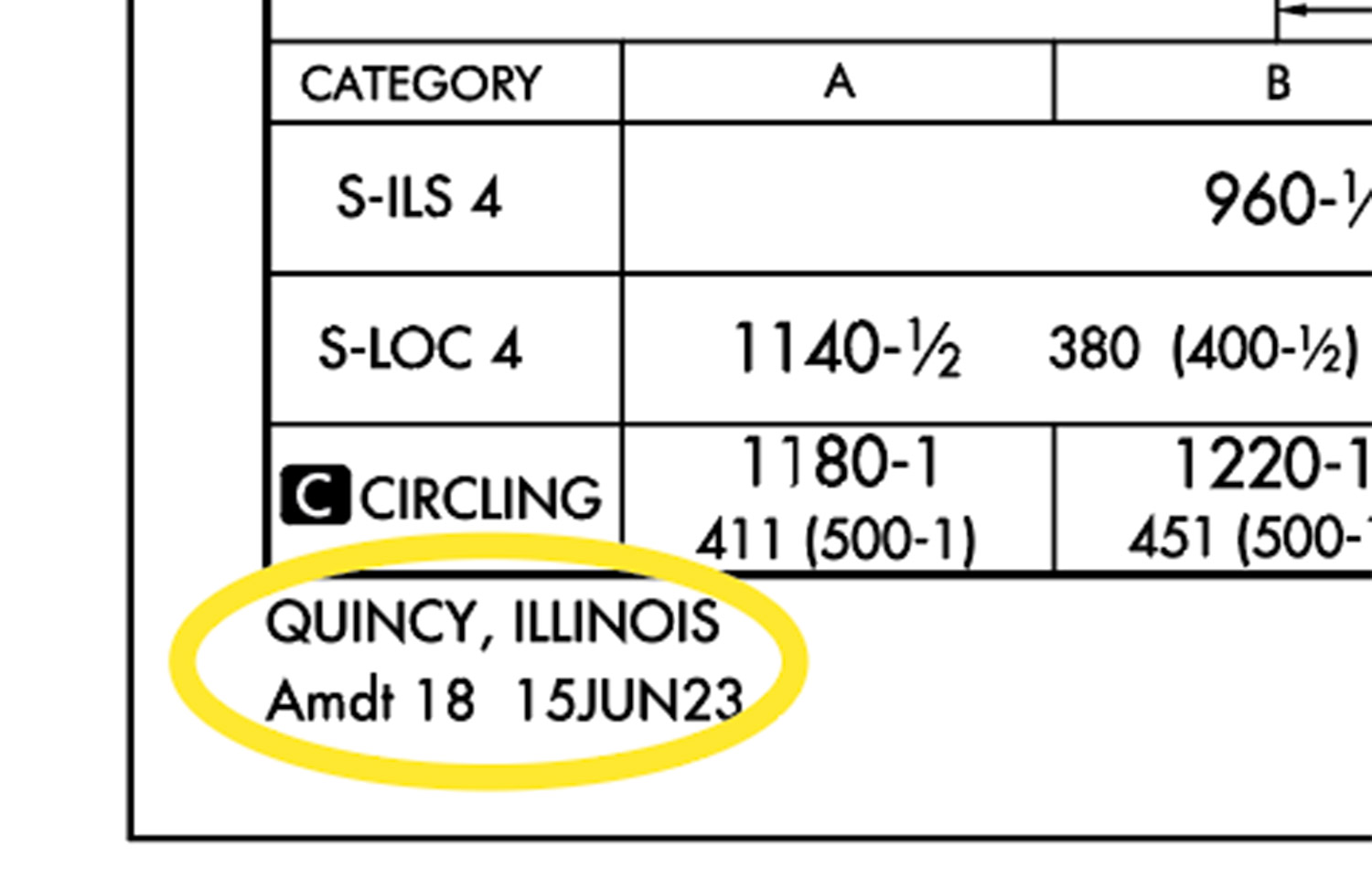
In the Readback section of the February 2024 magazine, you discuss DME and the KUIN ILS 4 approach. You note that TACAN (UIN) is not depicted on the FAA charts. Interestingly it reappeared in the Jan 25, 2024 to Feb 22, 2024 update as you noted the next month, in March.
The revised chart, though it is still the Amdt 18 15JUN23 version as in your depiction in the magazine that didn’t show the TACAN. Maybe in a future article (or past one you can refer me to) you can cover what kinds of changes warrant an amendment to an approach chart and why you think the TACAN appeared in this one.
—Paul Mitrokostas, Boston, Massachusetts
Yeah, we noticed that too, Paul. So, we sought out our TERPSter, Lee Smith, and he provided an education that apparently we needed.
The amendment level for an instrument procedure on AIS (FAA) charts is shown in the lower-left corner as you see above. But, as you noted, the addition of the UIN TACAN on the chart didn’t trigger a new amendment.
The amendment number and date as shown on the chart is for the procedure itself. This would be triggered by things like a routing change, new minimums, etc., but not a simple charting change.
But wait! There’s more. Look in the top-right corner. See that five-digit number up there? That’s the date the chart itself was last revised. But it’s encoded: YYddd where YY is the year and ddd is the consecutive day of the year.
Since the chart date for the one on the right that does depict the UIN TACAN is 24025, that says the chart was updated on January 25, 2024.
On-Line Quiz Goof
Your on-line quiz system is messing up (again). In the on-line depiction of your January issue, the quiz is about wake turbulence. Question 2 asks, “Wake turbulence causes _____ vortices.” The available choices are:
a. clockwise
b. counterclockwise
c. counter-rotating
d. synchronous
Obviously, the correct answer is c. counter-rotating. Yet, when I take the quiz via the website, choosing “c.” yields a red X.
What’s up?
—Oren Cheyette, Berkeley, California
You’re correct, Oren. The translation of the print edition to the web is actually handled manually. This error was likely just a typo during data entry. The person responsible has been notified and spanked. He’s promised to be more careful.
Thanks for the note, Oren, and for reading IFR.
We read ’em all and try to answer most e-mail, but it can take a month or more. Please be sure to include your full name and location. Contact us at Frank@IFR-Magazine.com.
