












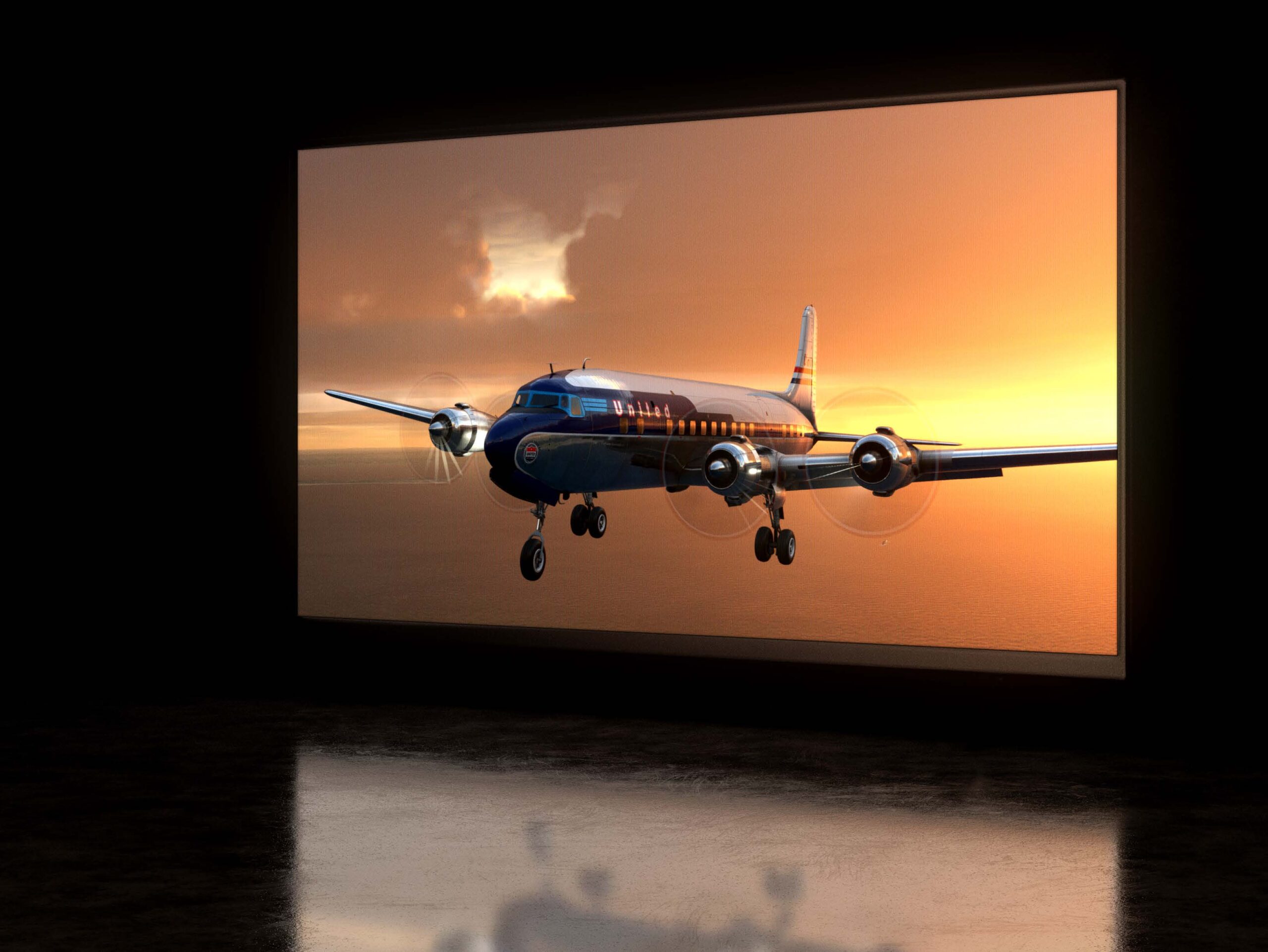


PMDG DC-6 Cloudmaster Provides Radial Engine Thrill

Flying Microsoft Flight Simulator's ultimate airliner is quite an experience.

PMDG DC-6 Cloudmaster [Courtesy: Sean Siff/MSFS 2020]
Gemini Sparkle

Key Takeaways:

  • The PMDG DC-6 in Microsoft Flight Simulator is a highly detailed, "study-level" simulation offering realistic systems, flight characteristics, and authentic sounds of the classic Douglas DC-6 Cloudmaster.
  • It balances complexity with accessibility through an Electronic Flight Bag (EFB) and an Automated Flight Engineer (AFE), which assist with checklists and workload, making it approachable for various skill levels.
  • The simulation provides a deeply immersive experience, from the challenging radial engine startup sequence and realistic engine behavior to detailed cockpit visuals and authentic sounds throughout all flight phases.
  • Ultimately, the PMDG DC-6 is praised for digitally preserving the experience and historical significance of this classic airliner, offering a compelling and rewarding flight simulation.
See a mistake? Contact us.

For this year’s Ultimate Issue, I wanted to push myself out of my comfort zone into an airplane worthy of the Ultimate title. I was inspired by Ernest Gantt’s seminal work, Fate Is the Hunter, which chronicles his adventures of flying the line when round-engined DC-2s, -3s, -4s, -6s, Boeing 307s, and Lockheed Constellations were the primary people movers during the golden age of airliners. 

This Article First Appeared in FLYING Magazine

If you're not already a subscriber, what are you waiting for? Subscribe today to get the issue as soon as it is released in either Print or Digital formats.


Subscribe Now

In what follows, I will share my experience of getting acquainted with the Douglas DC-6B Cloudmaster, built by PMDG—a popular production studio known for highly detailed study-level aircraft available for purchase in the Microsoft Flight Simulator (MSFS) marketplace. At $69.99, the DC-6 is one of the most expensive aircraft available in-sim, but like other aircraft in the same pricing tier, it offers a level of systems modeling that can take you from radial engine neophyte to feeling confident enough to step onto the flight deck of a real DC-6 to help out someday.

One can dream and prepare, right? 

About the Airplane

The real-world Douglas DC-6 was built in the same era as the slightly faster Lockheed Constellation, as both aircraft companies were competing to be flown on transatlantic and transcontinental routes by the major airlines of the late 1940s and early ’50s. The Cloudmaster is fitted with four Pratt & Whitney R-2800 engines, each making 2,400 hp at sea level. At first glance, it is easy to confuse the DC-6 with the earlier DC-4 as it is only a few meters longer. However, the DC-6 offered airlines increased range, higher cruising speed, and cruising altitudes of up to 25,000 feet (depending upon payload and fuel load) in pressurized comfort for a full 3,000 miles, making it a versatile hauler of both passengers (DC-6B) and cargo (DC-6A). 

To meet the DC-6B for the first time, I loaded onto the general aviation ramp at Boston Logan International Airport (KBOS)—my home airport in-sim. The elegant lines of the DC-6 make a visual statement on the ramp, like a time machine from the early 1950s, strikingly beautiful and now out of place amid the modern twin-engine jetliners. Zooming onto the aluminum skin of the DC-6 reveals that no pitot tube, landing gear strut, or antenna detail was ignored in its construction. The DC-6 sits tall on its landing gear to accommodate the three-bladed propellers, but the airplane has a balanced and proportional appearance. 

Besides having the desire, the curious sim pilot will need to dedicate some free time to learning the basics of the airplane’s operation and systems, and it is here that the PMDG DC-6 really shines. Every door on the DC-6 can be operated from the pilot’s seat using the built-in electronic flight bag (EFB) tablet mounted just below the captain’s left window. Common on many flight sim aircraft flight decks, the EFB tablet is your counterpart for all preflight activities allowing you to manage the aircraft systems without the crew that was typically on the flight deck. A simple menu system gives you a choice between three different aircraft states, depending on what kind of flight simulation experience you want to have and how much time you have to fly. The first state is “cold and dark,” where all aircraft systems are off. The next state is “ready for start,” where the DC-6 will be prepared through all the checklist items and ready for you to turn the number three engine. The final state is “ready to taxi,” where all engines are running and the aircraft is ready for taxiing. 

PMDG DC-6 Cloudmaster [Courtesy: Sean Siff/MSFS 2020]

“Cold and dark” is my favorite aircraft state, allowing you to experience what it would be like to walk onto the flight deck and sit down in the captain’s seat to prepare the airplane for its first leg of the day. The team at PMDG knew that its flight sim pilot customers would need help with aircraft systems management and accomplished this with a novel and well-integrated solution of a virtual first officer, called an automated flight engineer (AFE), who can manage checklists for each phase of flight with the click of a slider button. That way, the responsibilities of each phase of flight can be shared between you and the AFE. This allows the DC-6 to be flown by both the novice and advanced sim pilot, making the DC-6 approachable despite the complete systems modeling. 

In case you worry that the combination of the EFB and AFE may water down the realism too much, the nearly 100 circuit breakers above the rear flight deck bulkhead are all operational. There’s a slider button that you can toggle that sets the engine behavior to realistic, which will test even the most experienced flight sim pilot and make the R2800s as lifelike in their behavior as is currently achievable in MSFS. No matter what difficulty level you select, once the engines are running, you still have to fly the airplane—which is exactly what you’ll want to do.

Preparing to Fly

While the PMDG DC-6 comes with a 300-plus page POH written by the design team, I recommend you download and print a free color-coded checklist for your kneeboard. When I inevitably ran headfirst into the DC-6 learning curve during my first engine-start attempt, I found that having the checklist on my lap was very helpful. Try the PMDG DC-6 checklist from accomplished MSFS content creator @JayDeeGaming, which can be found on www.flightsim.to. 

You will experience PMDG’s commitment to realism as you must follow the correct sequence of control inputs to light all four R-2800s. To assist, I used the AFE to tackle the “before start” checklist items by clicking the slider button on the EFB. Once the process is done, the AFE will announce that the DC-6 is ready for you to turn on the No. 3 engine, indicating that the starting process is in your hands. 

To begin, find the red No. 3 mixture lever, located on the back of the center pedestal. Use the camera control shortcut on your keyboard to look at the center pedestal and verify that it is pulled up into its highest setting of “auto rich.” Then look up to the center overhead panel and check that the ignition switch is pointing to engine three. 

Next, verify that the fuel booster pump is set to “low.” Look down to the instrument panel and make sure you have fuel pressure for engine three. Then, swing the camera back to the center overhead panel and, using your mouse, engage the starter switch. As you will be seated in the captain’s seat, you won’t be able to see the prop turning, but you’ll be able to hear the whine of the starter. 

PMDG DC-6 Cloudmaster [Courtesy: Sean Siff/MSFS 2020]

Since starting each engine is a two-person job on the real-world flight deck of a DC-6, the AFE automatically counts the blades, so you can focus your attention on the overhead panel for the next critical steps. Once 12 propeller blades have been counted, you will click the ignition booster switch and the primer switch one after another, and your No. 3 engine should cough and sputter to life. 

With the engine running, the instrument panel will vibrate a bit—a very realistic detail, per the PMDG designer. Next, check the oil pressure and set engine three’s throttle to 1,000 rpm. Then, check that the ignition booster switch and primer switch have been reset to their “off” position. Now, you’re ready to repeat that process for engine four. Locate the ignition switch on the center overhead panel and make sure engine four is selected, then you can repeat the starting process. 

Lighting all four digital R-2800s and listening to the resulting symphony from an exterior camera view is nearly worth the purchase price of the aircraft. With 10,000 hp, the 72 cylinders all firing together is about as good as it gets in MSFS. Taking in the sights and sounds of a successful four-engine start will also give the oil time to come up to temperature before taxi—a must-do to prevent engine damage. 

Once you’re back on the flight deck, click the “after start” checklist by pressing the slider button, and the AFE will clean up the switches, turn off the fuel boost pumps, disconnect you from the ground power unit, and end by letting you know that you’re ready to taxi. Although it is unlikely that the engine starting sequence will lose its shine, you can always select the “ready for taxi” state on the first tab of the EFB if you are short on time. Having the AFE helps make operating the DC-6 fun while still making the experience realistic. 

The crowning achievement of the AFE is the remarkable balance struck between ease of use and realism—two elements that are commonly at odds in flight simulation. Flight sim aircraft designers always have to tackle the challenge of wanting to create a fun and rewarding experience without making it overly complex and burdensome to operate. PMDG executed the integration of the AFE into all DC-6 operations by providing assistance through all phases of flight with slider buttons that keep the virtual copilot busy on takeoff, cruise, descent, approach, landing ,and after landing. 

As the captain, you will fly and handle power management using the AFE as a backup. You can lower your reliance on the AFE too, as you learn the DC-6, taking command of the checklists and systems management, eventually only using the virtual first officer when you need him. The useful AFE integration confirmed how this airplane has built such a highly positive reputation in MSFS. You can effectively use the EFB to manage the aircraft systems and the AFE to share the workload, but to fly it satisfyingly well, you will still need to learn how to fly it. 

If you want to go deeper into the DC-6 systems, you can watch nearly 20 video tutorials recorded by the PMDG lead designer that serve as an effective multihour ad-hoc ground school. When you are ready, you can turn on the “realistic engine settings” slider button, making starting the engines more finicky and lifelike to provide the ultimate radial engine modeling. Thinking that I was “ready for the realism,” I shut off the AFE during a practice takeoff and set my manifold pressure and engine rpm too high. I cooked all four of those R-2800s in just a few minutes of inattentiveness. Gantt would not have been impressed.  

The Maiden Voyage

With a few hours of practice completed, I was ready to fly the DC-6. I selected what used to be a common route for the airliner and a manageable short flight for me as a novice sim pilot: Boston Logan to John F. Kennedy International Airport (KJFK) in New York City. I added a short sightseeing detour down the Hudson River special flight rules area (SFRA) corridor. In my many years of sim flying I had never flown the corridor and wanted to take in the sights of the Big Apple skyline from the captain’s seat of the Cloudmaster at 1,000 feet. In addition, I had never landed at JFK before either, which made the entire short trip feel like a new in-sim adventure. To keep the flight period correct, I selected United Airlines’ vintage Mainliner New York livery for this flight, which was part of a $4.99 livery pack available for purchase from the MSFS marketplace.

I set the weather in-sim to realistic winds and clouds for early spring in the Northeast and timed my departure from KBOS to allow for a near-sunset arrival at the start of the Hudson River SFRA. I opted for a 14,500 feet cruise from Boston to Bradley International (KBDL) in Connecticut, using the airport as my top of descent point. Once there, I would use the AFE to help me set up the DC-6 for a comfortable 500 fpm descent, providing a healthy margin to reach the start of the SFRA at 1,000 feet. Adding real-world details, like a preflight plan that includes correct VFR cruising altitudes and adhering to VFR airspace rules, makes the flight simulation experience more realistic and enjoyable.

I loaded into the “cold and dark” DC-6 on the GA ramp at KBOS and used the AFE’s assistance to prepare for engine start. I worked through the starting process patiently, first engine three, then engine four, engine two, and ending with engine one. With all four engines showing satisfactory oil pressure and temperature, I released the parking brake and taxied out to Runway 4L at KBOS, being sure to observe the rpm restrictions due to propeller harmonization that can occur when taxiing in low rpm settings. For such a large airplane, the DC-6 was nimble and satisfying to taxi. 

With the Cloudmaster lined up on 4L, I clicked the button on the EFB to instruct the AFE to set the power for a “dry takeoff.” During preflight, I used the EFB to add fuel and reserves, keeping the weight below the need for water injection, called a “wet takeoff,” which is standard operating procedure when the DC-6 is over 89,000 lbs gross weight. The water injection system sprays water into the air intake, immediately evaporating and cooling the air, making it more dense so more power can be achieved during combustion. One of the charms of flying the PMDG DC-6 is the roar of takeoff power, which is loud and satisfying. The instrument panel shakes, the needles blur and bounce in their round housings, and you can almost feel the Cloudmaster straining against the parking brake. I checked the manifold pressure and oil pressure gauges one final time, and with everything looking good, the DC-6 and I thundered down the runway. 

The airspeed gauge rotated slowly through the white arc to V1, then V2, and I pulled back on the yoke to raise the nose a few degrees off the deck. The R-2800s were at full song now, and I was making sure to not use more than 53 inches of manifold pressure. If an observer on the ground saw the takeoff, they’d notice yellow and blue flames shooting out of the exhaust stacks—which PMDG modeled on the DC-6. I kept firm pressure on the yoke and established a positive rate of climb and then raised the landing gear in time with the AFE’s instructions. 

I was soon watching the countryside of western Connecticut out the captain’s left window as I approached my top of descent over KBDL. The soundtrack of the engines in cruise was spot on. I’ve never flown in a DC-6 in real life, but I have been fortunate to be a passenger on a B-17 and B-29 before, and it sounded period correct to me. With the descent approaching, I directed my attention back inside to the engine instruments, wary now that too much inattention can bite you quickly in the DC-6.  

Cruise and Touchdown

I was on a gentle descent now, aiming for the Tappan Zee Bridge, which is located 5 miles north of the entrance to the Hudson River SFRA, pleased that I could spot it a few miles away in-sim. There’s an airspeed restriction in the SFRA, and 10 degrees of flaps helped to keep the DC-6 in a slow cruise. Before me lay the majestic sight of Manhattan to my 11 o’clock, the buildings lit with a digital sunset contrasting with the Hudson River and the dark gray broken cloud layer hanging over the city at dusk.

Having never flown the Hudson River SFRA in the real world, I didn’t know what to expect. The detailed modeling of New York City was staggering. Block after block of skyscrapers, high-rises, houses, and cars crisscrossed the Hudson River Greenway on the west side of the city below me. 

I flew down the river, looking out of the captain’s left window, the radial engines humming along in a low power setting. I crossed over George Washington Bridge, then passed by Central Park and the Empire State Building on my left. Shortly, I passed by the World Trade Center and rounded the southernmost point of Manhattan, making my turn toward JFK over the Statue of Liberty. 

I set up the DC-6 on a very wide left downwind approach to JFK’s runway 4L. I used the AFE to prepare for landing, running the perfunctory checks. On a 5-mile final, I lowered the landing gear and brought the master propeller lever up to high rpm. I spent the rest of the approach keeping my concentration outside the airplane while making small trim and rudder adjustments. I crossed over the fence on 4L at 120 knots, just a bit fast, bringing the throttles to idle. In the sim, the DC-6 feels stable at landing airspeed, flyable right down to the runway, and it typically uses all 45 degrees of flaps on landing. 

Upon touchdown with the throttles at idle, I selected the propeller reverse lever, which acts like a mechanical safety, allowing me to access the reverse prop setting below the idle position on the center pedestal. The DC-6 rewarded my use of the reverser with a cacophony of wonderful radial engine noise. The cockpit modeling and engine sounds are terrific, inspiring the sim pilot to want to master the airplane. The immersive detail of the systems modeling and the sounds of the R-2800s quickly turned me into one of the many Cloudmaster converts on MSFS

Thankfully, there are still some real DC-6’s flying with a few airworthy examples serving Everts Air Cargo in Alaska. The finest example is owned by the Flying Bulls aircraft collection (of Red Bull energy drink fame) in Austria and is kept in pristine condition and flown multiple times per year. But due to the fleet’s age and cost to operate, it gives me pause to appreciate how PMDG and other high-quality digital aircraft builders like them are helping to digitally preserve these historically significant aircraft through their creation of these highly accurate digital models. 

From the systems, sounds, and flight characteristics, the DC-6 is a compelling flight simulation experience from engine start to shutdown.


This feature first appeared in the June Ultimate Issue 959 of the FLYING print edition.

Sean Siff

Sean Siff is a private pilot who has worked in marketing in the aviation industry. He’s an active flight sim user as he works to stay current in the airplane.
Pilot in aircraft
Sign-up for newsletters & special offers!

Get the latest stories & special offers delivered directly to your inbox.

SUBSCRIBE
