













Register

Paper Stops

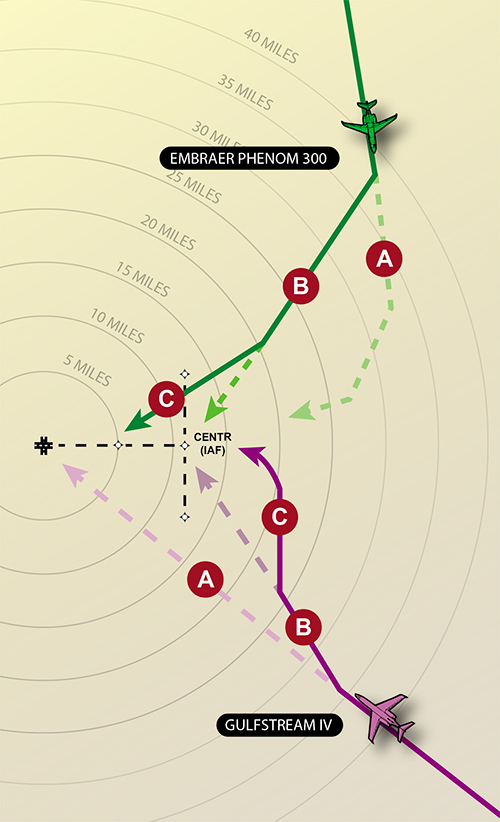
(A) Both aircraft check in on their initial routes, assigned the same indicated speed, but the winds are affecting their ground speeds. It’s difficult to tell who will be first. (B) Both are cleared direct to the IAF to create a common point of reference. (C) As they close on the fix, ATC makes the call, and vectors one to follow the other.
Gemini Sparkle

Key Takeaways:

  • "Paper stops" are temporary air traffic control instructions issued when controllers lack complete information about evolving situations, aircraft performance, or pilot actions.
  • These interim instructions act as safety buffers, guiding aircraft to the edge of uncertainty (e.g., a temporary altitude, a holding fix, or a specific taxi route) without committing to a final clearance.
  • Once controllers gather sufficient information or observe the situation clarify, the "paper stop" is superseded by a new, more precise instruction, ensuring continuous safe traffic flow despite initial unknowns.
See a mistake? Contact us.

Information is the foundation on which air traffic control is built. Controllers absorb tons of data as we work our traffic—winds and weather conditions, advertised runways, aircraft types, filed routes, NOTAMs. The list goes on. We take all this data and use it to build sequences for arrivals and departures, and keep aircraft safely separated.

Sometimes, though, we’re missing a key piece of information. Perhaps we’re waiting on something from an aircraft, like a turn or an IFR cancellation. Maybe we’re gauging how the winds aloft impact our traffic’s speeds before we build a sequence. Until those gaps in our traffic picture get filled, we can’t follow through all the way on many tasks.


Ready to Sell Your Aircraft?

List your airplane on AircraftForSale.com and reach qualified buyers.

List Your Aircraft
AircraftForSale Logo | FLYING Logo
Pilot in aircraft
Sign-up for newsletters & special offers!

Get the latest stories & special offers delivered directly to your inbox.

SUBSCRIBE