










NTSB Accident Reports—June 2024

A monthly summary of recently published NTSB preliminary accident reports involving general aviation and air carrier aircraft.

Image courtesy of Monroe County Sheriff's Office.
Gemini Sparkle

Key Takeaways:

  • Multiple general aviation accidents in March 2024 were caused by engine failures, leading to forced landings and substantial aircraft damage, sometimes with fatal consequences.
  • Pilot error during critical flight phases, such as go-arounds and landings, contributed to several incidents, resulting in loss of control or improper maneuvers.
  • Other mechanical malfunctions, including aileron control system failure and landing gear issues, also led to substantial damage to aircraft.
  • The reported incidents resulted in a range of outcomes, from uninjured occupants to serious injuries and multiple fatalities.
See a mistake? Contact us.

March 1, 2024, Key Largo, Fla.

Cirrus Design SR20

At about 1243 Eastern time, the airplane was substantially damaged when its pilot lost control after striking a tree during an attempted go-around. The solo pilot was seriously injured.

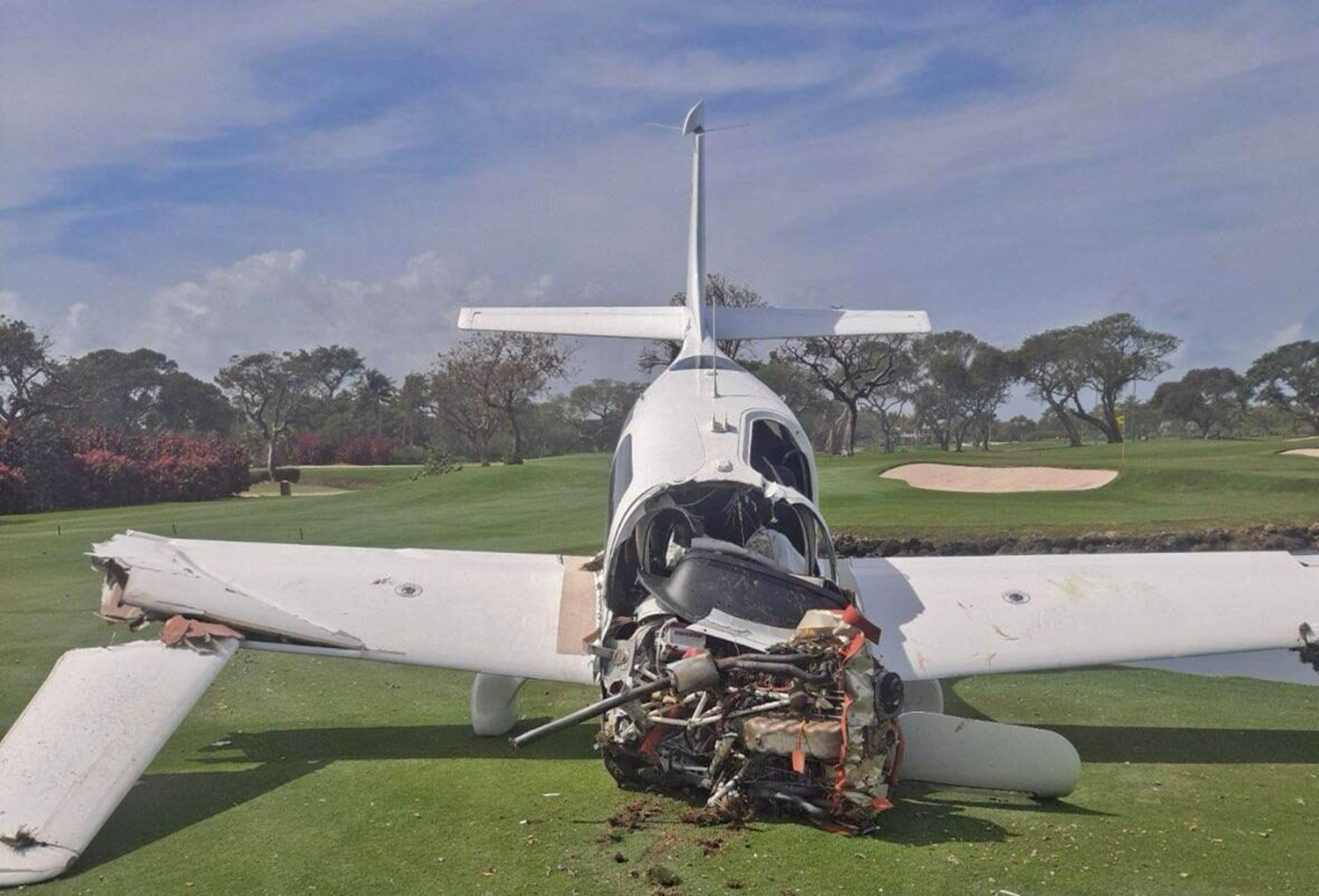
According to the pilot, the flight was normal until flaring for touchdown. A wind gust caused the airplane to drift left and the pilot chose to go around. On initial climb, the propeller and landing gear struck the top of a tree, and he then lost control of the airplane, which came to rest on an adjacent golf course. According to the NTSB, ADS-B data show the flight joined the left base leg at approximately 650 feet, and then turned final at approximately 525 feet. The last ADS-B data point was at an altitude of about 50 feet, approximately 104 feet left of the Runway 05 centerline.

Recorded weather at the destination airport eight minutes prior to the accident included winds from 120 degrees at 10 knots, gusting to 16 knots. Winds about 12 minutes after the accident were from 110 degrees at 11 knots, with gusts to 17.


March 1, 2024, Edgewater, Fla.

Cub Crafters PA-18-150 Super Cub

The airplane was substantially damaged when its aileron control system failed on short final and it collided with a hangar. The solo commercial pilot sustained minor injuries.

After dropping his banner, the pilot was on short final to land when, approximately 20 to 30 feet above the runway, he heard a loud snap. The control stick went slack in his hand, and he lost aileron control of the airplane. The airplane rolled to the right, and the pilot attempted controlling it with rudder and elevator. It missed two airplanes on a taxiway but hit the side of a hangar. Examination revealed one of the aileron control cables was broken.


Safety In Numbers: The chart at above presents raw numbers on non-military aviation accidents and fatalities for CY 2022. There always are more general aviation accidents annually than for those aircraft operating under FAR Parts 121 and 135, but sometimes it’s informative to be reminded of the stark differences.

March 2, 2024, Afton, Minn.

Globe GC-1B Swift

At about 0942 Central time, the airplane was destroyed when it collided with terrain after experiencing reported engine trouble. Both occupants were fatally injured.

A witness reported the engine was “steady and loud, followed by 1-2 seconds of silence, then 1-2 seconds of engine noise then it ‘went quiet’ again.” Another witness said the airplane engine “sounded like it was going back and forth from high rpm to low rpm multiple times” before he heard the impact..

The airplane impacted in a nose-down attitude, and sustained a post-impact fire. The propeller remained attached to the engine, with both blades exhibiting chordwise/rotational scoring. One blade was bent opposite rotation and twisted to low pitch. Both blades were bent aft. Engine disassembly revealed the only real anomaly was that the oil pump contained multiple fragments of a soft, solder-like metal. The oil pressure screen was clean from debris, and its seam was split open and missing solder. The oil suction screen was free of debris. Records showed the pilot purchased 9.1 gallons of fuel about 30 minutes before the accident.


March 4, 2024, Oklahoma City, Okla.

Beechcraft B19 Musketeer Sport

The student pilot was on his first solo flight. He flared too early on his first landing attempt, and bounced. He applied nose-down input on the yoke and the airplane bounced into the air again. He then pitched the nose up. The airplane stalled and impacted the runway in a nose-low attitude, collapsing the nose landing gear and damaging the left wing. The student pilot was uninjured.

The NTSB already has determine the accident’s probable cause: “The student pilot’s improper landing flare, which resulted in a bounced landing, aerodynamic stall, and impact with the runway.”


March 4, 2024, Nashville, Tenn.

Piper PA-32RT-300T Turbo Lance II

The airplane was substantially damaged at 1943 Central time when it impacted an interstate highway’s shoulder after a reported engine failure, then struck an embankment and caught fire. The private pilot and four passengers sustained fatal injuries.

The airplane reportedly climbed to 10,500 feet msl for the 180 nm flight, and then leveled off at 2500 feet msl about 2.5 miles from the destination airport, roughly aligned to land on Runway 20. The pilot did not land, and instead overflew the airport at 2500 feet on a track of 200 degrees for unknown reasons. When queried by ATC, the pilot responded, “My engine turned off, I’m at one thousand, six hundred,” followed by, “I’m going to be landing, I don’t know where.” As the airplane descended through 1200 feet msl, ATC declared the emergency and cleared the pilot to land on Runway 2. The pilot indicated the runway was in sight but was too far away. There were no further communications from the pilot.

Multiple witnesses heard the airplane pass overhead; it sounded like it was having engine issues, with one witness stating the engine was “sputtering and making popping sounds.” The airplane impacted terrain about two miles south of the approach end of Runway 02.


March 5, 2024, Bellevue, Wash.

Cirrus Design SR22T

At about 1704 Pacific time, its crew activated the Cirrus Airframe Parachute System (CAPS) following engine failure. The flight instructor and the pilot receiving instruction were not injured.

After taking off, the airplane leveled at 2500 feet msl. “A few minutes later,” engine rpm surged a few times, there was a loud bang and the engine lost all power. Unable to restart the engine, the pair deployed the CAPS and the airplane descended under canopy into a wooded wetland area adjacent to a residential neighborhood.


March 10, 2024, Chino, Calif.

Beechcraft 60 Duke

The airplane was intentionally landed at about 2330 Pacific time with its left main gear retracted, resulting in substantial damage to the left wing. The pilot and the five passengers were not injured.

According to the pilot, he extended the landing gear about five miles from his destination airport and noticed that the left main landing gear’s green annunciator light did not illuminate. He cycled the landing gear, with the same result. The pilot also changed the left landing gear annunciator light bulb during the accident flight, but the green annunciator light remained OFF. He then overflew the airport while activating the manual extension system, but was still unable to extend the left main gear. He landed with the left main landing gear retracted, resulting in substantial damage to the left wing. Examination revealed that the left main landing gear downlock cable was severed.


March 12, 2024, Front Royal, Va.

Beechcraft K35 Bonanza

The airplane was substantially damaged at about 1902 Eastern time when it collided with trees during a forced landing. The solo pilot was not injured.

Earlier in the flight, the propeller control temporarily was unresponsive, but then began functioning. Later, while conducting an aerial survey, the #3 cylinder’s exhaust gas temperature was lower than normal, and the pilot chose to climb. At 6300 feet msl, the propeller control again became unresponsive. Shortly thereafter, rpm spiked followed by loss of engine power. The pilot initiated a glide and headed toward a nearby airport but then picked a field for an off-airport landing. During the landing, the airplane contacted trees, separating both wings, and came to rest upright.


March 14, 2024, Fort Meade, Fla.

Glasair Sportsman 2+2 Experimental

At 1442 Eastern time, the airplane was destroyed when it was force-landed following engine failure. The pilot and passenger were not injured.

According to the pilot, about 30 minutes into the flight, smoke entered the cockpit and the engine noise changed. Shortly thereafter, the engine stopped producing power and the pilot performed the forced landing to the field. During the landing, the airplane’s nose landing gear dug into the ground and the airplane nosed over. The pilot and passenger egressed the airplane, which was then consumed by fire. Examination revealed the exhaust pipe was missing.


March 17, 2024, Blackshear, Ga.

Beechcraft A36 Bonanza

The airplane was substantially damaged at 0825 Eastern time when it was force-landed following engine failure. The private pilot and the two passengers were not injured.

The airplane was passing 11,000 feet msl, on its way to cruise at 13,000 feet, when the pilot noted reduced engine power and the inability to climb. Moments later, engine oil pressure began dropping and the engine then began to run rough, making “loud banging noises.” The engine seized and the pilot made a forced landing to a rural road. During the landing, the airplane impacted a tree, resulting in substantial damage to the right wing and engine mounts.


March 22, 2024, Acton, Calif.

Piper PA-28-140 Cherokee 140

At about 1804 Pacific time, the airplane was substantially damaged when it was force-landed after the engine suffered a partial power loss. The student pilot and the designated pilot examiner (DPE) were not injured at the conclusion of the student pilot’s private pilot practical test.

The DPE announced a simulated engine failure and reduced the engine power to idle, using the throttle control. The student pilot turned on the carburetor heat and performed the simulated emergency procedures for an engine failure. At approximately 800 feet agl, the DPE instructed the pilot to abort the simulated emergency. The student pilot advanced the throttle full forward, turned the carburetor heat off and pitched the airplane for an indicated airspeed of 65 knots. After approximately 10 seconds, the student pilot told the DPE that the airplane would not climb. The DPE confirmed that the throttle control was set to full power, mixture control was set to full rich, the carburetor heat control was off and that the flaps were up. He noticed that the tachometer indicated about 2000 rpm.

The DPE took control of the airplane and determined it could not outclimb the surrounding terrain, and then made an emergency landing along a ridgeline. During the landing, the airplane impacted vegetation and came to rest upright, with substantial damage.


March 25, 2024, San Saba, Texas

Cessna T210M Turbo Centurion

The airplane was substantially damaged at about 1100 Central time during a forced landing. The solo pilot was not injured.

While in cruise flight at 11,000 feet msl, the pilot noticed the engine’s manifold pressure was decreasing slowly. The pilot turned toward a nearby airport and prepared for a precautionary landing. The oil pressure gauge then went to zero, and the propeller began to overspeed during the descent. With the airport in sight, smoke began to exit the engine cowl as the pilot lined up to land on Runway 31. The pilot lowered the landing gear but kept the flaps retracted as the airplane approached stall speed. The airplane touched down about 100 yards short of the runway in wet grass. The landing gear dug into terrain and the airplane flipped over, resulting in substantial damage to fuselage and wings. After egressing, the pilot emptied a handheld fire extinguisher into the engine cowling’s air intake to suppress a small fire.


March 29, 2024, Jasper, Ga.

Van’s RV-9A Experimental

At about 1130 Eastern time, the airplane was substantially damaged when it was landed off-airport following loss of engine power. The solo private pilot sustained serious injuries.

According to the pilot/builder, the accident flight was the airplane’s second during phase one flight testing; It had fewer than two hours of total flight time. The test flight’s purpose was to obtain engine performance data. The pilot maintained 4000 feet msl near the departure airport during the flight and then descended to traffic pattern altitude. While approaching a left downwind for Runway 34, he observed an rpm drop as the electronic flight instrument system timer announced, “change fuel tank.” The pilot subsequently engaged the fuel boost pump and switched from the left to right fuel tank. Complete loss of engine power followed. The left wing struck a utility pole during the off-airport landing.

Ready to Sell Your Aircraft?

List your airplane on AircraftForSale.com and reach qualified buyers.

List Your Aircraft
AircraftForSale Logo | FLYING Logo
Pilot in aircraft
Sign-up for newsletters & special offers!

Get the latest stories & special offers delivered directly to your inbox.

SUBSCRIBE


