












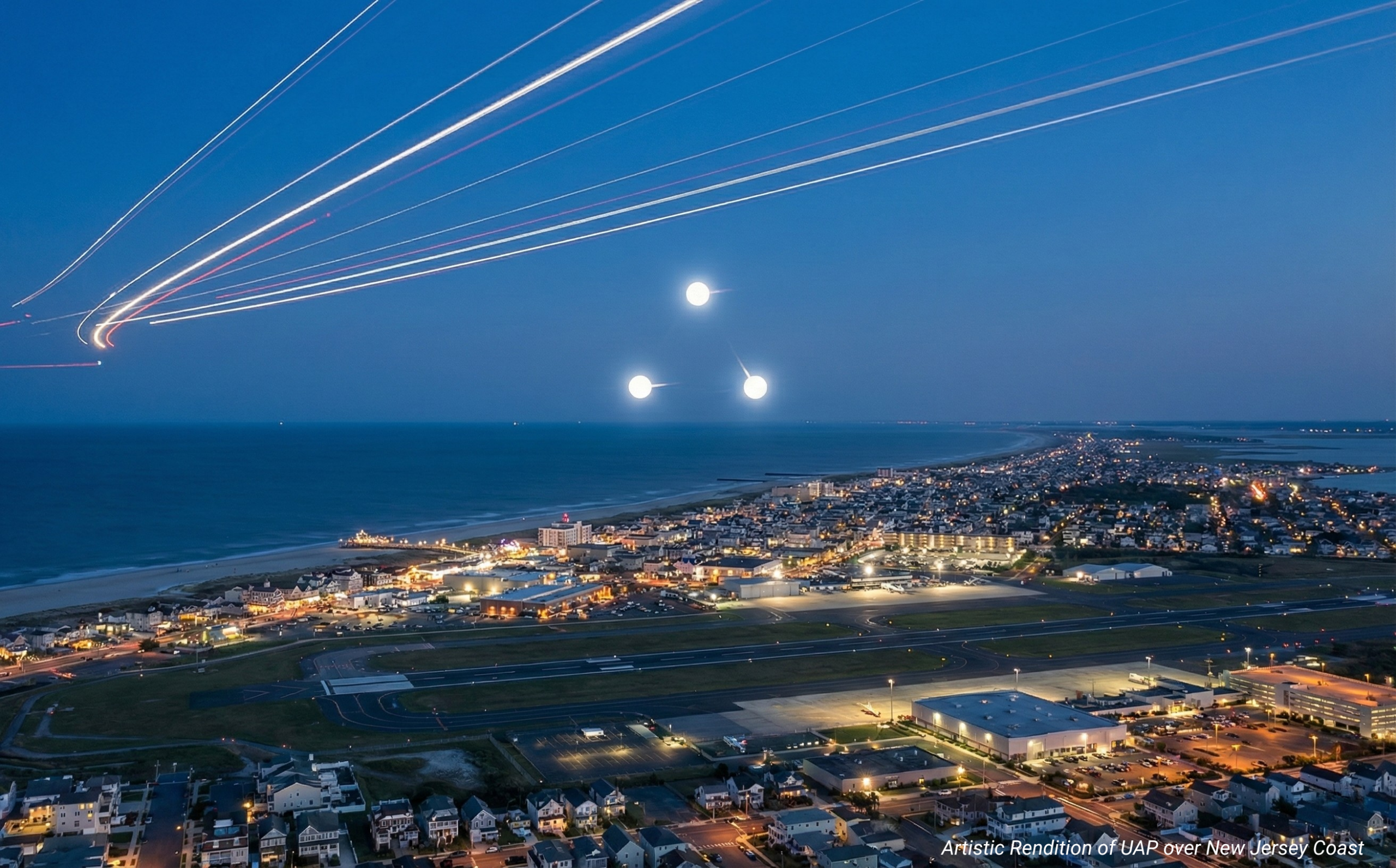


New Jersey could be the first U.S. state to fund a center dedicated to the study of unidentified aerial phenomena (UAP).
The U.S. government a few years ago began using UAP in place of “unidentified flying object” to reflect that sightings reported by pilots may not be objects at all, since they are unidentified. But according to Ryan Graves, executive director of the nonprofit UAP advocacy group Americans for Safe Aerospace (ASA), most pilots do not report sightings because they fear professional repercussions. ASA earlier this month published a white paper exploring the topic.
Graves in 2023 testified to the House Oversight committee about a pair of UAP he said he encountered in 2014, while stationed in Virginia Beach, Virginia, as an F-18 pilot for the U.S. Navy.
“The stigma hasn’t changed much since my 2023 testimony,” Graves told FLYING. “Pilots still face three main barriers: professional risk, institutional dismissal, and lack of clarity on where to report…Airlines don’t want their pilots associated with UFO stories, and the FAA historically hasn’t had a clear process for handling these reports.”
Because of that, “pilots make a calculation—is it worth the professional risk to report something I can’t explain?” Graves asked. “Usually, they decide it isn’t.”
That could change this year. New Jersey Governor Phil Murphy on Monday signed legislation that allocates $3.5 million annually across two state aviation safety programs. About $2.5 million per year will be available as grant money for universities that want to establish the country’s first state-funded UAP research center.
“Universities could develop sensor networks, analyze pilot encounter data, establish standardized collection protocols—the kind of rigorous scientific methodology this subject has lacked,” Graves said.
The remaining $1 million in annual funding will go toward an air traffic control (ATC) loan redemption program. ATCs who live in New Jersey and began working for the FAA at an “approved site” after Monday, the bill’s effective date, are eligible for up to $100,000 over four years to cover the cost of their training. Approved sites include not just airports but the facilities that support them, such as terminal radar approach control (TRACON) facilities or air route traffic control centers (ARTCCs).
Graves said that provision will also help improve visibility around UAP.
“It addresses the workforce shortage that impacts aviation safety broadly, including our ability to track and respond to unusual aerial activity,” he said.
ASA, which backed the legislation, estimated that the funding could support an initial cohort of 18 to 20 controllers. Unused funds will roll over into subsequent years.
Solving the UAP Mystery
Per his biography, Graves was the first active duty U.S. military pilot to publicly share regular UAP sightings. The former F-18 commander made two deployments across his decadelong service and later studied military autonomy technology for BAE Systems’ FAST Labs.
Graves cofounded ASA in 2023, establishing the nation’s first pilot-led advocacy group dedicated to UAP. The nonprofit advocates for more robust reporting mechanisms and greater government transparency around the subject.
“If pilots are encountering objects they can’t identify at frequency, and we believe they are, that represents a significant gap in our safety data,” Graves said. “Every near-miss, every unexplained radar contact, every encounter that goes unreported is information we’re losing about potential hazards. Government officials are finally starting to acknowledge this, but there’s still disconnect on urgency.”
In the House, Graves described his 2014 sightings—video of which was shared by the Pentagon in 2020 as part of a larger UAP-related release—as “dark gray or black cubes…inside of a clear sphere, where the apex or tips of the cubes were touching the inside of that sphere.”
He said the episode was “not rare or isolated.” Another pilot, Graves recounted, told him about an incident during which an object similar to the one he described flew within 50 feet of two fighters.
Graves also testified that there was no way to report the sightings. He estimated that 95 percent of UAP incidents go unreported. Since there is no official channel to report UAP, pilots instead turn to resources such as the FAA and NASA’s Aviation Safety Reporting System (ASRS), which was designed to field reports of conventional hazards like mechanical issues or bird strikes.
“When pilots do try to report through these systems, the data often goes nowhere meaningful,” Graves said.
How New Jersey Could Lead the Way
It is only fitting that New Jersey, whose residents reported a spate of unidentified drone sightings in late 2024, could lead the way. Federal officials in December determined that out of thousands of reports, most were “cases of mistaken identity”—birds, aircraft, or even drones that were legally authorized.
However, officials did confirm that unidentified drones were spotted over military installations. In at least one case, the reported presence of the aircraft thwarted an attempt to airlift a crash victim to the hospital.
The episode frustrated New Jersey lawmakers, who said they lacked the resources to adequately track unusual activity. But the state’s universities can now apply for the $2.5 million in grant money, which will become available in the next six months.
“It normalizes this as serious safety and scientific work, not career-threatening fringe belief,” Graves said.
Preference will be given for institutions located in the state’s most populous counties. As in the ATC loan redemption program, unused funds will carry over to subsequent years. ASA plans to work with universities to identify prime candidates, assist with applications, and provide consulting on research methodologies, access to reports, guidance on infrastructure, and more.
Applicants must be participating or plan to participate in the FAA’s Uncrewed Aircraft System Collegiate Training Initiative (UAS-CTI). These universities already have sensor networks, tracking algorithms, and technical capabilities that Graves said could support UAP research.
“Both fields deal with the same fundamental challenge: identifying and characterizing objects in our airspace,” he said. “It’s leveraging existing infrastructure rather than building from scratch.”
ASA contends that a larger, multistate network would provide distributed coverage, regional expertise, and increased transparency around UAP reporting. It is offering consultations, professional testimony, state-specific UAP data, and other resources for states that are interested in creating their own research centers. Already, Graves said, many are looking to New Jersey’s bill as a “template” that could be replicated.
“We need research efforts across multiple regions with different geographic, atmospheric, and aerospace characteristics,” Graves said.
In the former Navy pilot’s view, though, only a federal system can adequately track UAP reports. ASA has its own reporting platform, “but we’re a nonprofit filling a gap that should be a government function,” he said.
ASA helped craft the Safe Airspace for Americans Act, which was introduced in the House in September. The legislation would create an official FAA channel for commercial pilots, air traffic controllers, flight attendants, and other aviation professionals to report UAP without jeopardizing their medical or airman certificate.
“It’s exactly what pilots have been asking for—a confidential, official pathway that doesn’t threaten their careers,” Graves said.

