














NASA Postpones Europa Clipper Launch as Hurricane Milton Takes Aim at Cape Canaveral

Kennedy Space Center is battening down the hatches as the storm gathers strength over the Gulf of Mexico.

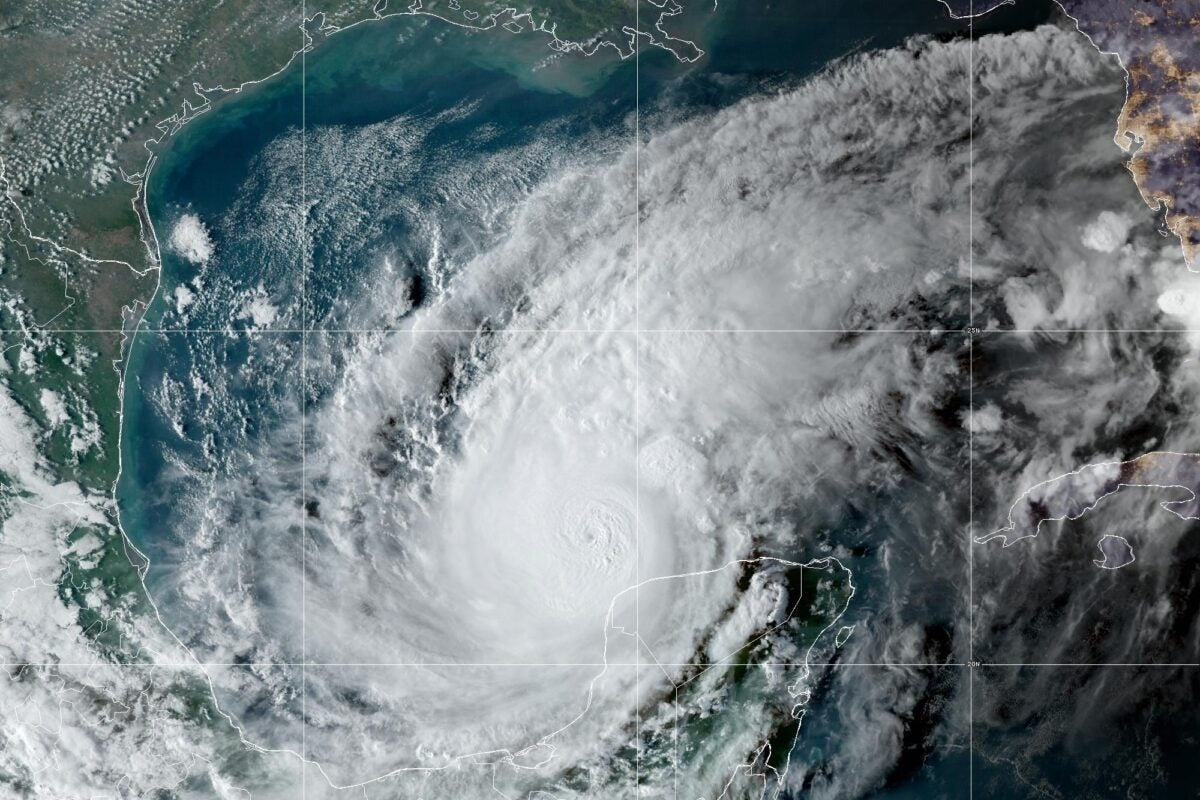
Hurricane Milton — pictured here in a NOAA satellite image — has intensified at near-record pace, fueled by abnormally warm waters in the Gulf of Mexico. [Credit: CIRA/NOAA]
Gemini Sparkle

Key Takeaways:

  • NASA's Europa Clipper mission launch from Kennedy Space Center has been postponed due to Hurricane Milton, necessitating the spacecraft's securement.
  • Kennedy Space Center (KSC) is implementing its hurricane preparedness protocols, as Milton is projected to weaken to a Category 1 hurricane by the time it reaches the Space Coast, with some damage and outages still expected.
  • A new launch timeline for the Europa Clipper, which aims to investigate Europa's potential for life, will be determined after post-storm assessments, within a launch window that remains open until November 6.
See a mistake? Contact us.

NASA’s Europa Clipper mission will have to wait out Hurricane Milton before it begins its five-year journey to Jupiter’s icy moon Europa.

The spacecraft had been scheduled to launch Thursday from the Kennedy Space Center (KSC) at Cape Canaveral, Florida, aboard a SpaceX Falcon Heavy rocket. The highly anticipated mission is seeking to find out whether Europa and its subsurface ocean could support life.


But on Sunday, NASA and SpaceX announced they would be standing down the launch attempt “due to anticipated hurricane conditions in the area.”

Workers have secured the Europa Clipper craft in SpaceX’s hangar at Launch Complex 39A at KSC, NASA said, and the center began preparing for Hurricane Milton that day.

“The safety of launch team personnel is our highest priority, and all precautions will be taken to protect the Europa Clipper spacecraft,” said Tim Dunn, senior launch director at NASA’s Launch Services Program, in a statement.

The announcement came as Milton was rapidly intensifying from a tropical storm into one of the strongest hurricanes on record. On Monday evening, the National Weather Service’s National Hurricane Center reported Milton was a “potentially catastrophic” Category 5 hurricane with maximum sustained winds near 165 mph (270 km/h), threatening the northern coast of Mexico’s Yucatán Peninsula.

NASA’s Crew-8 mission has also been impacted by Hurricane Milton. The SpaceX Dragon capsule was scheduled to splash down Tuesday off the Florida coast carrying three NASA astronauts and one Russian cosmonaut, all of whom have completed a crew rotation at the International Space Station that began in March. The Crew-8 undocking has now been postponed to no earlier than Sunday.

KSC Will Face Weakened Milton

Milton’s winds are forecast to ease slightly before making landfall on Florida’s Gulf Coast as a still-deadly Category 3 hurricane late Wednesday or early Thursday. Storm surge warnings are in effect for much of Florida’s Gulf Coast, with water rising potentially by as much as 15 feet (4.6 meters) in the Tampa Bay area.

However, by the time Milton crosses the peninsula and reaches the Space Coast, the storm is expected to have weakened significantly to a Category 1 hurricane, the Space Force’s 45th Weather Squadron reported on Monday. A Category 1 hurricane has sustained winds between 74 and 95 mph (119 and 153 km/h).

Although KSC lies in roughly the center of the cone of possible paths, it is not under a mandatory evacuation order. Still, “we do expect downed trees, power outages, possible cell service outages, and localized flooding,” said the 45th Weather Squadron, which is responsible for KSC’s launch forecasts.

All of KSC’s original major facilities—including the massive Vehicle Assembly Building (VAB) and the launch pads—were designed to withstand winds of at least 104 mph (167 km/h). And every facility at KSC built after 1992’s Hurricane Andrew was built to a higher standard of 130 to 135 mph (209 to 217 km/h).

But that doesn’t mean the center is immune to wind damage. In 2004, Hurricane Frances ripped over 800 exterior panels off the south side of the Vehicle Assembly Building, leaving gaping holes requiring years of repairs—even though ground-level winds at KSC never reached hurricane strength.

How NASA Battens Down the Hatches

NASA has a well-defined hurricane preparation plan at KSC that it is currently carrying out.

On Monday night, KSC was at HURCON 3, or Hurricane Condition III, a status activated when surface winds of over 58 mph (93 km/h) could arrive within 48 hours. At HURCON 3, KSC’s protocol calls for securing facilities, property, and equipment.

HURCON 3 is also when NASA briefs and deploys the ride-out team (ROT)—a core team of around 100 to 120 essential personnel that will ride out the storm at KSC while all other workers are offsite. As the storm nears, KSC will go to HURCON 2 and eventually HURCON 1, with the ROT hunkered down and the facility closed.

During the storm, the ROT’s job is to keep essential infrastructure running. After the storm passes, the ROT will perform an initial damage assessment from a vehicle and do what it can before handing off to another team for a fuller assessment and to start recovery efforts.

When the facility is deemed safe, the rest of the center’s staff can return to work, including launch teams, who will assess launch pads and processing facilities for storm damage. Only then will NASA be able to set a new timeline for Europa Clipper’s launch.

“Once we have the ‘all-clear’ followed by facility assessment and any recovery actions, we will determine the next launch opportunity for this NASA flagship mission,” said Dunn.

The mission has daily launch opportunities during a window that runs through November 6.


Editor’s Note: This article first appeared on Astronomy.

Mark Zastrow

Mark got his bachelor’s degree in astrophysics from the University of Minnesota and master’s degrees in astronomy and science journalism from Boston University. At BU, he researched topics ranging from Jupiter’s magnetosphere and Enceladus’ plume to stellar activity on M dwarfs and the migration of hot Jupiters. Before joining Astronomy, he freelanced in Seoul, where he covered stories including AlphaGo’s victory, air pollution, dog cloning, research misconduct, and the MERS and COVID-19 outbreaks. He was also the science contributor for tbs eFM’s This Morning, the flagship news program on Korea’s largest English-language radio station, and editor of a South Korean politics newsletter from Korea Exposé. Mark lives in Milwaukee with his fiancé, Katelyn, and their two Jindo mixes, Gguri and Ahto. Mark is a licensed pilot, though these days, you’ll find him in his free time hiked out on his Laser sailboat on Lake Michigan or on the hill between turns 5 and 6 at Road America cheering on his beloved Indy cars.
Pilot in aircraft
Sign-up for newsletters & special offers!

Get the latest stories & special offers delivered directly to your inbox.

SUBSCRIBE
