












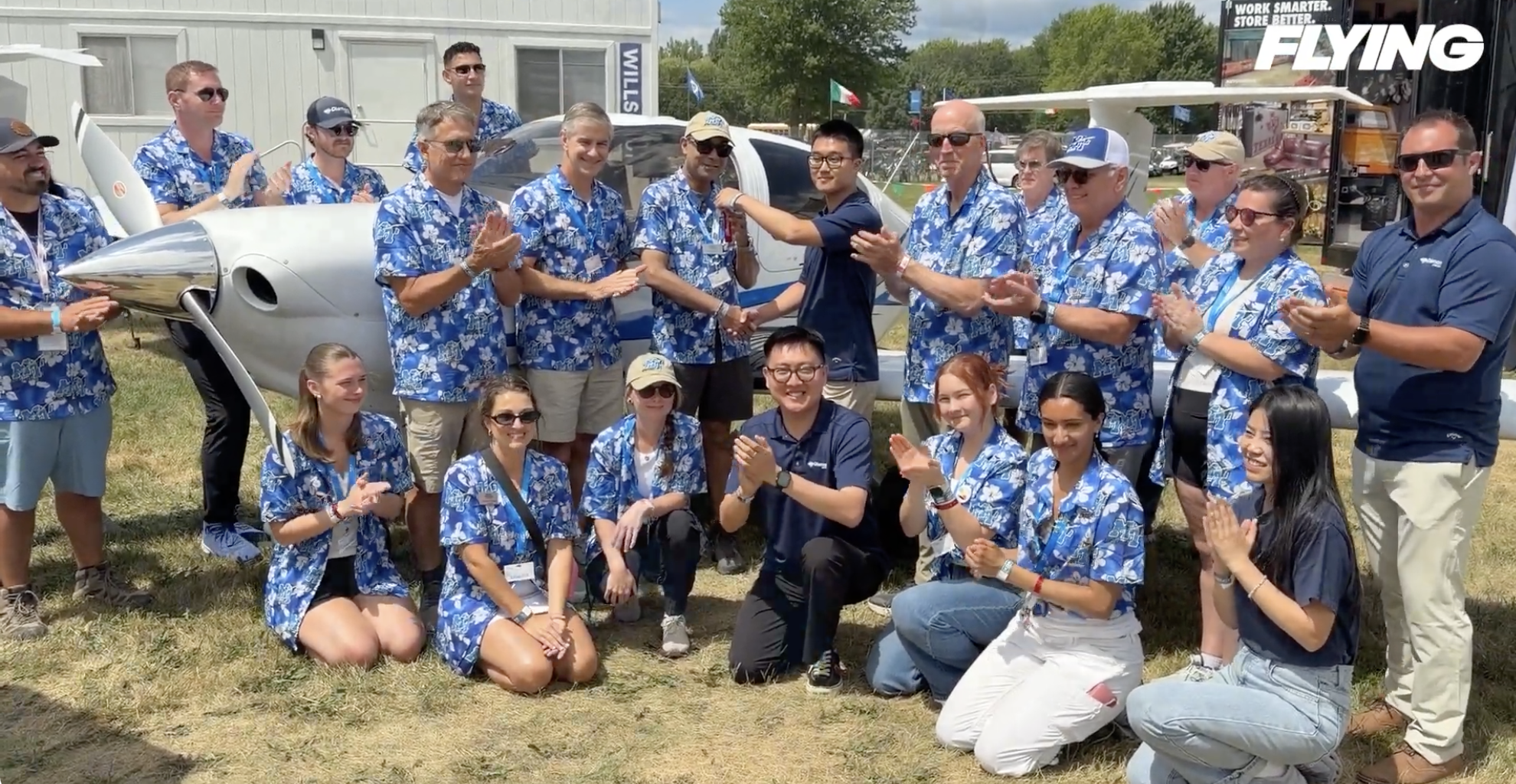



Every July, the flight line at Wittman Regional Airport (KOSH) becomes the epicenter of general aviation, and every year, Middle Tennessee State University shows up. This year’s EAA AirVenture Oshkosh was no different.
This time, though, the university’s Department of Aerospace had something specific to celebrate—the delivery of its 41st Diamond aircraft, a milestone two decades in the making.
“It is my honor to hand you the key to your 41st Diamond DA40 aircraft,” a Diamond representative told Chaminda Prelis, chair of MTSU’s Department of Aerospace, during a ceremony captured on video at the show.
The relationship between Diamond and MTSU’s collegiate flight training program has been built airplane by airplane, refurbishment by refurbishment, since the university’s DA40s first arrived in the early 2000s.
Why Diamond?
For a program the size of MTSU’s, the choice of training aircraft is a matter of infrastructure. According to Matt Taylor, the school’s director of maintenance, the decision to build the university’s fleet around Diamond was made with the entire pipeline in mind, from a student’s first solo to the flight deck of a commercial airliner.
“When next gen was an idea coming out, Diamond was the obvious choice because of the safety behind their designs,” Taylor said. “Once we got into that, it was a no-brainer to keep that on as our flight program progressed.”
That decision was made as glass cockpits were beginning to reshape GA training, and it has proven durable precisely because it wasn’t just about the airplane MTSU students would fly on day one. It was about what came after.
“It integrates well with pilots that are out in the industry today, to the new technology that they see when they get to the airlines,” Taylor said.
Since MTSU produces airline-ready pilots, that continuity between trainer and airliner avionics is non-negotiable.
MTSU has needed both safety and reliability as its fleet and student population have both scaled up dramatically over the past 20 years.
Regarding what the partnership has meant for the maintenance side of the operation, Taylor described the DA40 as the “ safest platform for our students” and the training built around it as “flawless.”
“The partnership we have with Diamond supports us in achieving our goals of training the best pilots in the industry,” he said.
Relationship Measured in Airplanes
The 41-aircraft figure is a record of sustained investment on both sides. Diamond has periodically expanded and refreshed MTSU’s fleet over the years, delivering new DA40 XLTs and rotating older airframes back to the factory for complete restoration.
The university has repeated that cycle as its Professional Pilot program has grown into the largest major on campus.
Kyle McClennan, a Diamond representative at the Oshkosh ceremony, framed the delivery as the latest chapter in a partnership that has become almost familial after years of repeat business.
“We’re always very excited to see each other,” McClennan said. “We’ve worked with each other for so long that there’s not a whole lot of work that needs to be spoken about. It’s more about how everything is going, how our families are, and the way that both companies are working. New pilots who come by our [AirVenture] booth are excited to support and wear our Diamond merch because they seem very proud and grateful for the opportunity to fly Diamond aircraft.”
Prelis also expressed his gratitude for the historic relationship with Diamond.
“Our students absolutely love [the DA40],” Prelis said. “It’s a very easy airplane to fly and makes life a lot easier for our students when it comes to their training opportunities.”
Flight programs live and die by how quickly and safely students can progress from private pilot certificates through instrument and commercial ratings and into instructing roles themselves. An aircraft that’s approachable for low-time students but avionically sophisticated enough to prepare them for the airlines removes friction at every stage of that pipeline.
Scale That Sets MTSU Apart
What makes the Diamond relationship significant is the scale of the program it supports. MTSU’s Department of Aerospace has grown into one of the largest and most respected collegiate aviation programs in the country, drawing students from across the U.S. and abroad.
“It’s one of the leading university aerospace programs in the country, so we’re super proud of it,” said Mark Byrnes, provost at MTSU. “We have students who come from all over the country and really all over the world. It’s the largest major by far.”
The numbers back that up.
“We’ve got about 1,400 majors, which out of a student population of 20,000, that’s a lot,” Byrnes said. “Nearly 7 percent of the students at MTSU are aerospace majors, and the bulk of those are pro pilots. Building a really robust fleet of aircraft is vital to the success of the program.”
Jimmy Granbery, a member of MTSU’s board of trustees, framed that growth against the backdrop of continued demand across the industry.
“It’s just a wonderful asset, and we need to continue to grow it,” Granbery said. “The demand is going to always be there, not only in the airlines but also in the fractional jet and the corporate world. It’s endless. As trustees, we’re just proud to continue to promote and grow the program along with the great state of Tennessee.”
MTSU’s 41-aircraft fleet is a proof point of what a long-term training partnership can look like at scale. It’s the tangible result of a bet placed on glass-cockpit technology, and it has paid off in a pipeline of pilots now flowing into regional and mainline carriers, fractional operators, and corporate flight departments across the country.
As both organizations look ahead to the next delivery, this is a partnership built for the long haul.
Click here to learn more about MTSU’s Department of Aerospace.

