Mesa City Council’s New Landing Fees Create Turbulence at Falcon Field

Flight schools warn the $20 per landing charge will increase student costs and trigger business closures.

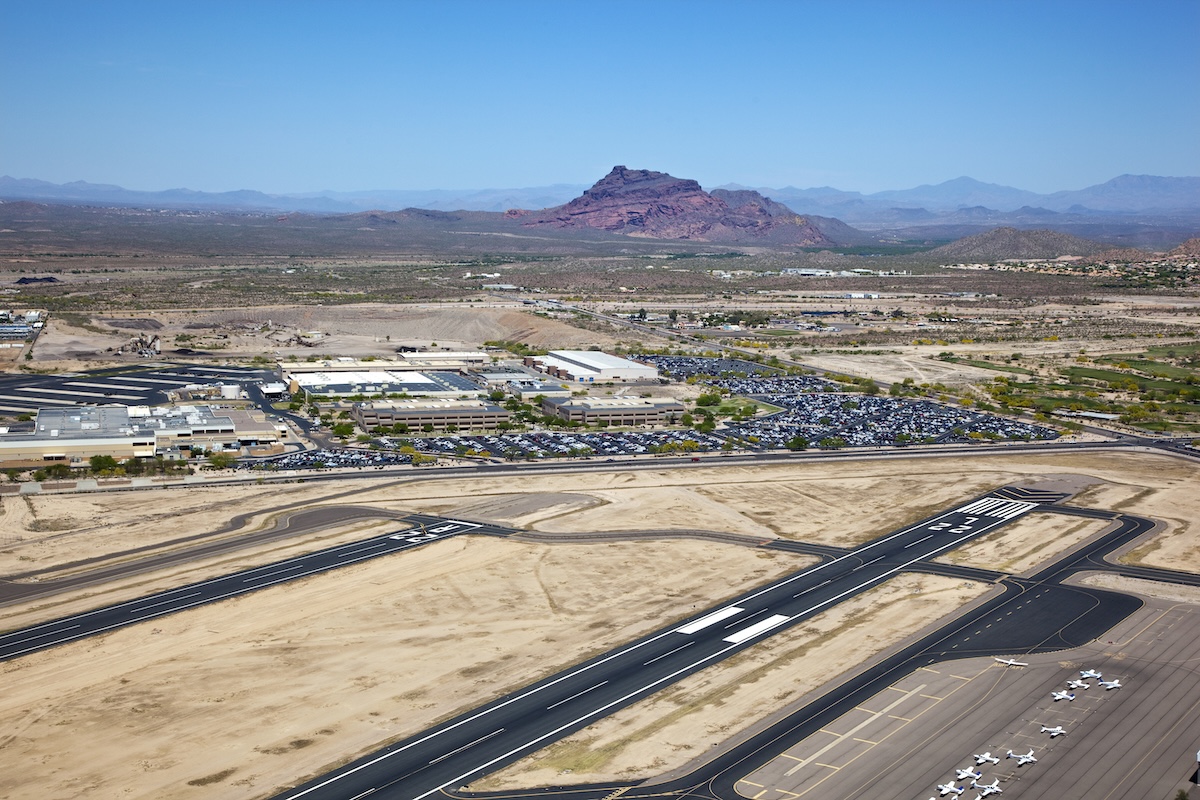
Falcon Field in Mesa, Arizona
Falcon Field in Mesa, Arizona [Credit: Shutterstock/Tim Roberts Photography]
Gemini Sparkle

Key Takeaways:

  • Mesa City Council approved new landing fees of $20 per landing at Falcon Field (KFFZ), effective May 1, aiming to generate $2.6 million annually for airport operations.
  • Flight schools at KFFZ strongly oppose the fees, arguing they will significantly increase the cost of pilot training, negatively impact their businesses, and potentially lead to closures amidst an existing pilot shortage.
  • Operators suggest the fees may be driven by noise complaints from airport neighbors rather than solely financial necessity, and criticize the city's decision process for lacking collaboration with affected businesses.
See a mistake? Contact us.

The decision by the city of Mesa, Arizona, to impose landing fees at its municipal airport has triggered talk of business closures.

On Tuesday the Mesa City Council voted to adopt landing fees at Falcon Field (KFFZ). According to city officials, the fees could bring in about $2.6 million a year that will be used to support airport operations.

But according to the many flight schools located at the airport, the $20 per landing fee will have a negative impact on their businesses, resulting in less activity, which means less revenue for both the schools and the city. Schools that remain at KFFZ will likely pass the fee onto their clients, increasing the price of obtaining a pilot certificate that already is north of $8,000 for the private certificate. Most flight lessons involve multiple takeoffs and landings.

The landing fees go into effect May 1.

Thrust Flight, one of the largest schools at KFFZ, sent a statement to FLYING expressing disappointment in the Mesa City Council’s decision.

“[It’s] a new financial barrier for flight training at an airport that has long served as a critical entry point for students, instructors, and aviation professionals,” the Thrust Flight statement said. “Training flights are built around repetition. A policy that charges by each landing hits that activity directly and makes the path to certification more expensive and more difficult for the people trying to enter the industry.”

During the City Council meeting, Steven Devine, who “grew up in the world of general aviation” and now owns Aero Angel, one of the smaller flight schools at Falcon Field, was vocal in his opposition to the fees.

“I figure it will be $750 for the first week,” Devine said. “Multiple that by four weeks—one month—$3,000 a month. I will not be able to operate. I can’t afford it. I don’t think any of the other flight schools will be able to afford it either.”

According to Devine, after he voiced his objections, the city responded by demanding to see his business license.

“They asked to see my license and said I don’t have permits to operate a motor vehicle as part of my business,” he said. “I’ve been on the field for seven months. None of the other flight schools need that permit.”

FLYING reached out to other flight schools at KFFZ. Two of the larger businesses, CAE, which has training locations all over the world, and U.S.-based Thrust Flight responded.

“CAE remains committed to finding solutions that preserve Falcon Field’s critical role in workforce development and the local economy,” said Samantha Golinski, CAE’s senior vice president of communications.

Thrust Flight was more expansive in its reply.

“We are concerned about the significant cost increases this will place on early-stage flight training,” the school’s statement said. “These added expenses will raise per-student costs at a time when the aviation industry faces an acute pilot shortage, without improving safety or training outcomes.”

Mesa city officials maintain the landing fees are necessary for the airport to be self-sustaining. Documentation obtained from the FAA Airport Compliance Manual— (5190-c) chapter 18—offers this definition: “Self-sustaining: Sponsors must maintain a fee and rental structure that—in the circumstances of the airport—makes the airport as financially self-sustaining as possible.”

Devine said the issue is not so much about financing the airport but about people who live near it disliking the noise and hoping that the increased fees will lessen the amount of aircraft that use it.

“They say that when they bought their homes in 2015, 2019, or whatever the airport wasn’t as busy and they wanted it to stay that way,” said Devine, adding that he has tried to communicate with the neighbors and been met with hostility.

Devine isn’t the only school owner to hear the complaints from neighbors.

“We know the discussion around Falcon Field has been shaped by neighborhood concerns, and those concerns should be taken seriously,” the Thrust Flight statement said. “But a landing fee is a blunt instrument. It doesn’t create a thoughtful long-term answer. It places the burden on training activity without resolving the broader challenge in a way that reflects the airport’s role in Mesa’s economy and workforce pipeline.

“We are also concerned that the city moved forward without meaningful collaboration with the operators, schools, and businesses most affected by this decision. Airports function best when policy is objectively informed by the people who work in the business every day and understand how operations, safety and economics intersect.”

Exactly what technology would be used to count each landing has not been revealed.

“There are a variety of technologies that may be used to count and document the landings, none of which would require active participation of air traffic control personnel,” said John Zielonka, public information officer for the city of Mesa.

Meg Godlewski

Meg Godlewski has been an aviation journalist for more than 24 years and a CFI for more than 20 years. If she is not flying or teaching aviation, she is writing about it. Meg is a founding member of the Pilot Proficiency Center at EAA AirVenture and excels at the application of simulation technology to flatten the learning curve. Follow Meg on Twitter @2Lewski.


Ready to Sell Your Aircraft?

List your airplane on AircraftForSale.com and reach qualified buyers.

List Your Aircraft
AircraftForSale Logo | FLYING Logo
Pilot in aircraft
Sign-up for newsletters & special offers!

Get the latest stories & special offers delivered directly to your inbox.

SUBSCRIBE