














Marines Train to Recover Downed F-35

Unit simulates a mission on a nonoperational F-35 airframe.

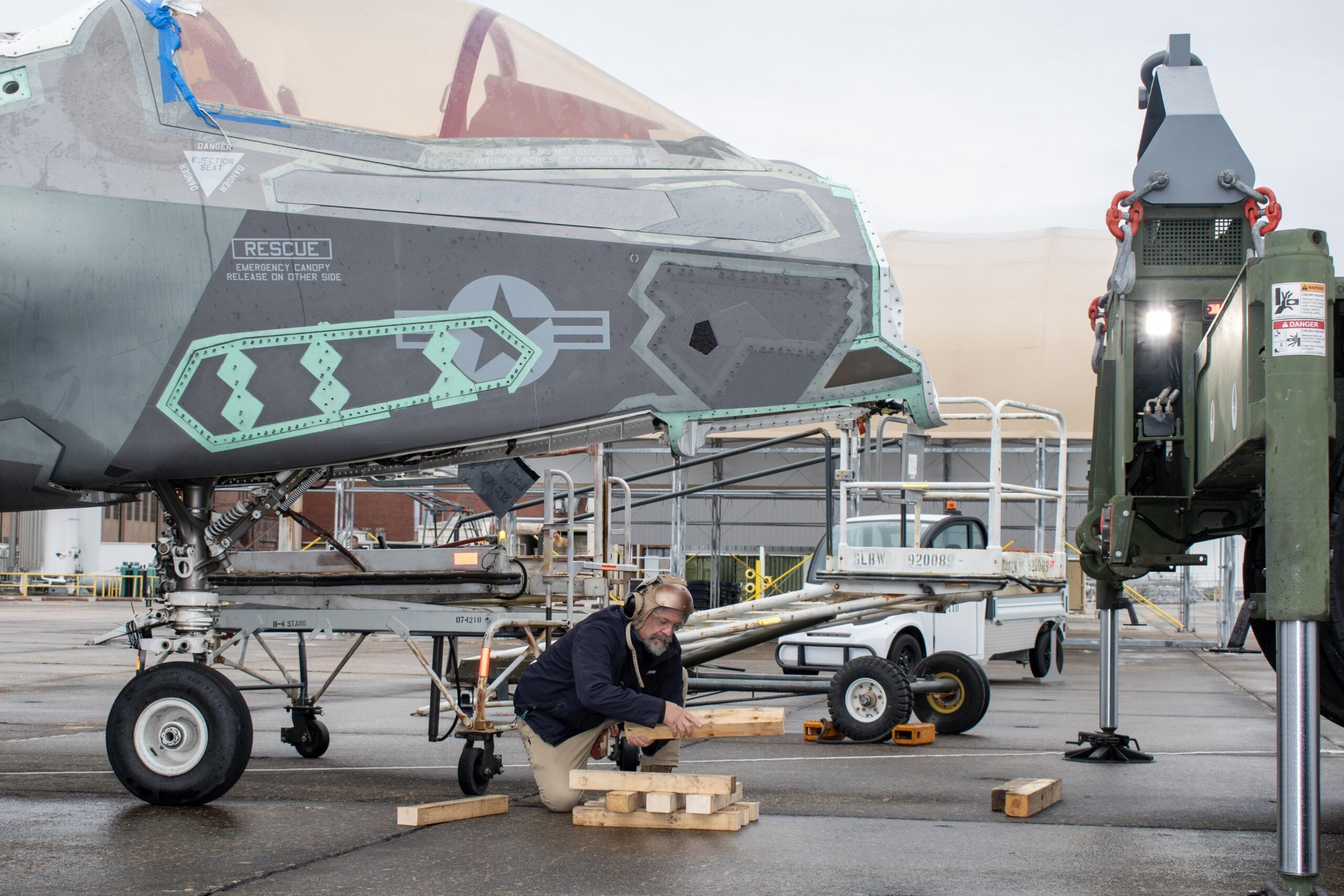
David White, an F-35 support equipment engineer at Fleet Readiness Center East (FRCE), builds a temporary structure to support the nose of an F-35B Lightning II during aircraft recovery training conducted by Marine Wing Support Squadron 271 (MWSS-271), based at Marine Corps Air Station Cherry Point in North Carolina. [Courtesy: Naval Air Systems Command]
Gemini Sparkle

Key Takeaways:

  • Marines from Marine Wing Support Squadron 271 (MWSS-271) at MCAS Cherry Point trained at Fleet Readiness Center East (FRCE) to recover damaged F-35B Lightning II aircraft.
  • The three-day training simulated a collapsed front landing gear scenario, teaching proper crane lifting, gear stowing, and establishing a controlled recovery site.
  • The training utilized a nonoperational F-35 airframe, allowing hands-on experience without risking damage to an active aircraft.
  • This initiative aims to widely educate Marines on the complex, pertinent, and hazardous procedures required for F-35 recovery to ensure aircraft readiness.
See a mistake? Contact us.

Marines based in North Carolina recently trained to recover a damaged, downed F-35B Lightning II before a worst-case scenario occurs.

Marine Wing Support Squadron 271 (MWSS-271) at Marine Corps Air Station Cherry Point, North Carolina, recently completed a three-day training event at Fleet Readiness Center East (FRCE), simulating the recovery of an F-35 with collapsed front landing gear. The center is the lead site for Marine Corps depot-level maintenance on the F-35 and employs more than 4,000 civilian, military, and contract workers.


Marines with Marine Wing Support Squadron 271 (MWSS-271), based at Marine Corps Air Station Cherry Point, train with Fleet Readiness Center East (FRCE) artisans and engineers to learn proper crane lifting techniques for the F-35B Lightning II aircraft. [Courtesy: Naval Air Systems Command]

During the training, Marines learned proper F-35 lifting procedures through an introductory crane lift, how to stow the front landing gear, how to use the crane to rest the aircraft’s nose on a temporary structure to simulate landing gear failure, how to establish a controlled recovery site, and how to recover the aircraft, according to Chief Warrant Officer 2 Joseph Durand, who serves as MWSS-271 squadron’s salvage and recovery officer.

“Recovery has so many different scenarios, and the F-35 is a fairly new aircraft; recovery on this platform hasn’t really been conducted in a broad manner across the Marine Corps,” Durand said in a statement. “We’re training to educate on how pertinent it is to be able to recover an F-35, the practices that go into that recovery and the hazards that come along with it. We’re really stressing the need for that aircraft to be able to get back into the air and do its job.”

The unit trained on a nonoperational F-35 airframe that has been on-site at FRCE since 2021, Naval Air Systems Command (NAVAIR).

“Having an asset like this airframe on hand is really beneficial in terms of allowing for training without the concern of potentially damaging an operational aircraft,” F-35 Branch Head Ike Rettenmair said. “Using an airframe that isn’t an operational aircraft helps provide a real-world, hands-on experience—everything looks, feels and moves the same—without the added pressure that comes from working with an aircraft that needs to be back on the flight line later that day.”

Ready to Sell Your Aircraft?

List your airplane on AircraftForSale.com and reach qualified buyers.

List Your Aircraft
AircraftForSale Logo | FLYING Logo
Pilot in aircraft
Sign-up for newsletters & special offers!

Get the latest stories & special offers delivered directly to your inbox.

SUBSCRIBE
