












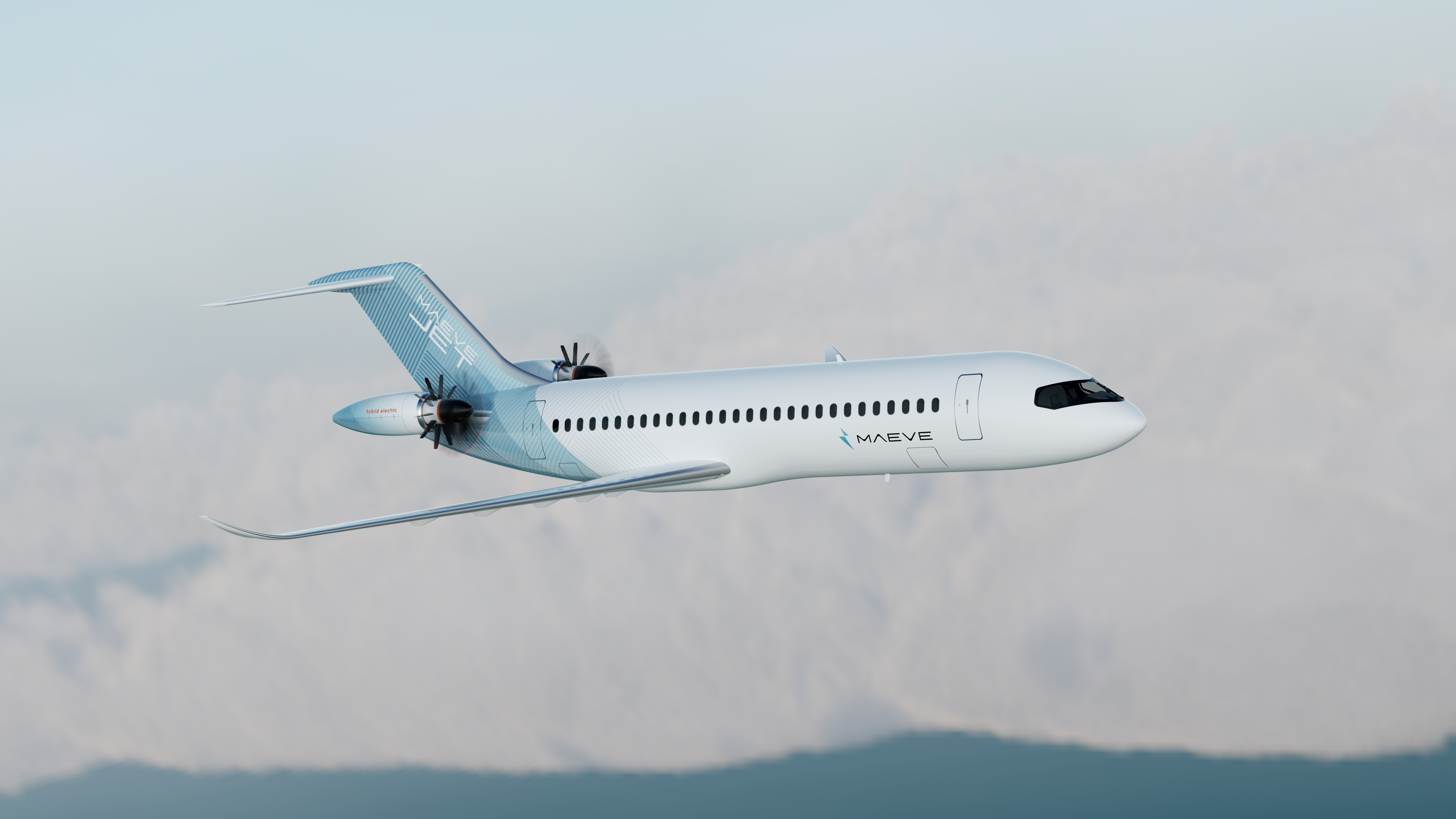


Dutch regional hybrid-electric aircraft developer Maeve Aerospace—which recently secured partnerships with Delta Air Lines, SkyWest, Pratt & Whitney Canada, and other major players—declared bankruptcy last week, according to the Dutch insolvency register.
Per documents, the fledgling manufacturer declared bankruptcy on Tuesday. Maeve did not immediately respond to FLYING’s request for comment.

But Martin Nusseler, the company’s chief technology officer who joined in 2023 after a 17-year career at Airbus, on Monday became vice president of aircraft and new program development for MHI RJ Aviation, per a LinkedIn post. Peter Spyrka, Maeve’s senior vice president of program and industrialization, also joined MHI RJ, per his LinkedIn page.
Foiling Plans
Maeve’s collapse could represent a blow to the sustainability ambitions of multiple airlines.
The developer’s flagship Maeve Jet (MJ 500) is designed to reduce fuel use and emissions by 40 percent versus existing regional designs, with sustainable aviation fuel (SAF) delivering potentially better gains. Maeve bills it as a combination of jet performance and turboprop efficiency, with dual hybrid-electric powerplants and a high-aspect-ratio, low-wing configuration. The company claims it will also reduce noise and operating costs.
The jet is intended to cruise at about 575 mph and 37,000 feet, consuming just 5.5 gallons of fuel per seat on a 500 nm trip. Five-abreast, single-aisle seating is designed to accommodate between 76 and 100 passengers. Per Maeve, it would have a range of 950 nm with 90 passengers.
The company has modified the design several times in the past few years. Originally, it was a smaller, all-electric model.
Delta in a September news release described the Maeve Jet as a “first-of-its-kind” design that “brings the economics and comfort of a narrow-body aircraft to short-haul operations.” In the same release, it described itself as “Maeve’s North American global airline partner” and said it would lend its “operational expertise” to the aircraft’s development.
“We’re proud to work together to tailor the Maeve Jet for the U.S. market,” Nusseler said at the time.
Maeve has an exclusive partnership with Delta’s Sustainable Skies Lab, joining a portfolio that also includes Boeing, Airbus, and blended-wing body developer JetZero. The airline is targeting net-zero emission by 2050 by investing in next-generation airframes, fuel, and flight operations systems. The September news release did not mention an investment in Maeve.
Delta is not the only airline that may need to recalculate after Maeve’s insolvency.
SkyWest in September made an undisclosed investment in the manufacturer that secured it exclusive launch customer rights for the Maeve Jet. Like Delta, the airline said it would lend its expertise to help develop the aircraft. The company said the move “enhances SkyWest’s long-term fleet replacement strategy,” implying it viewed the model as a future cornerstone.
Japan Air Lines (JAL) in 2025 similarly signed a memorandum of understanding with Maeve to tailor the jet for the Japanese market, envisioning it completing interisland trips. It had planned to develop a new aircraft design system to help Maeve meet the country’s airworthiness requirements and lend its expertise in operations and customer support.
MHI RJ—which on Monday snapped up Nusseler and Spyrka—has its own partnership with Maeve to provide engineering support and guidance on how to enter the regional aviation industry. The firm’s president and chief operating officer called it a “project that will undoubtedly transform the future of regional aviation” in a 2024 news release.
Pratt & Whitney Canada was one of the manufacturer’s earliest partners, agreeing to collaborate on the Maeve Jet’s hybrid-electric propulsion systems.
Is the Hybrid-Electric Dream Dead?
It is possible that Maeve goes the way of Germany’s Lilium, which ran out of cash in late 2024.
Lilium ultimately sold about 300 patents to American eVTOL (electric vertical takeoff and landing) air taxi developer Archer Aviation for nearly $21 million after failing to find a buyer for its prototypes. Per a LinkedIn post from the head of digital transformation at Deutsche Aircraft, at least one of them has been scrapped.
If that happens, there are a few companies positioned to capitalize on Maeve’s collapse.
Last year, Boeing-backed Evio emerged from stealth with its hybrid-electric Evio 810, which like the Maeve Jet is designed for 76 to 100 passengers. Evio also has its own partnership with Pratt & Whitney.
Elysian Aircraft, another Dutch company, is developing the all-electric, 90-passenger E9X. Heart Aerospace’s ES-30 and Aura Aero’s Era, both hybrid designs, are intended for 30 and 19 passengers, respectively.
Other developers are building smaller regional models, designing next-generation airframes, or retrofitting existing airframes with electric or hybrid propulsion systems.
It is also possible that Maeve survives bankruptcy and continues on in a new form.
Germany’s Volocopter declared insolvency in 2025 but had its assets scooped up by China’s Wanfeng Group and is now part of Austria’s Diamond Aircraft. Diamond is continuing certification efforts for Volocopter’s flagship VoloCity. Earlier this year, it unveiled the ultralight Volo XPro, for which it is targeting light-sport aircraft certification from the FAA, per Aviation International News.

