











Love of Warbirds Remains Timeless

Pilots’ obsession with former military aircraft never fades away.

The SNJ-5 is a variant of the North American T-6 Texan aircraft, a single-engine advanced trainer developed for the U.S. Navy and other allied air forces during World War II. [Credit: Alex Munro]
Gemini Sparkle

Key Takeaways:

  • Warbirds are rare and historically significant military aircraft, highly valued for preservation and civilian flight, often costing millions to acquire.
  • Piloting warbirds demands specialized training, typically beginning with tailwheel endorsements and progressing through complex aircraft like the T-6, due to their unique and demanding flight characteristics.
  • The warbird community is supported by specialized brokers for sales and dedicated flight schools, such as Warbird Adventures, which provide the necessary advanced training for these aircraft.
  • Owners and enthusiasts embrace preserving and showcasing these "living pieces of history" at airshows, connecting people to military aviation heritage.
See a mistake? Contact us.

“I remember when the ramp was covered with them.”

These wistful words were spoken by an elderly gentleman as he sat on his motorized scooter in front of a P-51 on display at EAA AirVenture in Oshkosh, Wisconsin. The year was 2004. The man was in his 80s and was accompanied by his adult children and grandchildren who wanted to see the airplane “Pop-Pop” flew when he was 19 years old and a member of the U.S. Army Air Corps.

This Article First Appeared in FLYING Magazine

If you're not already a subscriber, what are you waiting for? Subscribe today to get the issue as soon as it is released in either Print or Digital formats.

Subscribe Now

Thousands of aircraft were built for World War II, designed for combat and transport, and simply not created to last 80-plus years, which is part of the reason they are so rare. 

The other reason is that when the war ended, the majority of the aircraft were destroyed and the aluminum recycled. A fraction of these aircraft were sold at auction and turned into crop dusters, fire bombers, executive transports, and flight school airplanes. Others ended up in desert boneyards to rot in the sun. This means the ones that are airworthy today are a rarity, and that combined with the look, design, and history make them the rock stars of the ramp.

You can see for yourself if you are ever lucky enough to make it to Oshkosh in July. Be sure to head down to the north end of the field, where you will find the airplanes that often fuel the dreams of so many pilots—the warbirds. 

What to Expect

They are arranged in groups. In Fighter Town you will find P-51s, P-40s, Bearcats, and Corsairs. A few yards away there are rows of liaison aircraft, such as the Piper Grasshopper and Cessna Bird Dog, along with trainers like the venerable PT-17 Stearman, BT-13, and T-6 Texan. 

In 1946, you could find a demilitarized P-51 for $600, which is about $9,840 today. Currently, a restored airworthy P-51 Mustang typically costs between $3 million and $5 million.

“The warbirds you see on display at AirVenture are often owned by museums or private 501(c)(3) groups such as the Commemorative Air Force, [and] many more are in private hands,” said Moreno Augiari, publisher of Vintage Aviation News, a digital media outlet that carries stories about restorations and museum events along with warbirds on the airshow circuit. “A warbird is a vintage military aircraft, typically retired from active services and now preserved, restored, and flown by civilian individuals or organizations.”

Augiari recommends Platinum Fighter Sales in California as a broker for warbird purchases. Established in 2009, the company has a reputation for taking care of customers in the market for a warbird. They help with finding the aircraft, the pre-buy inspection, and ferrying. Sometimes there is even transition training for the new owner thrown in with the deal. 

For those looking for a warbird training school, Augiari suggests Warbird Adventures in Ninety Six, South Carolina. 

“We are the world’s only full-time T-6 flight school,” said Warbird Adventures flight instructor Wes Atteberry.

The school, which opened in 1998, also offers tailwheel training in a Citabria, which can make the transition to the T-6 easier, as the T-6 “demands respect” according to Atteberry. The T-6 became known as the “Pilot Maker” during WWII, giving many people the impression the aircraft was difficult to fly. That is a misconception, according to Atteberry.

The rear cockpit instrumentation of the SNJ-5 (right). Although it was an instrument trainer, it still retained the ability to swivel the rear seat 180 degrees. [Credit: Alex Munro]

“The airplane is actually quite a delight to fly,” he said. “That being said, the aircraft can be very unforgiving in the realm of takeoffs and landings, and stalls. The airplane gives you no warning prior to a stall, and she will always drop a right wing, if coordinated of course.”

The T-6 is a high-performance aircraft, and that takes some getting used to when a person’s tailwheel experience has been in the more docile designs.

“The other side of that coin is that people hop in the T-6 with lots of tailwheel time, but no high performance, ‘blind’ taildragger time, and end up realizing the T-6 is a whole different beast,” Atteberry said. “That is why we do what we do. You need specific training in this airplane. The airplane is very complex comparatively, and everything happens much faster than, say, a Cessna 172 or even a Citabria. It’s quite surprising to people at first.”

Simply put, the T-6 is not your average GA airplane.

“Students must learn that immediately if not sooner,” he said. “You simply can’t just hop in it and go. She will slap you in the face every time. Also, these aircraft are living, flying pieces of history, and must be taken care of and preserved for the next generation.”

Most of Warbird Adventure’s clients either own a T-6 or they are part of an organization such as the CAF or Canadian Harvard Aircraft Association, which gives them access to a T-6.

“Our job is to check pilots out to ensure they can safely operate their own aircraft or one they may go fly for someone else,” Atteberry said.

Warbird Adventures offers high-performance, complex, and tailwheel endorsements through five- or 10-hour courses. The 10-hour course costs $11,900, the five-hour course $6,450. 

If Warbird Adventures is not an option and a pilot still has the dream to fly, Rick Siegfried, director of EAA Warbirds of America and lifelong pilot from a multigenerational aviation family, suggests aspiring warbird pilots begin by earning a tailwheel endorsement. So many of the popular warbirds require these skills, and the pilot might be able to find one of the civilian designs that was repurposed by the military, such as the Cessna L-19 Bird Dog for starters.

“It is rare to find a flight school that offers training or rental of a warbird like a PT-17,” Siegfried said. “You are much more likely to find someone with a Bellanca Scout or Citabria or Decathlon. Find a tailwheel, learn it, get good at it, then find an organization like the Commemorative Air Force that will take a pilot and transition them to an airplane like the Stearman, then the BT-13, and advanced training like the AT-6.”

Often receiving training in a warbird comes down to finding a business or flight instructor with an aircraft and the time to take you on as a client.

Modern Warbird Pilot 

Alex Munro, a 2,900-hour ATP rated pilot, started his aviation journey as a child doing control line and free flight airplanes then later radio-controlled models with his uncle, father, and brothers.

“My first airplane ride was with (airshow pilot) Bud Granley, who was a friend of my uncle,” Munro said. “The flight was in my uncle’s T-6 [his first airplane]. We did loops, rolls, and Cuban Eights. I was completely hooked at that point.”

Munro earned his private pilot certificate in 1997 and now holds commercial single engine, multiengine ATP instrument, and CFII ratings, and a type rating in a North American T-28. His first flight as PIC in warbird came in 2014 when his uncle acquired a BT-13 out of Midland, Texas.

“It was ferried to Ephrata, Washington, where it needed quite a bit of work on the landing gear struts and the brakes,” Munro said. “A local crop duster who had flown both a T-6 and BT-13 test flew the plane for us and was going to give me a checkout. When that day arrived, he wasn’t available, so he basically gave me a checkout over the phone. I convinced myself that it was built as a trainer, so it must not be that hard to fly.  It was a very different experience but a great flying aircraft.

An extremely rare airworthy Yakovlev 18. Built in 1949, it was delivered new to the Chinese. [Credit: Alex Munro]

“My transition to the T-6 was similar. I had flown the BT for about 300 hours, so I just had to get used to the hydraulic system. It was an early model with the ‘power push’ lever, which can be entertaining if you’re trying to do a touch-and-go.”

Many warbird owners note one of the best parts of owning a piece of aviation history is taking the aircraft to airshows around the country for display. People gather to admire the aircraft, and often you’ll hear a family story about a relative who flew it during their service in the military. 

“The very first fly-in event I went to was a family aviation day at Wenatchee [Washington],” he said. “I had a very long line of youngsters and some adults who wanted to sit in the plane, and I hosted them all.  It’s fun to be able to make historic aircraft approachable.”

There have been many honors for the plane.

At the 2018 Hood River Fly-in the BT-13 brought home Best Warbird, and when Munro took the BT-13 to the Heritage Flight Museum Heritage in Burlington, Washington, he was invited to fly in its memorial tribute to Cornelia Fort, a 22-year-old civilian flight instructor who was giving a lesson over Pearl Harbor in an Interstate Cadet on December 7, 1941.

Fort did some fancy flying, and her student landed at the airport and sprinted for cover as a Japanese Zero strafed the runway. Fort returned to the mainland and joined the Women’s Auxiliary Ferrying Squadron (WAFS), a civilian group created by the Army to deliver military aircraft from factories to bases. She was killed in 1943 while flying in a formation of  BT-13s when another pilot drifted out of line and struck her aircraft.

Alex Munro sits in the front seat of a T-28C with airshow pilot-instructor Chris Rounds as they prepare to depart Peachtree Airport in Georgia on a training flight.

These days Munro makes the airshow and fly-in scene around Washington state and Oregon in a 1957 North American T-28C that belongs to his uncle. He did transition training to the aircraft with airshow pilot Chris Rounds.

”We operated out of Douglas, Georgia, until he was satisfied I would pass my check ride,” he said.  “Then we flew the plane together to Huntsville, Texas,, where I took my check ride and passed.I fly it at least twice per month from late spring to early fall. I consider all of these planes to be VFR only, even though they were originally built as instrument trainers. They have no current certs which would allow IFR flight, and I wouldn’t trust the old avionics.”

At airshows and fly-ins the pilots of the warbirds are easy to spot because they often wear fire-retardant Nomex flight suits. According to Munro, these are for protection, not fashion.

“For a long time I did not wear a flight suit,” he said. “However, I do wear one now for two reasons. It is Nomex, and all you have to do is gaze into the belly of one of these planes and look at the fuel lines the size of garden hoses and think about the 80-year-old plane you are flying to make it seem like a good idea. Bob Hoover used to wear suits when he flew until his P-51 caught on fire on the ground, and he became a big fan of Nomex. Be like Bob.

“The other reason is that the pockets come in very handy for the pens you’re always dropping into the belly of the plane or accessing your phone camera to take some epic images to share with your friends and family.”

Searching for Your Warbird

If you are looking for a warbird of your own, go online and search for type clubs or reach out to your local chapter of Warbirds of America, or a local aviation museum.

Find people who own the type of aircraft you have interest in and cultivate a friendship. Most owners love to talk about their airplanes and can tell you all you want to know about their features, both good and bad.

This T-28C sits on the ramp in Douglas, Georgia. [Credit: Alex Munro]

As most of us can’t afford to buy, own, or fly a warbird, there is also the option to take selfies with them on the ramp at airshows or museums. There are aviation enthusiasts who have it on their bucket list to take a photo in front of every airworthy (insert your favorite design) they can find. 

In my family, the special warbird is the Lockheed P-38, as it was my mother’s favorite aircraft during WWII. She grew up near a training base and often saw the aircraft flying overhead. The aircraft was a topic of discussion on my parents’ first date as my father, who was in the Army, was planning to go to work for Lockheed as an engineer when his hitch was up. 

When I became a pilot and was making the airshow circuit, I took a picture of the P-38 Glacier Girl and sent it to Dad. 

He was pleased, and told me that, had it not been for the P-38, I would not have been born because the only thing he and Mom had in common when they met was an admiration for that fighter and the fact they were both carbon-based life forms.

Thank you, P-38!


This feature first appeared in the September Issue 962 of the FLYING print edition.

Meg Godlewski

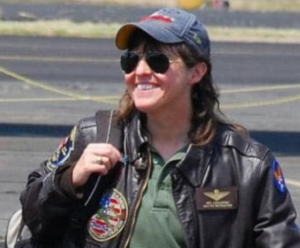
Meg Godlewski has been an aviation journalist for more than 24 years and a CFI for more than 20 years. If she is not flying or teaching aviation, she is writing about it. Meg is a founding member of the Pilot Proficiency Center at EAA AirVenture and excels at the application of simulation technology to flatten the learning curve. Follow Meg on Twitter @2Lewski.
Pilot in aircraft
Sign-up for newsletters & special offers!

Get the latest stories & special offers delivered directly to your inbox.

SUBSCRIBE


