












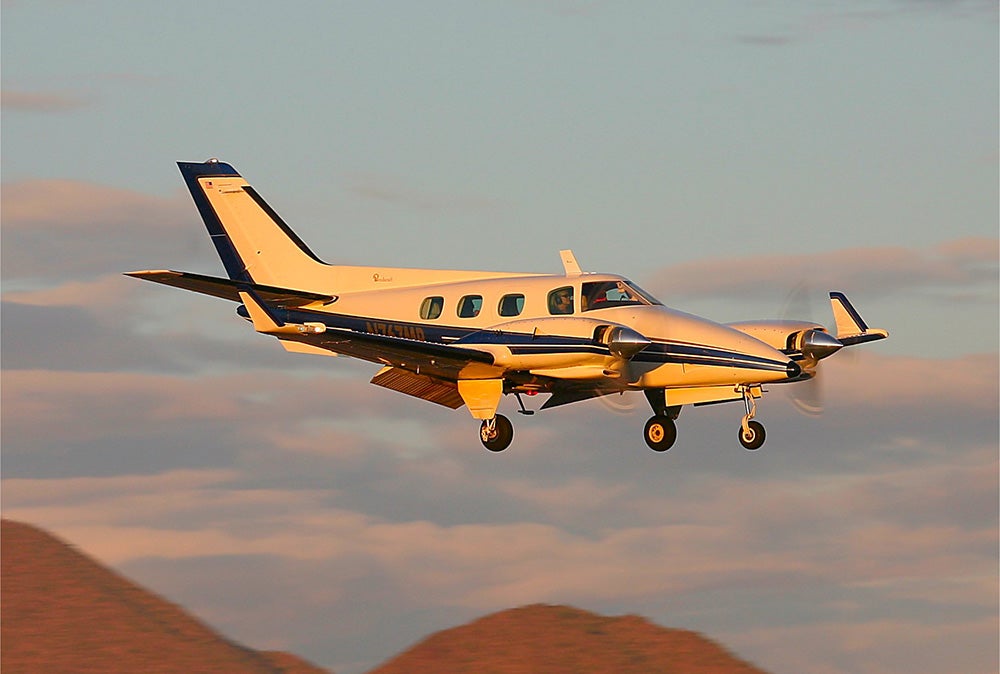


When Beechcraft introduced the Model 60 Duke in 1968, it set out to bridge the gap between the company’s successful Baron and its entry-level turboprop, the King Air. The result was a piston twin with jet-age style, pressurized comfort, and enough complexity to challenge even seasoned operators.
The Duke was not a timid airplane. Powered by a pair of turbocharged 380-HP Lycoming TIO-541 engines, each producing 380 hp. A 4.7-psi cabin differential provided a comfortable cabin altitude of about 10,000 feet while cruising near 24,000 feet, a rarity in the piston-twin world of the time.

Design Meets Ambition
Beechcraft engineers gave the Duke a distinctively muscular design—a long, pointed nose, tall vertical fin, and sculpted nacelles that looked more jet than piston. Inside, the aircraft featured a six-place pressurized cabin with a luxury finish aimed at business owners upgrading from unpressurized Barons or Cessna 310s.
But beneath the polished veneer was a demanding airplane.
The turbocharged Lycomings required careful engine management, particularly during climb and descent, and the early pressurization systems added layers of maintenance complexity. The Duke’s systems were top of the line for the 1960s but quickly proved expensive to maintain.
Performance and Pressure
In the hands of a pilot who respected its quirks, the Duke delivered impressive capability. The aircraft could reach 30,000 feet, fly above most weather, and comfortably cover about 1,000 nm. Its climb rate—around 1,600 fpm when light—was exceptional for a piston twin.

However, operating costs often rivaled those of a turboprop. The Duke burned about 40-45 gph, required meticulous engine cooling management, and punished neglect. As fuel prices spiked in the 1970s and ’80s, many owners discovered that their glamorous twin came with jet-like upkeep but without turbine reliability.
Variants and Evolution
Beechcraft produced three main versions: the Model 60 (1968-69), A60 (1970-73) with system refinements, and the B60 (1974-82) with improved engine cooling and other incremental upgrades. Production continued until 1982, with approximately 596 built.
The Legacy
The Beechcraft Duke never achieved the widespread success of the Baron or King Air. Its niche was too narrow, and its complexity too great for most owners.
Yet among enthusiasts, the Duke remains a symbol of an era when Beechcraft built airplanes to impress first and economize second. As The Aviation Consumer noted, owners should “be prepared to write hefty checks when it comes to maintaining one,” a reminder of both the Duke’s sophistication and its demanding upkeep.
Production of the aircraft type officially ended in 1983.

