Updated Tuesday, December 19 at 10:15 a.m. EDT with additional information from Joby.
Electric vertical takeoff and landing (eVTOL) aircraft developer Joby Aviation believes 2026 will be the year its air taxi begins flying passengers.

As the new year approaches, Joby on Monday shared a recap of its 2025 flight test milestones, reiterating its plans for the launch of passenger service in the coming months. The company intends to integrate its flagship S4 on the Blade Air Mobility and Uber platforms to offer 10-20-minute flights between U.S. city centers and airports. It is partnered with Delta Air Lines, with plans for service in major cities such as New York and Los Angeles.
“2025 saw the most extensive and rigorous flight testing in our history,” said James “Buddy” Denham, Joby’s chief test pilot.
The company said its test aircraft in 2025 completed more than 850 flights—a 260 percent increase over 2024. It said the vehicle is “already performing within FAA airworthiness standards” ahead of type inspection authorization (TIA) testing, during which FAA pilots will fly it for the first time. Joby recently powered on its first type conforming aircraft and expects to begin TIA testing in 2026.
“We continue to plan for this aircraft to take to the skies later this year, flown by Joby pilots, clearing the way for FAA pilots to start for-credit testing next year,” Joby said in its third-quarter earnings report in November.
But passenger flights could begin even before that testing wraps up.
In November, Joby outlined what it described as a “qualification program” in the United Arab Emirates (UAE), under which president of aircraft OEM Didier Papadopoulos said it is “possible, depending on where things go” that its S4 could fly passengers before receiving FAA type certification.
Those flights, Papadopoulos said, will likely be noncommercial and intended to gather data ahead of a commercial launch. But he added that the FAA could count its flying in the UAE’s scorching desert heat toward its TIA. The UAE’s General Civil Aviation Authority (GCAA), in turn, will “give us credit for everything that we do with the FAA,” Papadopoulos said.
Joby’s Active 2025
Joby on Monday said its test fleet completed “more than 4,900 test points” and covered more than 9,000 miles in 2025, surpassing 50,000 miles since testing began.
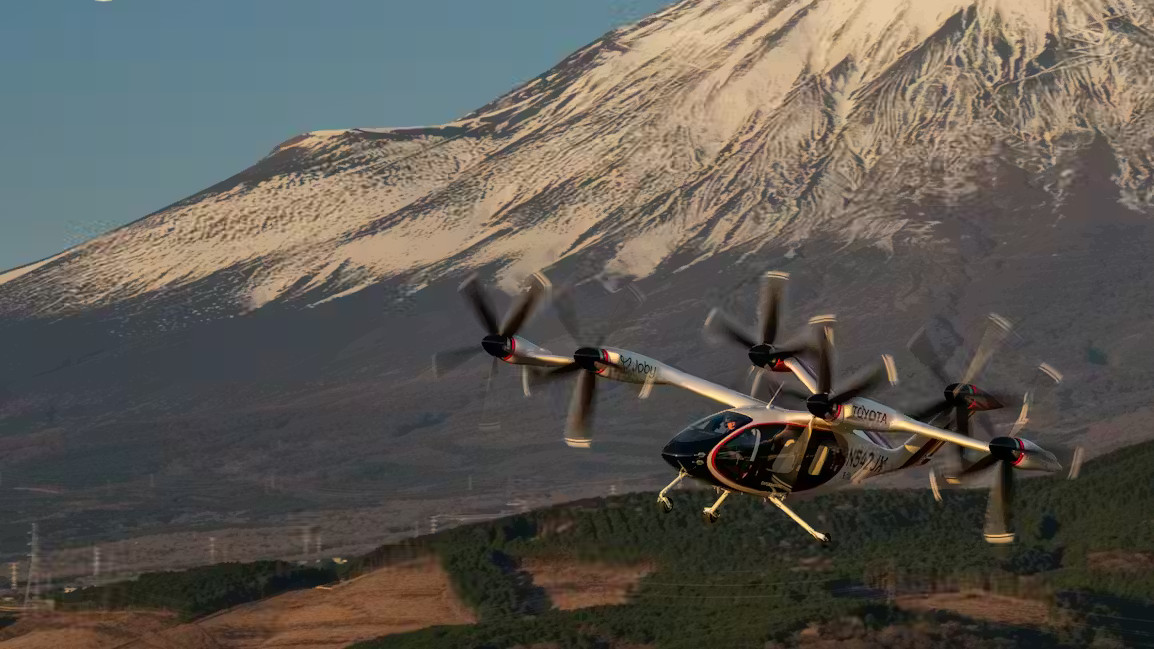
Among those flights were a series of public demonstrations. On Monday, for instance, Joby announced the culmination of its fourth and final international demonstration of 2025 at Fuji Speedway in Japan, where it made 14 flights. Those followed 41 flights at Japan’s World Expo 2025 and a demonstration at the Dubai Airshow in the UAE, where Joby over the summer completed 21 flights as part of an environmental and operational test campaign.
As part of that campaign, Joby completed the country’s first piloted, point-to-point eVTOL flight between its test facility in Margham and Al Maktoum International Airport (OMDW) in Dubai—a centerpiece of its planned network.
The air taxi also flew in the California International Airshow in Salinas, where it traveled from Marina Municipal Airport (KOAR) to Salinas Municipal Airport (KSNS). The company’s first point-to-point flight between Marina and Monterey Regional Airport (KMRY) took place in August.
“Flying in active, controlled airspace in three countries this year—from the California coastline to the iconic Fuji Speedway and the deserts of Dubai—has been a powerful showcase of Joby’s operational maturity,” Denham said.
Many of these sorties have been piloted transition flights. Joby pilots first demonstrated the transition from hover to forward flight—the capability that sets eVTOL aircraft apart from other designs—in April. They have also gauged how the aircraft responds to contingencies, such as landing after powering down some of its propellers, Joby told FLYING.
In addition, the company has tested some future technologies.
In November, for instance, its hybrid turbine-electric prototype made its maiden voyage, just three months after the concept was announced. Its Superpilot autonomy system, acquired from Xwing in 2024, logged more than 7,000 autonomous flight hours aboard a Cessna 208B Grand Caravan during a U.S. defense exercise over the Pacific this summer.
The Outlook
According to Joby, all of this testing has helped it validate aircraft design and manufacturing processes, gather compliance data, and develop operating and maintenance manuals ahead of TIA testing in 2026. But it may not be enough to move the needle on the S4’s commercial launch.
Joby, Archer Aviation, Beta Technologies, and Wisk Aero are among the leading developers of eVTOL air taxis, which the FAA classifies as powered-lift aircraft. Joby’s S4 is designed to lift off and land vertically like a helicopter but cruise on fixed wings at about 200 mph. Like other eVTOL designs, it relies on a mix of fixed and tilt propellers. The latter rotate to support both vertical and forward flight.
The FAA will regulate powered-lift operations using a combination of fixed-wing aircraft and helicopter rules, per a 2024 special federal aviation regulation (SFAR) that also establishes training and certification procedures for powered-lift pilots. In July, the FAA published guidance on powered-lift type, production, and airworthiness certification, further defining their pathway.
Air taxi developers will use previously agreed-upon certification bases to validate their aircraft and systems during TIA. Before then, though, they are testing internally. Joby’s completion of piloted transition and point-to-point flights therefore represents a key milestone in the process.
Testing has also helped Joby mature its future operations, it said.
During the PGA’s Ryder Cup in September, for example, its Blade helicopter service, acquired in August, transported more than 2,500 people from the New York metro area to Bethpage Black Course on Long Island. According to Joby, Blade completed “one of the largest multi-day civilian helicopter movements in U.S. history”—and collected critical data on high-tempo passenger operations.
The company will soon have another opportunity to conduct real-world operations under the FAA’s eVTOL Integration Pilot Program (eIPP). The three-year effort will comprise five projects intended to study passenger transport, cargo and medical logistics, and other use cases in a sandbox environment. Papadopoulos compared it to the testing already underway in the deserts of Dubai.
Joby in September said it was in discussions with partners in Texas, Florida, Ohio, New York, and California for both passenger and cargo eIPP projects. Archer, Beta, Wisk, and many others are also looking to participate.
However, all of that certification work may not translate to a speedier commercial launch.
SMG Consulting, which tracks eVTOL developers’ progress toward scaled production and commercial service, in June projected Joby’s entry into service in mid-to-late 2027. The company’s outlook for Archer and Beta is similar.
But Sergio Cecutta, who leads the effort, told FLYING that SMG this week will release an updated forecast pushing those projections back by at least six months. Cecutta said the slip is due to no eVTOL developer yet advancing to TIA. He estimated that Joby’s certification fleet in 2025 racked up just over 100 flight hours as of the beginning of December—a figure he said needs to significantly increase to achieve relatively short certification timelines.
Cecutta said SMG will consider the impact of the eIPP before finalizing its next forecast. Joby said it views TIA and eIPP testing as complementary programs on its path to certification.