“How can we help?”
You will get this question via text or social media, and if the person sending it comes from the aviation world, they mean it. There is something about people who move in the world of airports, airshows, and flight training that makes us hardwired to provide assistance when someone is in need.
This can take many forms, and here are some examples.
Holiday Food Drives
Many airport businesses are drop-off locations for community food drives. Thousands of pounds of nonperishable food are collected for local food banks and then distributed to those in need.
In Washington state, one particular food drive was an outgrowth of the popular Fly Washington Passport Program and was launched in February 2019. Pilots carry passport booklets and visit airports, where they collect a passport stamp.
It was such a hit and involved so many pilots in flying to their local airports that passport program president Tim Mensonides, secretary Chris Paolini, and Washington State Department of Transportation aviation planner Max Platts proposed the Fly Washington Passport Program host a food drive in 2020.
- READ MORE: GA Pilot Group Delivers More Than 100K Pounds of Supplies to Storm-Ravaged North Carolina
- READ MORE: Pilot Animal Rescue Organization Steps Up Following Hurricane Helene
“The food drive was launched in October of 2020 with Max Platts taking the lead,” said Marjy Leggett, who took over for Platts until he left the area for a job in 2023.
In the three years Leggett has been organizing the event, there have been 12 participating airports, including:
- Auburn Municipal
- Harvey Airfield
- King County International-Boeing Field (KBFI)
- Mears Field (concrete)
- Prosser
- Richland
- Skagit Regional (KBVS)
“In the three years that I have served as the organizer, 12 participating airports have collected a total of 38,536.61 pounds of food and $14,591,” said Leggett, adding that each airport taking part in the food drive is asked to name a facility that will take the donations.
![Trunk holds the donations from Harvey Field in Washington State to be donated to the Snohomish Food Bank . [Credit: Marjy Leggett]](https://flyingmag1.b-cdn.net/wp-content/uploads/sites/2/2025/12/Harvey-Food-Drive.jpeg?width=768&height=1024)
“Each participating airport has a person in charge who oversees the food gathering. There are also volunteers who weigh the food and transport it to their community food banks. And, of course, there are all of those who contribute to the food drive. All donations stay local.”
Hurricane Relief
In 2021 the Carolina Aviators Network (CAN) was established as a Facebook group to encourage social connection among pilots.
In 2024 the devastation caused by Hurricane Helene turned the CAN into an action-driven organization. The southern Appalachians were decimated by the Category 4 storm that brought heavy rainfall, resulting in unprecedented flooding and landslides. Entire communities were destroyed, and some 250 people were killed by the flooding that washed out roads and destroyed power lines, leaving communities from the Gulf Coast to the North Carolina mountains isolated for weeks.
Within hours of the storm’s passage, CAN members were organizing what would become a massive civilian airlift. Some 300 general aviation pilots and 1,000 volunteers were mobilized through the CAN Facebook page. CAN set up operations at airports across North Carolina and South Carolina, using vacant hangars to collect, sort, and weigh donations.
Airport managers assisted by finding the group space to work and, in some cases, arranging for fuel discounts for participating aircraft that ran the gamut from Kitfoxes and Super Cubs to DC-3s, C-47s, R-44 helicopters, and Citation jets.
Along with the Hurricane Helene Airlift Relief Facebook group, CAN volunteers gathered supplies that were transported and distributed.
![The Carolina Aviators Network readies supplies during Hurrican Helene relief efforts in 2024. [Credit: Carolina Aviators Network]](https://flyingmag1.b-cdn.net/wp-content/uploads/sites/2/2024/10/supplies-ready-to-load-CAN-3.png?width=1024&height=768)
“Helene was our first large-scale disaster response,” said Yolián Ortiz, media relations manager for CAN. “We were making it up as we went. Over two weeks, our pilots flew 800 missions, delivering over 100,000 pounds of supplies to isolated communities.
“We developed an incident command structure mid-response, assigning specific leads for air ops, ground logistics, and intake. Our partner organizations took the lead on ground operations, which was huge for us. It meant we could focus entirely on the aviation side, lining up pilots and volunteers and tracking down priority supplies that seemed to change every day. That structure made all the difference.”
One of the hardest missions was the transport of body bags, Ortiz said.
“None of us had ever done that before,” she said. “It wasn’t something we’d thought about when we volunteered, but it was what those communities needed. Flying those missions was heartbreaking. It made everything feel very real, very fast.”
Out of the crisis, she said the group learned best practices—among them defining clear roles for the volunteers and the rule that mission pilots are required to have at least 300 hours. CAN also created strict cargo lists and established safety protocols for weather minimums.
Today the 501(c)(3) nonprofit organization boasts more than 8,400 members. And it is ready to act if needed again.
“With all this live practice, what emerged wasn’t just a response. It was a complete playbook, so we’re never starting from scratch again if another large-scale incident occurs,” Ortiz said. “Before Helene, we were basically a bunch of aviators who loved flying and hanging out together. But watching entire North Carolina towns become islands and others get wiped out completely, that changed everything for us. We saw what pilots could do when communities had no other option.”
Finding Julie Vessigault
One of the first things you learn when joining the aviation world is how small the community is. This is especially true for the warbird and airshow circuit. So when misfortune befalls a member, the word is spread quickly.
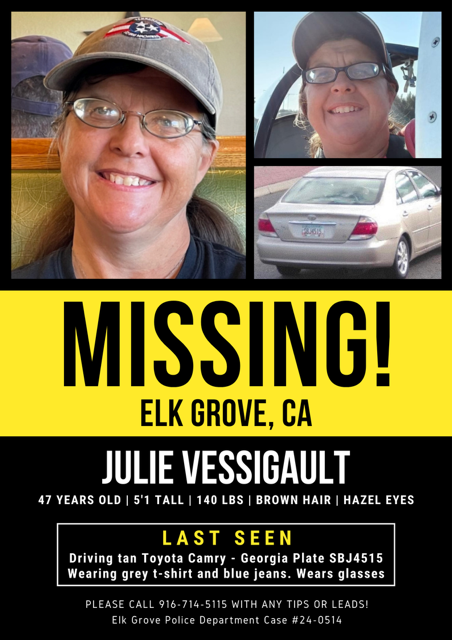
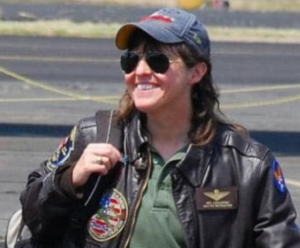
For just under a year the warbird and airshow community has been trying to find Julie Vessigault, an aviation enthusiast who disappeared on January 23, 2024 from Elk Grove, California.
Vessigault left her mother’s apartment carrying just her keys and debit card, leaving her purse, money, and cell phone behind. She was driving her tan 2005 Toyota Camry with the Georgia license plate number SBJ4515 and two airplane stickers on the driver’s side of the trunk.
A traffic camera caught an image of the car heading westbound on Elk Grove Boulevard toward Interstate 5—and that was the last time Vessigault was seen.
Vessigault is in her late 40s, approximately 5-foot-1, 140 pounds, with brown hair and glasses. For decades she has been a regular on the circuit, spending decades traveling to airshows and fly-ins like Sun ’n Fun in Lakeland, Florida, where she helped out by marshaling aircraft and cleaning the grime off aircraft.
Friends describe her existence as often nomadic, as she often lived in her car as she traveled across the country or in a tent at aviation events. But they say she always stayed in touch.
In 2024, she relocated from Georgia to California to be with family. She was living with her mother and her mother’s caretaker and appeared to be settling into a new life. Her recent social media posts contained posts of her adventures at the Sacramento International Airport (KSMF), where she found her niche cleaning airplanes.
When she disappeared, she was wearing a Sacramento airport T-shirt.
At the time of her disappearance, she had plans to take her mother’s dog to the groomer and go to the airport to clean airplanes a few days later. But she never kept those appointments. That is out of character for her, according to friends and family.
Sergeant. Jason Jimenez of the Elk Grove Police Department, family members say Vessigault did have a habit of “going off the grid” from time to time but would always get back in touch or use social media to let friends and family know she was OK.
She had a robust social media presence, using Facebook and X, and most of her posts were made by phone, so leaving her phone behind was also out of character. Although not a pilot, most of her posts show her interacting with airplanes, either washing them or getting a ride with a pilot.
When no new posts appeared after 30 days and she did not make contact, the aviation community grew concerned. Although the failure to contact family and friends may be out of character, Jimenez noted there is no indication of foul play, therefore, her disappearance is not being investigated as a crime but as a missing person.
There also are those who wonder if she went missing intentionally, but there’s been no activity on her bank account since the day she went missing.
There are several Facebook pages dedicated to finding Vessigault, and the aviation community members often share information or ask for intel about her disappearance. Jimenez is hoping the national reach of the aviation community will help find her.
“No one has stopped looking,” he said. “Each week they run her license plate. We’ve sent bulletins to surrounding agencies and area hospitals, gone through hours of traffic camera footage, and interviewed family and friends. We’ve done social media pushes. We’ve done media interviews. We reached out to an organization that specializes in underwater searching. They have done an extensive search of a river that’s nearby us twice. No one has forgotten about her.”
Jimenez asks that anyone who may know something that could help locate Vessigault contact the Elk Grove Police Department.
“Unfortunately, we’ve gotten to the part now where all of our investigative steps, our leads, all that stuff has dried up,” said Jimenez. “So now it’s just a matter of someone coming forward with any piece of information that may kind of move [the case] forward. We know that Julie is that sister, that daughter, that friend, and we haven’t stopped looking.”