

A hearing looking at the deadly collision of an American Airlines passenger jet and a military helicopter over the Potomac River in January unearthed a number of concerns about the safety of the airspace over Washington, D.C., with one witness calling it the “least safe” it has ever been.
The three-day session, organized and headed by the National Transportation Safety Board (NTSB), touched on issues with air traffic control (ATC) operations, faulty instruments on military helicopters, and even concerns that the FAA may be holding back what it knows about the events leading up the crash, which killed 67 people.
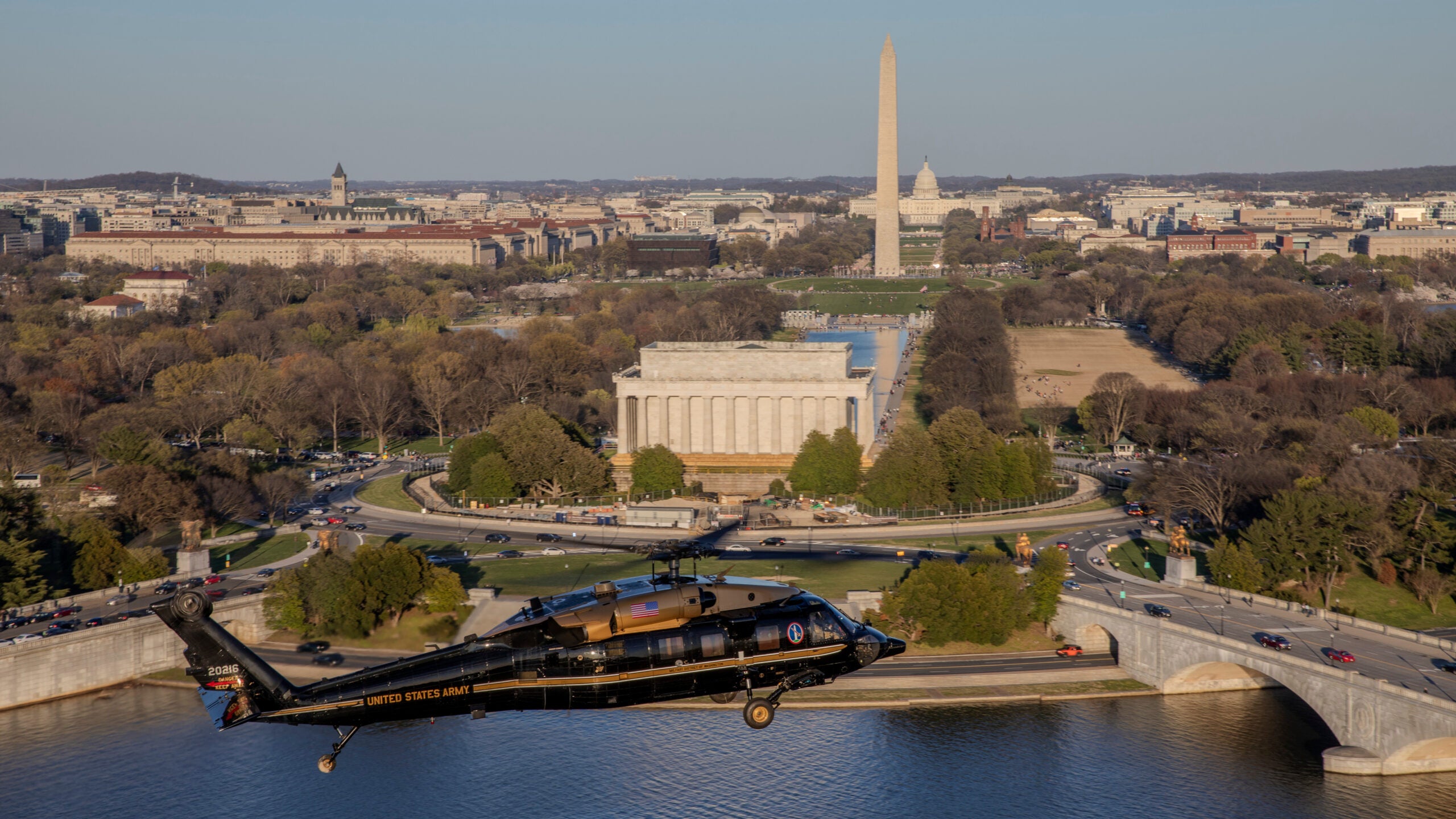
One major area of focus was the way airline and helicopter pilots avoid other aircraft while taking off from and landing at Ronald Reagan Washington National Airport (KDCA), which the American flight was approaching before it hit a U.S. Army UH-60 Black Hawk helicopter.
A number of witnesses said flights navigating to, from, and around Washington National often rely on visual separation, where the pilot assumes responsibility for preventing a collision based on their observations from the flight deck. The crew of the Black Hawk was using visual separation on the night of the accident.
“Visual separation was used on a daily basis between helicopter operators and the commercial traffic departing and landing at DCA,” said air traffic controller Clark Allen. “Visual separation was paramount to making the operation work efficiently, for the amount of volume and complexity that the airspace has.”
Rick Dressler, an official with medevac operator Metro Aviation, told the NTSB that visual separation is somewhat encouraged by air traffic controllers at Washington National because it “relieves the controller of some percentage of responsibility” and allows them to focus elsewhere.
The method is not without its challenges, he noted.
“It’s still remarkably hard to identify aircraft while you are flying,” Dressler said. “We use traffic alerts and traffic monitoring systems in our helicopters, all the D.C. operators, the civilian and law enforcement side, and it is exceptionally challenging when you have particular units that don’t broadcast using ADS-B.”
When asked if he is generally comfortable with the use of visual separation around Washington National, Dressler said he is because he knows most of the helicopter operators and air traffic controllers by voice. But when asked if there are any operators in the area that make him uncomfortable, he replied, “Sadly, yes.”
“I don’t like saying this,” he told the NTSB. “I’ll say it again on the record. I’m a former Army aviator, and I’m a retired Air Force officer, and I don’t like saying that first heli [1st Helicopter Squadron] of the USAF from Andrews and 12th Aviation Battalion [of the U.S. Army] gives us all pause in the community. And I’m speaking for my group there. We are all very uncomfortable when those two units are operating.”

The Black Hawk involved in the collision was part of the 12th Aviation Battalion.
FAA officials said that, even in cases where visual separation is used, ATCs “will always go the extra mile” to make sure a pilot is flying safely and not nearing another aircraft.
Technical Problems
NTSB officials revealed that the Black Hawk was flying at 278 feet at the time of the crash—over its 200-foot limit for that portion of its route.
The crew might not have known their true altitude, the board said, because its barometric altimeter was off by between 80 and 100 feet.
An Army official said it wasn’t unusual for barometric altimeters to be off by that much and it usually wasn’t a problem. Subsequent tests of altimeters on other helicopters from the same military unit found similar discrepancies in the aircraft’s true altitude.
Investigators pressed the Army and Sikorsky Aircraft, which manufactures Black Hawk helicopters, about the acceptable margin of error on such a critical flight instrument.
“You just told me, I believe, all of the equipment in this manufacturing process is within the tolerances for safety,” said NTSB member J. Todd Inman. “How much is that tolerance? I think it should be zero.”
‘Make It Work’
FAA officials spoke at length about systemic challenges that have made it difficult to govern Washington’s congested airspace, including a lack of air traffic controllers and support personnel, high turnover, loss of institutional knowledge, and poor quality control mechanisms.
James Jarvis, who works for FAA contractor Leidos, said ATCs are constantly having to balance the need for efficiency with the need for safety, and at times that task strains their resources and manpower. He observed operations at the ATC facility overseeing Washington National two years ago and found conditions there “not necessarily healthy.”
NTSB officials also zeroed in on so-called “squeeze plays” used by controllers and a “make-it-work” mentality that had set in among overextended staff.
“Are they constantly having to ‘make it work’ in the tower?” asked NTSB member Katherine Wilson.
“The majority of the time, yes,” Allen answered.
Wilson then asked Nick Fuller, executive director of air traffic safety oversight service at the FAA, if the airspace over the nation’s capital is safe for flying.
“Absolutely it’s safe to fly in,” Fuller said. “I flew out myself this weekend, round trip, and I plan to do so in another few weeks. The U.S. is one of 193 countries in the world, but we operate and maintain and safely provide air traffic services to about 28-36 percent on any given day of world aviation traffic. The controllers at DCA are responsible, well trained, and I would have no problem getting on a flight in or out of that airport on any given day.”

But Dressler had a much different answer.
“Today the airspace is the least safe it has ever been, thanks to the changes that have been implemented after January 29,” he said.
Dressler was not asked to elaborate on what specific changes he thought had made the airspace more dangerous.
Question of Transparency
At one point in the hearing, NTSB Chairwoman Jennifer Homendy interjected to ask several FAA employees if they had been instructed by the agency’s administrator to be fully transparent with the investigation. When they said they had, Homendy questioned if they had taken those orders to heart.
“We’re going to do a change in the seating,” Homendy said. “I had noticed—and not just me, members of the audience, NTSB staff, and members watching virtually—had all reported that one of the supervisors had elbowed an FAA employee midsentence. I’m not going to make an assumption about that but that person had stopped speaking as a result. We want people to be fully transparent and feel safe in providing us answers, so we’re going to switch seats. I’m not going to put up with that.”
It was not clear which FAA employees Homendy was talking about.
Homendy has taken the FAA to task for, in her view, failing to take ownership of the accident.
“I don’t get it,” she said on the first day of the hearing. “Every sign was there that there was a safety risk, and the tower was telling you that.”