












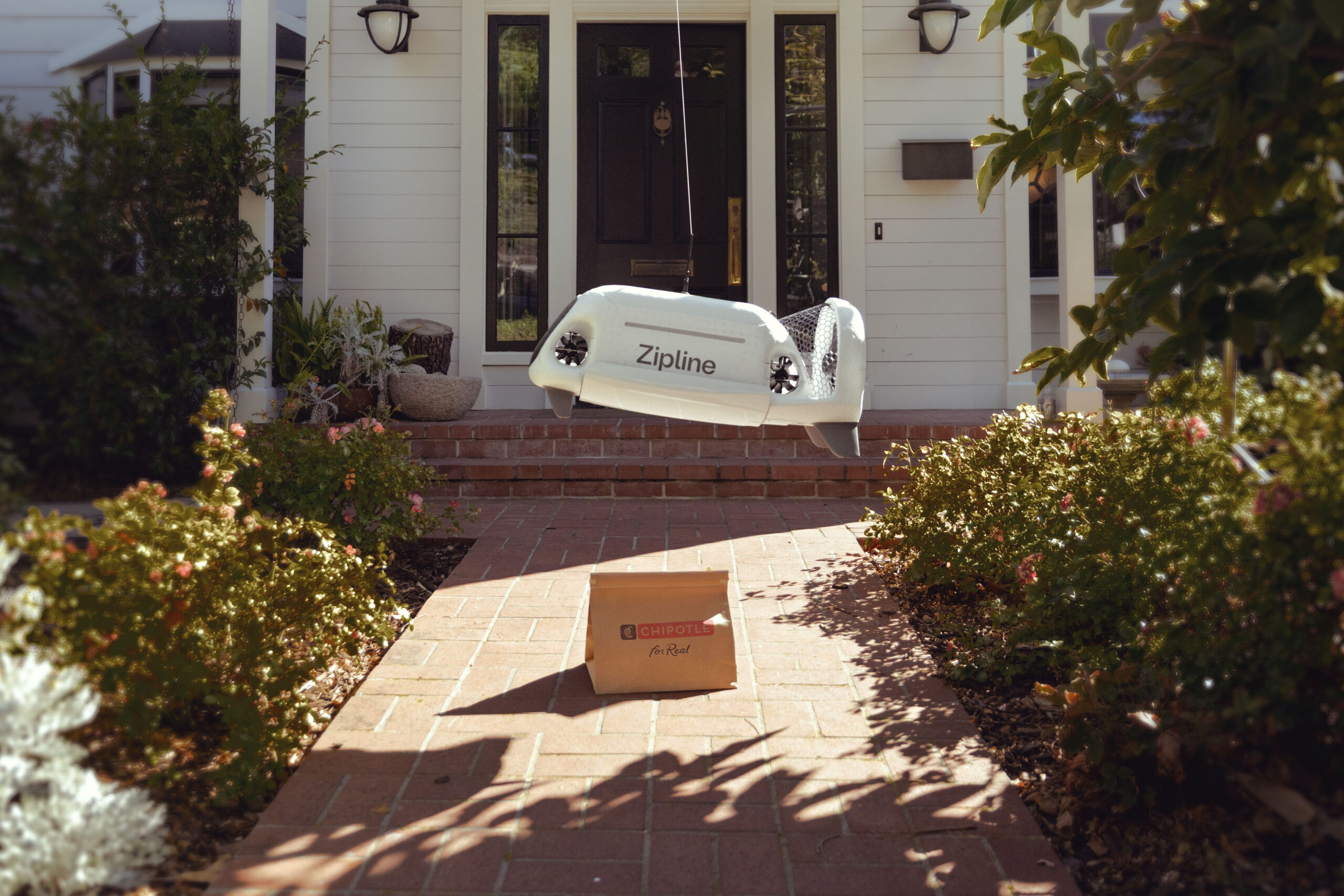


Chipotle is the latest restaurant chain to take food delivery to new heights.
Starting Thursday, the company said, select customers in Rowlett, Texas—about 30 miles east of Dallas—can get burritos, chips and guacamole, and other items delivered by drone, straight to their doorstep, within minutes. The drones will initially operate out of a single Chipotle location, but more will be added in the coming weeks.

The highly automated service is operated by partner Zipline, the world’s largest commercial drone delivery provider. The companies have dubbed the collaboration “Zipotle.”
“You tap a button, and minutes later food magically appears—hot, fresh, and ultra-fast,” said Zipline founder and CEO Keller Rinaudo Cliffton.
Eligible Rowlett residents can order any Chipotle menu item through the Zipline app. Store associates place the order in a “Zipping Point”—a curbside mailbox that autonomously positions orders to be scooped up by a drone. Zipping Points can be installed on sidewalks or against buildings to enable deliveries within a 10-mile radius, with no construction or power required.
Once the package is secured, the drone lifts off vertically and flies to the customer’s address at about 72 mph and 300 feet in the air. Hovering at that altitude, it releases a tether attached to a smaller “Zip.” The Zip uses sensors and fans to guide itself to a precise landing spot, such as a doorstep, releasing the order before spooling back up and returning to the store.
According to Cliffton, Zipline drones deliver 10 times faster than cars and often spend less than two minutes in the air.
The service will operate seven days a week from 12 p.m. to 8 p.m. CDT but will later expand to 10 p.m., Chipotle said. Curt Garner, the company’s chief technology and strategy officer, said it will open up deliveries to new locations, “including backyards and public parks.”
Zipline Expands
Zipline got its start delivering medical supplies to hospitals in Rwanda in 2016. It has since expanded across four continents, servicing about 5,000 health facilities worldwide. The company’s drones have completed more than 1.6 million commercial deliveries—approximately one every 60 seconds—and flown more than 100 million miles.
Until recently, the Part 135 air carrier was focused almost exclusively on long-range medical delivery in rural, hard-to-reach places. That changed with the introduction of its Platform 2 (P2) system in the Dallas-Fort Worth area in April. P2 drones, by contrast, are designed for shorter deliveries in cities and suburbs.
The key innovation with P2 is the Zip. Unlike Platform 1 (P1) drones, which drop packages on a parachute, it stows inside the aircraft and enables “dinner plate-level” precision, per Cliffton. Both aircraft have fixed wings, but P2 drones have propellers for vertical takeoff and landing (VTOL). They are also slightly faster, carry more payload, and can fly in rain, heat, and wind gusts up to 45 mph.
With the addition of Rowlett, P2 drones are now flying in 10 Dallas-area neighborhoods—with some limitations. Zipline will initially limit Chipotle orders to under 5.5 pounds, for example, to allow the system to mature. And while all P2 locations will eventually have a 10-mile service radius, early operations with Walmart and Chipotle are limited to two miles.
Range will remain limited until Zipline ramps up to beyond visual line of sight (BVLOS) operations, though that could happen quickly. The company deployed visual observers to monitor its Walmart service but is beginning to phase them out. In 2023, it obtained a BVLOS waiver from the FAA that authorizes the drone’s onboard detect and avoid system to steer clear of obstacles—including other aircraft.
In 2024, the regulator went a step further by authorizing Zipline, Wing, and others operating near Dallas to manage their own drone traffic. Its goal is to develop a framework for uncrewed aircraft system (UAS) traffic management.
Commercial drone delivery could receive yet another boost in the near future. The FAA last month published its proposed Part 108 rule, which would make it far easier to secure BVLOS permissions. The White House in June added to the momentum with a pair of executive orders that aim to further open the floodgates.
Like this story? We think you’ll also like the Future of FLYING newsletter sent every Thursday afternoon. Sign up now.

