Correction Section

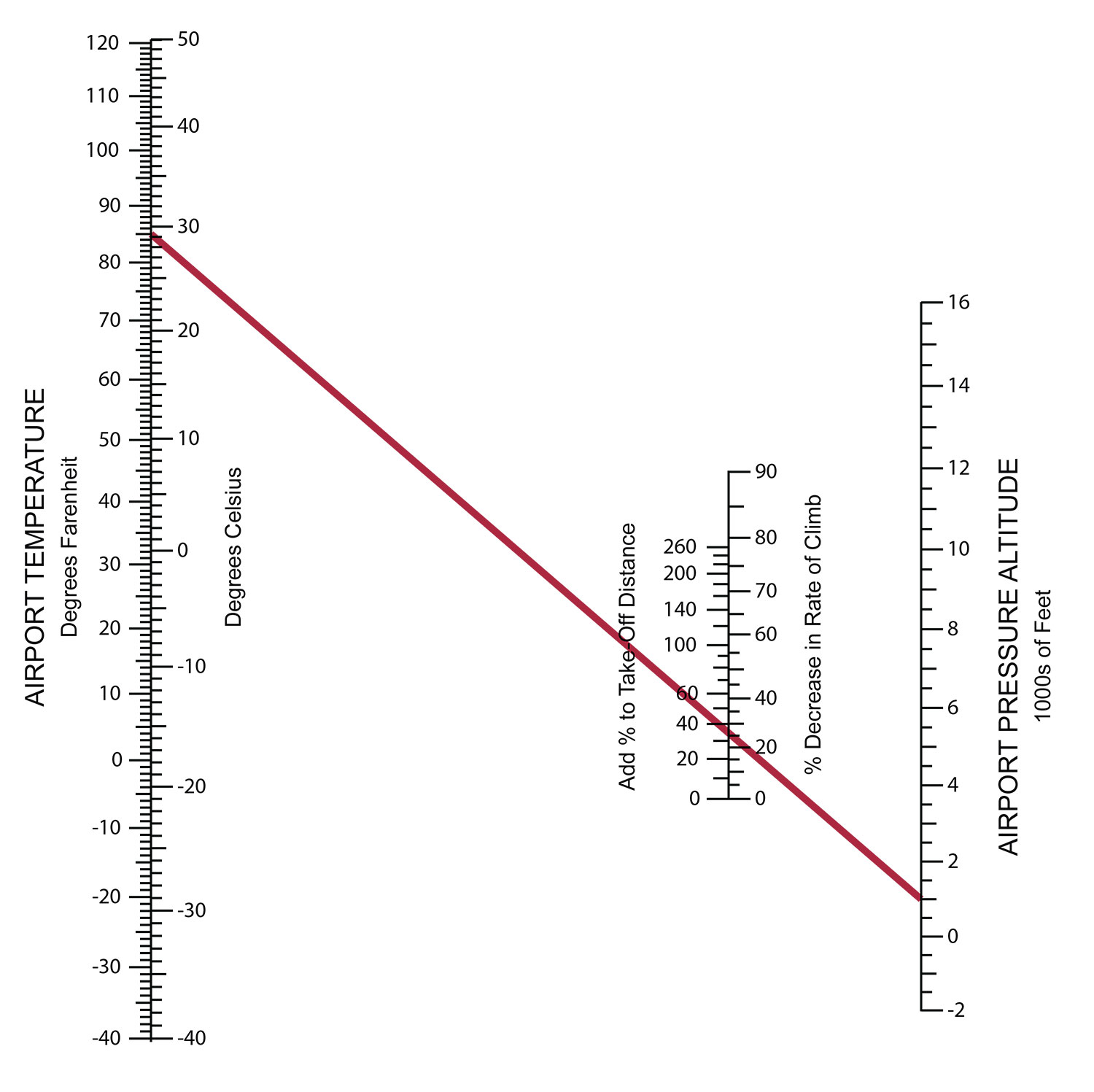
A real Koch chart is reproduced above. To use it, draw a straight line between the temperature (85 degrees F) on the left and the pressure altitude (1000 feet) on the right. Read the results from the center (35 percent increase in takeoff distance and a 25 percent reduction in climb rate).
Gemini Sparkle

Key Takeaways:

  • The article features corrections to previous magazine content, clarifying a misidentified chart (pressure altitude vs. Koch chart) and correcting advice regarding missed approach procedures during circling approaches.
  • The Koch chart is highlighted as a valuable yet less well-known tool for pilots to correct takeoff distance and climb rate based on pressure altitude and temperature.
  • An experienced pilot and FAA Senior AME shares insights on aging in aviation, emphasizing the absence of age restrictions for First Class Medicals, the importance of personal safety measures, and the positive impact of flying on quality of life.
See a mistake? Contact us.

In the December 2023 issue, the figure on page 5 is not a Koch chart, but rather a chart for computing pressure altitude.

A Koch chart normally has a pressure altitude scale on the right and temperature on the left. In the center are scales for correcting takeoff distance and climb rate relative to sea level values.

While these factors are monotonically related to pressure altitude, the reason to use the Koch chart is when the values available in provided tables don’t cover the pressure altitude one is working with.

I have discussed with many experienced CFIs who don’t know the Koch chart. It is a very useful but less well-known tool.

—Peter N. Steinmetz, Tempe, AZ

You’re right, of course. We have no idea how we did that. A “real” Koch chart is reproduced at upper right. Thanks!

Circling And Missing

I am an avid reader and supporter of Aviation Safety. Your publications and approach to fostering safer pilots is much appreciated. Bravo for your efforts!

Top portion of the third column of page 17 says this: “So, when circling, we always want to return to the MAP and then turn onto the prescribed course or heading before initiating a climb.” This statement is NOT correct. This could lead a pilot to attempt to return to the missed approach point without navigation capability to the MAP, sometimes from the complete opposite direction with no guidance on which way to turn to reestablish themselves on the missed approach segment. Bad advice all the way.

Your insert on page 17 that references the Airman’s Information Manual IS correct. “To become established on the prescribed missed approach course, the pilot should make an initial climbing turn toward the landing runway and continue the turn until established on the missed approach course. If the aircraft initiates a missed approach at a point other than the MAP…from below MDA or DA, or on a circling approach, obstacle clearance is not necessarily provided by following the published missed approach procedure.”

Thank you for reviewing and correcting this info.

—Gary Garavaglia

You’re right, also, Gary. Thankfully, we didn’t make the same mistake in January’s article, by Matt Johnson, on this very topic. Thanks!

Journey Of Hope

The article “Journey of Hope” was of special interest to me as I am advancing in age. First, let me note that there is no age restriction to the issuing of a First Class Medical.

I have been flying since 1959, and have been an FAA Senior Aviation Medical Examiner since the mid 1970s. And have ATP, COM, CFII, SEL and MEL ratings. In addition to aviation medicine, I do some family medicine to keep my skills up.

I got my ATP when I was 75 years old, just because it was another goal. While I still fly my Cessna 421C, I decided when I turned 80, that, even though it’s not required, I would have a safety pilot with me. The thought of leaving my wife in a plane with me incapacitated made me very uncomfortable.

I have found flying, whether it was in the back seat of an F-4 Wild Weasel or a Cessna 140, adds to my quality of life. The camaraderie among pilots I take care of and fly with keeps me young, And I always fly safe.

—James E. Palen, M.D., Senior AME, via email


Send your thoughts, comments or questions to avsafetymag@gmail.com

Ready to Sell Your Aircraft?

List your airplane on AircraftForSale.com and reach qualified buyers.

List Your Aircraft
AircraftForSale Logo | FLYING Logo
Pilot in aircraft
Sign-up for newsletters & special offers!

Get the latest stories & special offers delivered directly to your inbox.

SUBSCRIBE