Squawk Box

Bent, Corroded, Cracked

While investigating a soft-brake condition, Skydrol was noted leaking from around the belly beacon-its lens was full of fluid. After removing the interior and center-aisle floor panels, hydraulic fluid was noted dripping from the rigid right brake line (p/n 90E5517010-64 at fuselage station FS248.1). The Cessna-installed Keith Air Conditioning cold-air duct is Ty-wrapped to the brake fluid lines. The belly beacon is directly below the corrosion and the Skydrol leakage. The aircraft is not equipped with belly drains. The submitter speculates water condenses in the belly of the aircraft and the beacon creates heat-(in turn generating) humidity, causing corrosion on component parts in the underfloor area.
Read More »

Corrosion And leaks

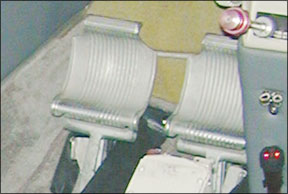
Upon investigating a loose rudder pedal, the controls were disassembled. We found the shaft had been double-drilled with the holes overlapping. This aircraft is a relatively new aircraft, having been certificated in January 2002. Pilots rudder pedal assembly: p/n 002-524040. Left rudder pedal shaft: p/n 002-524016-5.

Read More »

Fretting And Chafing

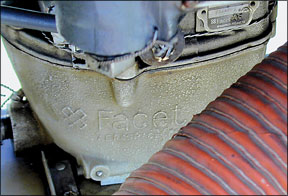
During an annual inspection, the IA found black fretting corrosion below the center two, l/h aft engine mount bolts. The bolts were loose in the mount even though their nuts were tight. Investigation revealed the bolts are a little too long and the nuts were running out of threads. The solution was to add another washer below the nuts, then re-torque back to specifications.

Read More »

Stuck, Jammed, Split

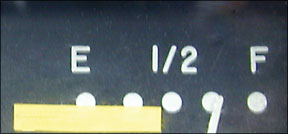
The aircraft lost power and landed in a field, coming to rest on its nose. During the post-crash investigation, the pilot stated he checked the fuel gauge prior to the flight and that it read one-half full. He did not visually check the quantity. Investigation revealed the fuel tank to be empty and the gauge stuck in the half-full position. The fuel gauge part number provided is 2-731.During a check ride, the chief pilot shut down the right engine in flight. When attempting a restart, the fuel shut-off lever jammed in the off position. The crew conducted a successful and uneventful single engine landing at the base airport. Upon investigation, a technician discovered the aft shroud on the r/h starter generator (p/n 23079-000-1) had slipped aft, blocking the linkage while the shutoff control remained in the off position. The shroud was repositioned and its clamp secured.

Read More »

Leaks and Shorts

After sitting idle on a ramp for at least 10 months, the airplane underwent maintenance. A strong fuel odor was observed in the cabin; an exterior inspection failed to detect anomalies. The odor subsided. Once the engines were started and the fuel selector placed in crossfeed, the odor returned. After removing the floorboards, a heater duct running perpendicular to the crossfeed lines was observed to be in contact, causing corrosion. Pinhole leaks had developed in both lines, p/n 5300108-53 and -54.

Read More »

Corrosion And Chafing

A repair station states it has begun removing the four screws attaching the elevator trim tab horn to the trim tab to inspect them for corrosion at every annual inspection performed on 300/400 series Cessnas. The facility reports finding numerous screws corroded almost in half; there is no way to inspect these screws (p/n AN515-8R26 and MS35206-251) without removing them.

Read More »

Cracks, Jugs And Mags

The l/h main landing gear failed to extend, but trailed. The pilot was able to rock it into the down and locked position and make a safe landing. Inspection revealed the (p/n 1281001-3) actuator body had cracked clear through the forward attach hole and half-way through the aft attach hole.

Read More »

High and Low Time

“On final,” states an unidentified submitter, “the student selected 30 degrees flaps; a loud pop was heard, the r/h flap came down to 30 degrees, but there was no movement at the l/h flap. The aircraft landed without incident. Investigation revealed the swaged ball end broke from the remaining cable (p/n 0400107-146).” The submitter suspects high time and cycles as contributing factors to the failure.

Read More »

Skin Game

Receiving inspection of a new Cessna leading edge skin (p/n 0523029-4) found it was drilled incorrectly. None of the nose ribs would line up with the rivet holes. The submitter wrote, “This (is) the second time we have received this same part. We have asked for this part not to be put back into Cessna stock since [it] is non-conforming. [It] came with an FAA Form 8130-3 Airworthiness Approval Tag.”

Read More »

Working Rivets

During the preflight inspection for a local training flight, blind rivets located halfway up the vertical stabilizer were found to be making aluminum oxide trails (smoking) on both sides of the vertical fin.

Read More »
Pilot in aircraft
Sign-up for newsletters & special offers!

Get the latest stories & special offers delivered directly to your inbox.

SUBSCRIBE