Preliminary Reports

NTSB Reports: January 2017

At about 0925 Central time, the airplane was destroyed after impacting trees and terrain during final approach. The pilot and the child passenger were seriously injured. Visual conditions prevailed. Initial reports showed the airplane experienced a complete loss of engine power when about one-half mile from the runway. During the accident sequence, both wings were separated at the wing root and the fuselage came to rest upright about 20 feet beyond initial impact with trees. The airplane was immediately involved in a fire. The pilot removed the child passenger, exited the airplane and walked to a nearby rural residence.

Read More »

NTSB Reports: December 2016

Except for the main wreckage area, there was no noticeable damage to the fields corn stalks. The cockpit, engine cowling and a majority of the fuselage were consumed by fire, although the wings and empennage were mostly intact. Witnesses reported hearing the engine sputtering, and then heard a thud and saw a fireball. They did not observe the airplane in the air.

Read More »

NTSB Reports: November 2016

The pilot later related he was in cruise climb at about 8500 feet msl when he noticed something in his peripheral vision, then felt a thud as something struck the airplane. There was no loss of control or abnormal control feel, so he continued the flight and landed uneventfully. Upon landing, about 12 inches of the airplanes vertical stabilizer was missing; there also was substantial damage to the rudder. Initial examination showed no evidence of organic material. A detailed examination by the NTSB is pending.

Read More »

NTSB Reports: October 2016

The flight instructor set the airplane up for simulated engine failure by pulling out the carburetor heat control and reducing throttle to 1200 rpm. The student pilot followed emergency procedures, used the checklist and prepared to land. After the carburetor heat control was pushed back in and the throttle advanced, there was a sudden loss of power; efforts to restart the engine were unsuccessful. The airplane collided with the fence during the landing.

Read More »

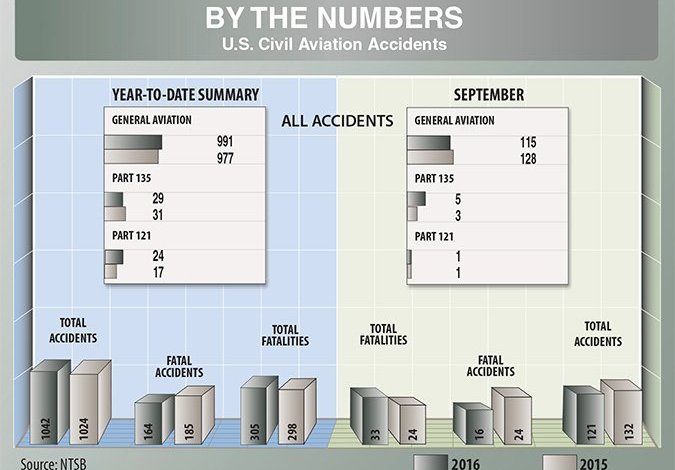
NTSB Reports: September 2016

At about 0900 Eastern time, the airplane was substantially damaged upon impacting an aircraft hangar following a total loss of engine power during a go-around. The flight instructor (CFI) and a student pilot received minor injuries. Visual conditions prevailed. The two had been practicing takeoffs and landings for about an hour when, on the downwind leg of the traffic pattern, the CFI directed the student to demonstrate a simulated engine failure. The airplane was about of the way down the runway when he initiated go-around. At this point, the engine sputtered and lost power. The CFI took over the flight controls and made a left turn at about 100 feet agl with the intent of flying over a hangar to a clear area beyond but realized they would not clear it. He placed the airplane in a 45-degree nose-up attitude so the engine penetrated the hangars metal door first.

Read More »

NTSB Reports: August 2016

The accident occurred during an FAA checkride for the airline transport certificate administered by a designated pilot examiner. Following the accident, several fire department personnel spoke with the commercial pilot. When asked what had occurred, he told fire department personnel that the left engine had experienced a loss of engine power shortly after takeoff. He further stated that, following the loss of left engine power, the examiner took over airplane control and was attempting to fly the airplane back to the airport when the accident occurred.

Read More »

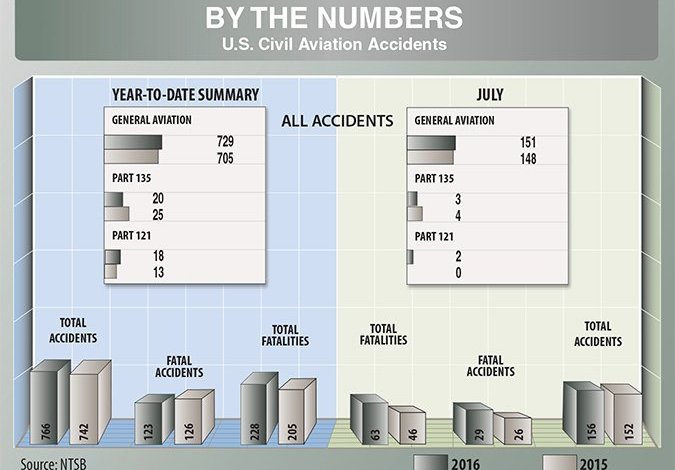
NTSB Reports: July 2016

The airplane was destroyed at 1456 Eastern time shortly after takeoff. The flight instructor, the private pilot receiving instruction and the pilot-rated passenger were seriously injured. Visual conditions were reported. An air traffic controller who witnessed the accident reported that, when the airplane was at about 400-500 feet agl, it made a sharp right turn followed by a sharp left turn. It then entered a steep nose-down descent before disappearing behind a tree line. An explosion followed. The controller recalled the airplanes landing gear was retracted.

Read More »

NTSB Reports

During his second solo flight, the student pilot encountered a gust of wind during the landing flare. The airplane ballooned and then bounced twice on its nosewheel. After the second bounce, the student pilot applied full power and aborted the landing. The subsequent landing was uneventful and he taxied to the ramp. Post-accident examination revealed substantial damage to the firewall.

Read More »

April 2016 NTSB Reports

At about 1800 Eastern time, the airplane was substantially damaged when it impacted terrain during final approach. The solo pilot sustained fatal injuries. Visual conditions prevailed. Witnesses indicated the airplane lifted off within the first 1000 feet of the runway then began to bank sharply and reached a 90-degree bank as it climbed to treetop height. While cruising at FL190, the engines manifold pressure dropped from 29 to 15 in. Hg. The pilot arrived over the divert airport and began a circling descent.

Read More »

March 2016 NTSB Reports

At 1945 Eastern time, the airplane experienced a total loss of engine power, was force-landed on a road and struck a telephone pole with the left wing. The commercial pilot and the passenger were both seriously injured. Visual conditions existed.

Read More »
Pilot in aircraft
Sign-up for newsletters & special offers!

Get the latest stories & special offers delivered directly to your inbox.

SUBSCRIBE