Aviation Safety

Another ILS Trick

I have some comments on Nailing The Needles [Instrument Check, November]. I am a CFII and already made copies of your article for my students, as I think the information may clarify some things to them or at least bring up questions (both will be good).

Id like to add what I consider another major component of an ILS (or any approach): the winds aloft and on the ground. These are taken too lightly prior to starting an approach, but Ill stick to an ILS since that was the subject. Winds aloft provide a lot of information, including preferred altitudes, freezing levels, potential areas of turbulence and an idea of how you will be correcting for the wind.

The enroute portion of the fl…
Read More »

NTSB Reports

The following briefs were selected from the 121 preliminary reports filed with the NTSB in December 2001. Statements in quotes were taken directly from the NTSB documents. The information is subject to change as the investigations are completed.


December 01, Prescott, Ariz.
Piper Comanche

At about 19:30 mountain time, a Piper PA-24-250 suffered fuel exhaustion while on final approach to runway 21R at Love Field and crashed about 450 feet short of the runway. The two occupants, both of whom were flight instructors, suffered minor injuries. The engine failed on approach with the fuel selector was positioned to the right auxiliary fuel tank and the pilot restored powe…

Read More »

No Radar? No Problem

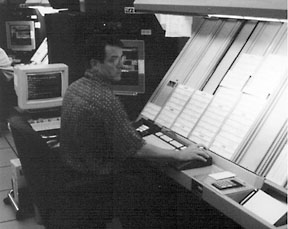
[IMGCAP(1)]Listening to ATC is a favorite diversion for my wife as we approach our destination, particularly when the weather is ugly. The chatter between pilots and controllers can be comforting, giving an eavesdropping passenger the impression that were all professionals quietly going about our routine missions.

But whats truly routine to a pilot can startle a passenger unfamiliar with the finer points of IFR flying. I recall the look of horror on my wifes face the first time she heard the phrase radar contact lost when I was cleared for an approach while we were bouncing around inside some turbulent gray clouds.

Like many, she had the impression that we couldnt land without…

Read More »

IFR Planning: Tactics vs Strategy

[IMGCAP(1)]A friend of ours likes to say that flight training is supposed to be difficult and unpleasant, otherwise everyone could learn to fly. We have to wonder if his grim humor forms more of the underpinning of the flight training edifice than were willing to admit.

Perhaps thats one way to explain the illogical way pilots learn the basics of flight planning generally and IFR planning specifically. The IFR written still contains a series of impenetrable questions that require pin point use of a whiz wheel to calculate time en route and fuel burns to a resolution of a couple of minutes – this despite the fact that no one does that in the real world and probably hasnt since the 1950…

Read More »

Too Much, Too Soon

As much as it pains some people to admit it, light airplanes are seldom the kind of go-anywhere-anytime transportation tools most pilots would like them to be. Generally speaking, the smaller the airplane, the less capable it is to perform all-weather duty.

The limitations of flying light aircraft are such that weather can easily overwhelm any pilot who does not both recognize and accept the fact that sometimes the wheels ought to stay on the ground. While thats a lesson instructors and examiners try to instill in every private and instrument applicant, sometimes the lesson comes too late to do the pilot much good.

The temptation to push the envelope of both airplane and pilot is stro…

Read More »

Get Down Right Now

[IMGCAP(1)]Aviation training is often bashed for having a tombstone mentality. We tend to ignore certain shortcomings until an accident or incident instills new religion. Emergency descent training is a prime example of this.

Throughout my private, commercial and ATP courses, I dont remember getting instruction in emergency descents. Yet after the ValuJet, Swiss Air and FedEx accidents-each of which involved fire in flight-every checkride Ive had has included an emergency descent.

Whats the big deal with emergency descents? And is this skill worth your attention? Take one look at the burned wreckage of the FedEx DC-10 at Newburgh, New York in 1996 for your answer. That crew had…

Read More »

Chasing Ratings

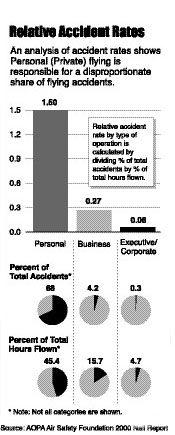
Advancing your ratings makes you a better/safer pilot. Weve probably all heard that statement more times than we can count, and most pilots probably accept it as an empirical truth. However, others feel that their lack of advanced ratings does not make them any less safe or competent to fly the planes they do, the way they do.

At the risk of sounding like a lawyer, the truth, I think, is that whether advanced ratings makes you a better/safer pilot depends a lot on what you mean by better and safer. Many folks equate the type of flying a pilot does or the certificates/ratings he holds with some sort of rank ordering of pilot skill/safety/proficiency.

Few people would argue that…

Read More »

Give Me Altitude

Many wags love to toss around cliches as if theyre the clever soul who invented them. Theres a grain of truth to most of them, of course, but, gosh, it gets tiring explaining the mystery and the dynamic environment of flight with such cookie-cutter phrases.

While we all might dust off a cliche from time to time, there are times when you might live one and wish you hadnt. Thats when it becomes crystal clear just why the cliche has emerged from the fermenting stew of language.

However, recently I turned a cliche on its tail and discovered a kernel of wisdom there, as well. Its better to be on the ground wishing you were in the air than in the air and wishing you were on the ground….

Read More »

Airspace Blunders

[IMGCAP(1)]It was a typical pre-9/11 afternoon as we approached White Plains. New York Tracon handed us off to White Plains Tower and the controllers were issuing their usual rapid-fire instructions to the arriving mass of airline, regional, business and general aviation aircraft.

The frequency was so congested that most of the arriving aircraft were unable to read back the instructions. We had the TCAS turned down to a six-mile range and our heads were on swivels since the airspace was so busy. The TCAS screen was full of targets.

We were watching the business jet ahead of us turn onto final when suddenly it made an abrupt nose-up maneuver. The pilot cried over the frequency, What…

Read More »

Why Twins Crash

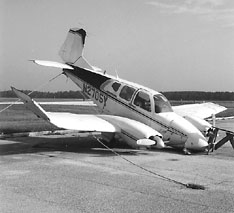
[IMGCAP(1)]Like the speed of light and the fact that the best parking spaces are already taken, one of the constants in the universe is this imponderable question: Is a twin safer than a single? Does having two motors really add measurably to the safety margin or is it, like so much else in GA, undiluted marketing hype?

If we could answer this question, we could also turn lead to gold and all of our computer hardware would actually play when plugged. In the end, however, we think there are too many variables to say with assurance that an extra engine really does improve the safety margin for the average owner-pilot. We emphasize average as a means of noting that not all owners pursue th…

Read More »
Pilot in aircraft
Sign-up for newsletters & special offers!

Get the latest stories & special offers delivered directly to your inbox.

SUBSCRIBE