










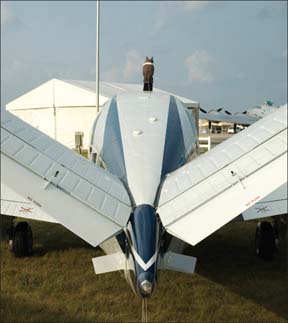
Fighting Flutter
Aerodynamic flutter can develop with great speed and quickly destroy your aircraft. Heres why, and what you can do about it.

Aerodynamic flutter can develop with great speed and quickly destroy your aircraft. Heres why, and what you can do about it.
It was a fairly warm summer, and exasperation with my quest to add my multi-engine land (MEL) rating was starting to grow like beads of sweat. In turn, my ME instructor-whose patience and professionalism has long since earned him sainthood-had been a pretty good sport all through this process. But, we still had some practice ahead of us, since I wanted Commercial privileges from the rating as well as to be comfortable with this well-worn-but-reliable Seneca I on the gauges. It was during this training that I learned to think before touching anything in an airplane.
The days mission was designed to add more polish to my skills. I had gotten fairly comfortable in the Seneca, which was just…
The Dumbest Thing
Its no secret that pilots are human. While the advances in technology and increasing number of applications for unmanned aerial vehicles, or UAVs, may eventually reduce our numbers, the overall impact on safety will probably not improve measurably until humans are completely removed from the equation. This means a totally automated-and thoroughly debugged-set of protocols for the design, engineering, manufacture and operation of UAVs wherein humans are not allowed to influence any aspect. Until then, aircraft will still crash as a result of human error, regardless of the phase of UAV development or operation in which that mistake is made.
In the meantime, we…
What Did You Say?
I just finished reading Mean What You Say (December 2005). This is a very good article providing powerful information for pilots to include in the art of aviating, navigating and communicating. We do a pretty good job of aviating and navigating but we sure could use some improvements in communicating.
In his non-towered airports discussion, Frank Bowlin says you are either departing or taxiing into position and hold. I tell pilots to never, ever go to position and hold at a non-towered airport. Doing this puts your back to traffic that may be landing on that runway.
Several years ago, I was inbound at night to a non-towered airport on the ILS. We made…
December 1, 2005, Raymond, Miss.
Piper PA-30
At 1357 Central time, the airplane was destroyed on impact with terrain following a loss of control during takeoff from Runway 30 at the William John Bell Airport, (M16). The Instrument-rated Commercial pilot and his two passengers were fatally injured. The flight was intended as a ferry flight to have required maintenance performed. Visual conditions prevailed. All aircraft components of the 1964-vintage airplane were original equipment on the aircraft since new and showed a total time according to the logbooks of 5123 hours. Several witnesses reported hearing abnormal engine sounds during the takeoff. At approximately 100 feet…
At 1357 Central time, the airplane was destroyed on impact with terrain following a loss of control during takeoff from Runway 30 at the William John Bell Airport, (M16). The Instrument-rated Commercial pilot and his two passengers were fatally injured. The flight was intended as a ferry flight to have required maintenance performed. Visual conditions prevailed. All aircraft components of the 1964-vintage airplane were original equipment on the aircraft since new and showed a total time according to the logbooks of 5123 hours. Several witnesses reported hearing abnormal engine sounds during the takeoff. At approximately 100 feet agl, they also heard a pop or bang followed by an immediate rig…
The airplane was presumed destroyed during a collision with water at 1644 Eastern time while on approach to the Nantucket Memorial Airport (ACK). The Commercial pilot was not located, and presumed to be fatally injured. Instrument conditions prevailed for the flight that departed Teterboro Airport (TEB), Teterboro, New Jersey, about 1530. Earlier in the day, the pilot flew his son to TEB, dropped him off, and refueled the airplane to capacity. Radar contact and radio communication were lost when the airplane was approximately one mile from the airport, at about 200 feet msl. The weather at ACK at 1653, included wind from 020 degrees at 17 knots; visibility 2 miles in light rain and mist; ov…
At 1244 Eastern time the airplane made an emergency landing following an uncommanded pitch-up during takeoff. Although the airplane was substantially damaged, the pilot did not report any injuries. During takeoff, the airplane pitched up violently, climbing to approximately 200 feet. The pilot made an emergency landing. The airplane landed hard and veered off the right side of the runway 1000 feet from its departure end. The bolt connecting the stabilator trim tab to the stabilator control arm was missing….
One person on the ground died and 12 others suffered injuries when the Southwest Airlines flight slid off the runway at Chicago Midway Airport while landing. The airplane slid off the runway and went through a barrier fence and onto a roadway. There were 98 passengers onboard and five crew members on board. An emergency evacuation was accomplished….
At 1716 Central time the airplane was destroyed during an in-flight collision with terrain near Arco, Minn. Instrument and marginal visual conditions prevailed; the Private pilot and two passengers sustained fatal injuries. The Cirrus Airframe Parachute System (CAPS) had deployed as a result of the impact sequence and not as an intentional activation by the pilot….

Get the latest stories & special offers delivered directly to your inbox.
SUBSCRIBE