Aviation Safety

November 9, 2007, McFarland, Calif., Piper PA-60-602P Aerostar

At about 1200 Pacific time, the airplane collided with terrain in a citrus grove during an attempted emergency landing. The private pilot and two passengers sustained fatal injuries; the airplane was destroyed. Visual conditions prevailed. A review of the communications reveals the pilot requested to divert to Bakersfield, Calif., for a “fuel stop.” At 1127, the airplane began a descent from FL210. At 1155, the ATC tower at Bakersfield received a radio call from the airplane, declaring an emergency due to engine problems. Witnesses near the accident site observed the airplane flying southbound, with the wings rocking side to side, until the airplane rolled to the right before impacting the citrus grove.

Read More »

November 10, 2007, Sacramento, Ky., Piper PA-28-151

The airplane was substantially damaged at about 1600 Eastern time during a forced landing following a total loss of engine power. The solo private pilot was not injured. Visual conditions prevailed. The pilot subsequently reported was ferrying the airplane back to his home airport after an annual inspection. After an uneventful takeoff, and at about 60 feet agl, the engine lost all power. The pilot subsequently performed a forced landing to a field. During the landing, the nose gear and firewall sustained substantial damage. The pilot further stated he thought the fuel selector was positioned to the right main fuel tank during takeoff, and that he moved the fuel selector to “OFF” after the forced landing.

Read More »

November 11, 2007, Sugar Land, Texas, Gulfstream Aerospace G-IV

At 1021 Central time, the airplane was substantially damaged when its nose landing gear collapsed while landing. The flight crew of three and the five passengers aboard were not injured and evacuated unassisted through the main cabin door. In a written statement, the pilot reported that, soon after the nosewheel touched down, “a violent vibration or shaking was felt, full back force was applied to the control yoke and the vibration eased until the aircraft slowed further and the vibration returned. The nose landing gear collapsed to the right side of the nose and the aircraft skidded to a stop.”

Read More »

November 12, 2007, Salt Lake City, Utah, Piper PA-31-350

The airplane was landed gear-up at about 0850 Mountain time. The commercial pilot, who was the sole occupant, was not injured. However, the aircraft sustained substantial damage. Visual conditions prevailed. The pilot subsequently reported he was initially inbound for landing on Runway 32, which was changed to Runway 35. He stated he felt “rushed” by ATC due to aircraft sequencing while he set the flaps, lowered the landing gear and set the propellers in no certain sequence. The pilot added that he did not verify their positions prior to landing. Subsequently, the aircraft landed gear-up.

Read More »

November 15, 2007, Erie, Colo., Evektor-Aerotechikas Sportstar Plus

At 1125 Mountain time, the special light-sport airplane sustained substantial damage following a loss of control during landing. The flight instructor and student sport pilot were not injured. Visual conditions prevailed. The airplane touched down on its main wheels, then the nose wheel was lowered, slightly right of the runway centerline. The instructor asked the student to apply light rudder pressure during the roll-out to realign the aircraft with the runway centerline. Ample left rudder pressure was applied and countered with opposite right rudder pressure, resulting in pilot-induced oscillations.

Read More »

November 20, 2007, Tacoma, Wash., Cessna 182A, ACA 7GCBC

The two airplanes collided in mid-air about six miles north of Tacoma Narrows Airport (TIW), Tacoma, Wash., at approximately 1245 Pacific time. The private pilot and sole occupant of the Cessna 182A was not injured. The private pilot of the American Champion Aircraft 7GCBC was not injured; his passenger sustained minor injuries. Visual conditions prevailed. The Cessna departed from Pierce County Airport-Thun Field (PLU) approximately 15 minutes before the accident. The 7GCBC departed from Crest Airpark (S36) at an unknown time with an intended destination of TIW.

Read More »

Bent, Corroded, Cracked

While investigating a soft-brake condition, Skydrol was noted leaking from around the belly beacon-its lens was full of fluid. After removing the interior and center-aisle floor panels, hydraulic fluid was noted dripping from the rigid right brake line (p/n 90E5517010-64 at fuselage station FS248.1). The Cessna-installed Keith Air Conditioning cold-air duct is Ty-wrapped to the brake fluid lines. The belly beacon is directly below the corrosion and the Skydrol leakage. The aircraft is not equipped with belly drains. The submitter speculates water condenses in the belly of the aircraft and the beacon creates heat-(in turn generating) humidity, causing corrosion on component parts in the underfloor area.

Read More »

Running Dry

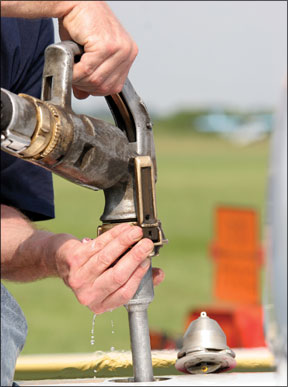
Some time ago there was an Internet debate on running a tank dry. Each side had some valid arguments and thought the opposing view was absurd. Debates are like that. One side was convinced airplanes would be falling out of the sky if pilots starting running tanks dry, then switching to one with fuel in it. The other side felt that airplanes would be falling out of the sky if pilots didnt run a tank dry, if for no other reason than to verify capacity. As such arguments go, both sides were right. And wrong. But both sides agreed on a central point: Theres no substitute for thorough knowledge and understanding of your airplanes fuel system. With that goal in mind, lets set aside the other arguments for a moment, take a look at what goes into fuel systems and what we as pilots should know about them.

Read More »

Miss Opportunity Approaches

Im either lucky or I dont fly enough: In more than 30 years of flying airplanes for personal transportation, Ive had to execute a for-real missed approach in IMC exactly twice. On both occasions, weather was the main culprit. At least thats my excuse. Both flights ended after a successful ILS approach. Of course, those two occasions dont include the trips I delayed or didnt make for weather-related reasons. In more than one instance, Ive waited out weather but still arrived at my destination before I had to be there. Theres no real secret to this kind of reliable personal-airplane use. Its a fairly simple matter of planning, keeping open as many options as possible, knowing what the options are and then-when its necessary-making the decision to execute the appropriate plan.

Read More »

Saving The Cessna Caravan

Theres virtually no substitute for Cessnas Model 208 Caravan as an economical, high-volume utility airplane. Thats why it was a shock to the industry when the FAA considered revoking the Caravans “known ice” certification. After becoming indispensable as a small-package workhorse and charter/backcountry passenger transport, a terrible trend began to develop: Caravans were crashing after encountering icing conditions. The FAA threatened to pull the 208s certification for flight in icing unless industry figured out how to reverse the trend. Somebody had to save the Caravan. What operators, Cessna and the FAA did may change the way we all think about icing certification.

Read More »
Pilot in aircraft
Sign-up for newsletters & special offers!

Get the latest stories & special offers delivered directly to your inbox.

SUBSCRIBE