Aviation Safety

December 18, 2012, Calhoun, Ga. – Hummel H5 Experimental

The airplane was substantially damaged at about 1400 Eastern time when it impacted trees and terrain shortly after takeoff. The private pilot was fatally injured. Visual conditions prevailed. Witnesses report the airplane took off with engine sounds, ground roll and departure all “normal.” Then, at about 300 feet agl, the airplane began a slow roll to the right, reaching about 90 degrees angle of bank and 60 degrees nose-down as it descended into trees. The airplane had accumulated 3.8 hours of total flight time as part of its initial Phase I operating limitations for an amateur-built aircraft.
Read More »

December 20, 2012, Indian Trail, N.C. – Cessna 150J

At about 1530 Eastern time, the airplane was substantially damaged during a runway overrun. The commercial pilot and passenger were not injured. Visual conditions prevailed. The pilot later stated he was demonstrating flight maneuvers to the passenger. During the landing approach, he had difficulty setting the wing-flap position since there was no indicator. Looking out the window, he estimated the flaps were eight degrees down. He continued the approach at 60 knots but realized he was fast and high.

Read More »

December 23, 2012, Lock Haven, Penn. – Piper PA-28R-200 Arrow

The airplane was substantially damaged at 1330 Eastern time during impact with trees and terrain following a total loss of engine power in cruise flight. The private pilot was seriously injured. Visual conditions prevailed. The aircraft was cruising at 7500 feet msl when the engine began to “surge,” then stopped producing power. An engine restart attempt was unsuccessful and the pilot selected a forced landing area in a clearing, but the airplane entered trees prior to the clearing and came to rest upright in flat, heavily wooded terrain. Preliminary examination of the engine revealed metal particles in the oil filter.

Read More »

December 1, 2012, Correctionville, Iowa – Beech Model P35 Bonanza

At about 1950 Central time, the airplane collided with trees and terrain while maneuvering for landing at a private airstrip. The pilot was seriously injured; two passengers were fatally injured. The airplane was substantially damaged. Instrument conditions prevailed. While en route, the pilot was receiving flight-following services from ATC. At 1936, the pilot advised ATC he had the airport in sight. Radar services were then terminated. The airplane struck trees and terrain about ½ mile northeast of the airport. A post-impact fire ensued.

Read More »

The Alpha Principle

Loss of control in flight (LOC-F) is implicated in 51 percent of all fatal personal and business-use GA accidents, according to the NTSB. The preponderance of LOC-F events are aerodynamic stalls, according to NTSB member Dr. Earl Weener and as reported in his presentation at AOPA Summit in October 2012. Notably, fatal stalls are less common in instructional flight, perhaps because pilots are expecting them when training, and the instructor helps detect and respond to them. In my almost 30 years of experience, stalls and stall avoidance are constantly emphasized and feature regularly in NTSB investigations. I suspect a lot of Aviation Safety readers have even more experience than me, and have seen the same emphasis and crash record even longer.

Read More »

Handle With Care

Any time repairs or other work is performed on an aircraft, it’s a good idea to conduct a post-maintenance test flight to ensure everything is working as it should. There’s even a regulation, FAR 91.407, covering such flights and the “operational check of the maintenance performed or alteration made.” In many ways, someone conducting such a flight is a test pilot, determining whether the work performed was completed properly and the aircraft performs as intended. During such flights, we generally plan to conduct a functional check of any and all systems potentially affected by the work performed and return. This, of course, presumes we don’t find a problem with the work performed. If we do find a problem during our post-maintenance check flight, an obvious response is to get the aircraft back on the ground expeditiously and resolve the issue. Depending on the problem, we may or may not be in a hurry: To us, an engine oil leak would mean hurry up and land, while a flight-control system issue might encourage us to take things easier and handle the aircraft gently.

Read More »

Complacency

It was a beautiful July afternoon in Illinois. I was flying a Piper Arrow at 8500 feet msl, with no worries in the world. Weather was CAVU, and the outside-air temperature about 70 degrees F at this altitude. Yet, I noticed the engine’s rpm would not stay where I set it. Airspeed also decreased accordingly. In response and mildly annoyed, I kept pushing up the power. It didn’t help. I also tried tightening the throttle quadrant’s friction lock, but that didn’t help, either.Meanwhile, I was safe, still flying, and able stay at altitude and airspeed with throttle control. Then, the “Red Flag” popped up, and the lightbulb in my brain came on! Induction blockage! Mr. Piper’s Arrow is powered by a fuel-injected Lycoming engine. We’ve all been told one of the advantages of fuel injection is eliminating the possibility of carburetor ice. But just because an airframe/engine combination doesn’t have a carburetor doesn’t mean it can’t suffer an induction-system blockage.

Read More »

Jammed, Cracked, Loose

Left and right elevators were disassembled for repair. When the inboard flange was removed, exfoliating corrosion was found on spar. Corrosion is located under flange attach to spar and is not visible until parts are disassembled. The submitter suggests the issue isn’t one of flight time but the calender.

Read More »

Five Tips From ATC

We bow to no one in our willingness to reject ATC clearances and forcefully but politely seek what we want and need from a controller. Since our chair usually is moving faster than their’s, we cop the attitude that our needs are more important than ATC’s. At the same time, we certainly understand controllers often have little flexibility in responding to our needs, whether due to their own requirements, conflicting traffic we know nothing about or high workload. But they also need things from us: basic airmanship, concise communication and the ability (willingness?) to follow instructions. To put it another way, both sides of the pilot/controller relationship have expectations. We know what ours are; What are their’s? To find out, we asked a controller-friend working in an ARTCC in the Midwest U.S. to share with us his top five pet peeves. Here’s what we learned.

Read More »

Gadget Flight Rules

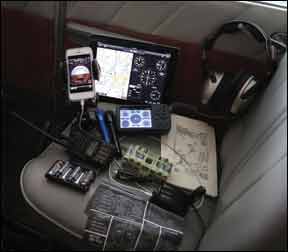
One thing we should have learned during our primary training is to always have an “out” or backup plan for when things don’t go according to plan. On any given flight, I typically have a smart phone with various aviation apps, an iPad with even more, a mounted Garmin 396 and a handheld radio. I would say most pilots have at least one, if not several of the above. Most of the time, everything in the panel works well and I can fumble my way to the destination without too much assistance from the portable devices surrounding me.But every now and then, we need a little “help.” The need can stem from a failed vacuum/pressure system and unreliable gyros, a total or partial electrical failure or simply a single instrument giving erroneous indications. Without going into too many specifics about hardware, brands and apps, let’s step through what it takes for an appropriate portable or handheld device to be a functional backup in your time of need, something I call “gadget flight rules,” or GFR.

Read More »
Pilot in aircraft
Sign-up for newsletters & special offers!

Get the latest stories & special offers delivered directly to your inbox.

SUBSCRIBE