










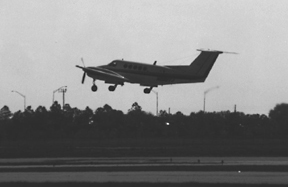
Engine Out on Takeoff
An engine failure on takeoff will take you by surprise, so be spring-loaded for action.

An engine failure on takeoff will take you by surprise, so be spring-loaded for action.
Historically, more incidents and accidents occur during the landing phase of flight than any other time. A look at the numbers shows pilots do a notoriously lousy job of ending their flights.
Overruns, landing short, loss of control on the runway, bounces that collapse landing gear, porpoises that bend firewalls, the list of woes goes on and on. This record points to the importance of increasing landing skills and building your pride in being a proficient pilot.
Although the concept of a stabilized landing approach has been around for 10 or 12 years, how many pilots actually use one? Seldom do I see anyone on a flight review, or checkout who uses the method.
Its often said that…
Remember that pilot personality self-survey, with the half-dozen psycho babble attitudes guaranteed to make a smoking hole? There was resigned, anti-authority, impulsive, macho and invulnerable.
We think a more accurate way to assess whether a pilot falls into one of these groups is to connect him to an EEG and see which button lights up following the words, Caution wake turbulence, departing 757.
Would your button be Resigned? Impulsive? Invulnerable? If you dont spend your spare time tearing up gyros for fun, the prospect of an uncommanded flight upset might make your blood run cold.
A better-than-average grasp of airmanship may cause you to understand that the instinct to p…
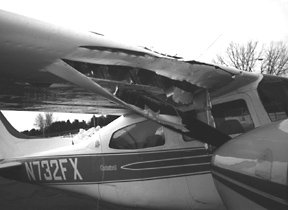
Driving the airplane to and from the runway is a piece of cake, right? Not for the dozens who prang something each year.
So there you are, sitting in your airplane, gazing dreamily at the new GPS, MFD, and autopilot on which youve just spent almost as much as you originally paid for the plane. Now youre faced with an IFR approach-certified GPS interconnected to a two-axis autopilot with ILS coupling and a moving map the size of a portable TV screen.
Maybe youre about to check out in a brand-new C-172 or Piper Archer with a whole pile of ultra-modern avionics, and all the FBOs other airplanes have a pair of Narco MK 12s or King KX-175s. You cant even find the on-off switch, much less tune the comm radio. How do you learn to use all that stuff?
If its your airplane, you might call your friendly loca…
Some tailwheel pilots believe there are two kinds of landings: wheel and three-point (also called full-stall landing, even though most pilots make them above stalling speed). But just as you dont see airshow pilots wheeling their high-performance mounts onto the runway, you dont see Ford Trimotors touching down on all three simultaneously.
For some taildraggers, theres only one kind of landing. Unfortunately, which kind of landing that is depends on both the pilot and the airplane, but more on the airplane.
The key to understanding tailwheel dynamics is to recall that the center of the airplanes gravity resides behind the main landing gear. This means that when the aircraft is dece…
[IMGCAP(1)]The key for all landings is the pilots ability to estimate how the airplane will descend to its landing. This ability directly affects the timing of configuration and power changes and the amount of maneuvering that might be necessary to arrive at a suitable touchdown point. The pilot needs to be able to maintain the correct glide angle while maneuvering the airplane.
The most important ability – and it comes easier for pilots with glider flight experience – is the ability to estimate the gliding angle and what distance can be picked up with it. All pilots should be able to do a pretty good job of estimating where their airplane is going to land, knowing the normal glide ang…
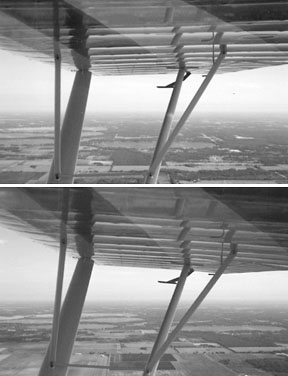
[IMGCAP(1)]In singles and even light twins in some circumstances, an engine failure means the airplane is going down. The pilots job at that point is to pick the best spot to land and properly execute the forced landing.
Sounds simple, but its a procedure that pilots routinely botch, either because their skills are so rusty or because they dont know the right way to make a forced landing.
Glider pilots are sometimes smug about their ability to land without power, but in fact, an airplane with a windmilling prop is markedly different from a glider. For one thing, the lift/drag ratio is about three times higher in gliders than in powered airplanes. An airplane cant gain altitude in…
Buzzing and hot-dogging are the leading spin scenarios, often by highly qualified pilots who ought to know better.
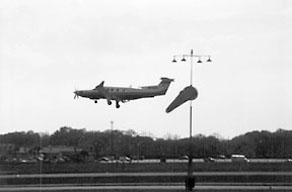
[IMGCAP(1)]One of the most basic tenets in aviation is that an airplane ought to take off and land into the wind. Yet each year the accident statistics show that some pilots refuse to follow this basic rule. And each year the tailwind factor results in bent aluminum, injured passengers, or worse.
Right off well acknowledge that there are occasions when a downwind departure is necessary. For example it is quite common due to ATC traffic flow and airport congestion at large terminals such as JFK, LaGuardia, Teterboro or Washingtons Reagan National. Then there are airports such as Aspen, Colo., with a mandatory downhill departure on runway 33 – often with tailwinds – due to surrounding t…

Get the latest stories & special offers delivered directly to your inbox.
SUBSCRIBE