













Airspeed And Ground Reference Maneuvers

The idea is to adjust your bank angle to compensate for changing groundspeeds, which depend on your airspeed.  

This file contains chapter 4, 5, and 6 of the handbook.
Gemini Sparkle

Key Takeaways:

  • Airspeed is a multifaceted and often confusing concept in aviation, encompassing different types like Indicated, True, Calibrated, and Groundspeed, each with distinct applications and relationships.
  • While Indicated Airspeed (IAS) for critical operations like takeoff and landing remains constant regardless of density altitude, True Airspeed (TAS) and Groundspeed (GS) are significantly affected by atmospheric conditions and wind.
  • Ground reference maneuvers, such as "Turns Around a Point" and "On-Pylon 8s," are essential practical exercises that teach pilots to dynamically manage bank angle, altitude, and aircraft control in response to varying groundspeeds and wind conditions.
See a mistake? Contact us.

Many flight instructors dread airspeed. Don’t get me wrong; We like having the right airspeed on approach, but airspeed is a hard concept to teach. It’s hard to teach because it’s actually a handful of concepts. Even experienced pilots get confused about airspeed and the different types. Knowing which airspeed concept to apply and when can simplify a lot of the mysteries of flying. And for some operations, we adjust airspeed to obtain the desired groundspeed. Confused yet?

Students working toward a private pilot certificate do turns around a point; those working on a commercial certificate do on-pylon 8s. These maneuvers sharpen stick-and-rudder skills, and they illustrate the different concepts of airspeed in ways that you can see in action. Let’s review.


Airspeed Concepts

The most meaningful speed we need to learn isn’t indicated airspeed, it’s true airspeed (TAS), which determines how much lift the wing produces. That said, the most popular speed probably is groundspeed (GS), which is what we’re most concerned with when trying to go somewhere. Groundspeed determines how long a flight will take, which determines how much fuel we will burn.

Indicated airspeed (IAS), meanwhile, is the value presented by the airspeed indicator. It’s what we use in our everyday flying, and tells us how close or how far we are from obtaining the performance we want. The least-discussed airspeed is calibrated airspeed (CAS). It’s what the airspeed indicator is supposed to tell us, but typically can’t do so precisely, thanks to instrument errors. It’s usually (but not always) close to IAS.

Primary students learn that GS is TAS corrected for wind, while TAS is CAS corrected for air density. As mentioned, CAS is IAS corrected for instrument errors, like pitot tube placement. Got all that?

I think it’s more informative to consider IAS as TAS corrected for air density. To see this, remember that the biggest proportion of the atmosphere is nitrogen molecules, followed by oxygen. Think of all these nitrogen and oxygen molecules as little Nerf balls. Now, imagine a wing moving at a moderate angle of attack. When the air density is low, i.e., we’re high, hot or both, fewer Nerf balls hit the wing’s bottom surface, so there is less Newtonian lift at that true airspeed. At the same time, fewer little Nerf balls work their way into the pitot tube, so the airspeed needle doesn’t get pushed as far around. The effects on the wing and the pitot tube match. 

One of the takeaways is that, according to every POH on this or any other planet, takeoff and landing speeds use the exact same IAS at every density altitude. The speed changes as the airplane gets heavier—it needs more lift, hence more TAS, which is controlled by IAS—but the density altitude makes no difference.

For example, the recommended final approach speed in a Cessna 172N Skyhawk at maximum gross weight (the only weight in the table) is 60 KIAS, whether you’re at sea level on a cold day in Newport, Oregon, or on a hot day at 9070 feet in Telluride, Colo. Similarly, the final approach speed in a King Air B200 at 12,000 pounds is 102 KIAS whether you’re at sea level on a cold day in Newport or on a hot day at Telluride.

That won’t feel right, because while the TAS at sea level is the same CAS, at 9000 feet density altitude the King Air’s 102 KIAS approach speed is a TAS of 124 knots. The 172’s 60 KIAS approach speed is 73 KTAS. You’re going a lot faster in Telluride, even though the airspeed indicator’s needle points to the same place.

More Corrections

Could there possibly be any more corrections? Unfortunately, yes.

One that you’re less likely to run into these days is in an airplane with two discrete pitot-static systems. The systems can have different errors. Usually the captain’s system has priority, so when the right-seater is the pilot flying, the crew has to compare the different indications and decide on a correction.

Even if the systems agree, the airspeed indicators can be different designs, so while one points to three o’clock at approach speed, the other points to three-thirty. Look at the numbers. (When I fly something with two sets of instruments, I compare the two airspeed indicators before takeoff. That way I know what to do if my airspeed indicator fails.)

What about gust correction? That’s an adjustment, not a correction. If you decide to add five knots, just fly five knots faster on the airspeed indicator. Easy, peasy, right?

What does all this have to do with ground reference maneuvers?

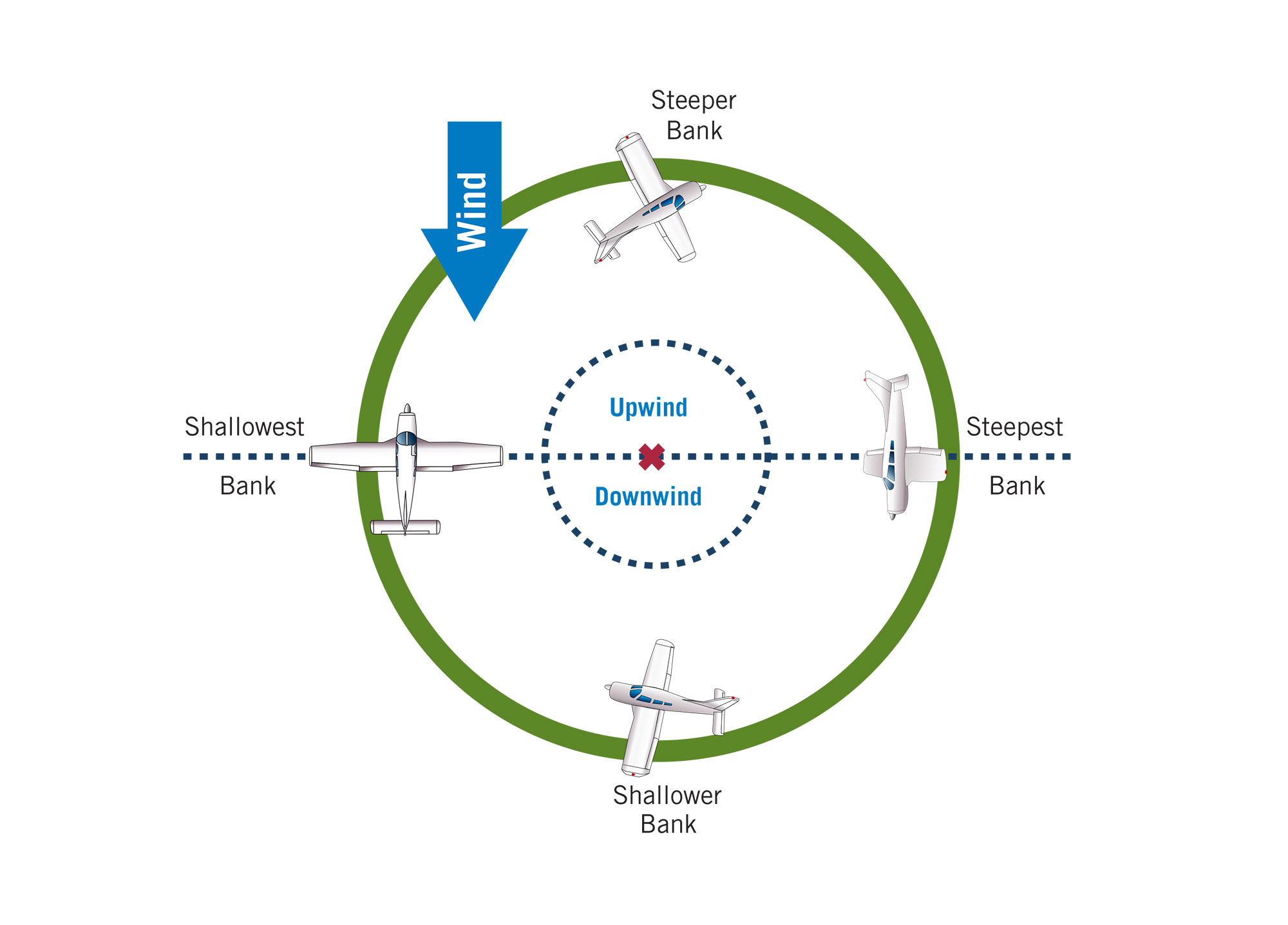
Turns around a point is an entry-level ground-reference maneuver flown at a constant altitude. Its objective is to fly a constant radius around the chosen reference point, correcting for changes in groundspeed by varying the bank angle and thus the rate of turn. Higher groundspeeds are experienced when flying downwind, where the bank angle is steepest. Of course, when flying into the wind, groundspeed is lowest and the bank angle should be shallowed. Aileron and rudder coordination is required throughout the maneuver.

One of the keys is to choose an optimum altitude. Another is establishing an appropriate distance from the reference point. As such, it may take a few tries to nail down these variables and perform the maneuver.

Errors include failure to keep the reference point in sight at all times. If the wing blocks it, a change in altitude and/or bank angle may be required. — J.B.

Turns Around A Point

Ground reference maneuvers like turns around a point bring groundspeed into play. The idea, as you’ll recall, is to stay the same distance away from some object on the ground while doing 360-degree turns around it. This is when you need to think about groundspeed. 

The maneuver is flown at a constant altitude and IAS, hence at constant TAS. When flying downwind, the groundspeed is higher, so you need a steeper bank angle to get the same turn radius. When flying into the wind, the groundspeed is lower, so you need a shallower bank angle to get the job done. In a strong wind, you might even fly nearly wings-level for a short segment.

It’s a good training exercise because it combines so many important skills: control coordination, division of attention between cockpit and ground, and smooth roll control. But it’s good for experienced pilots, too, because it presents every possible wind-correction scenario in the traffic pattern. It can also help train us to survive so-called moose turns.

A side note: To determine the wind at altitude, pick a landmark on the ground. As you fly directly over it, enter a 360-degree turn—fly a full circle—at constant altitude, airspeed and bank angle. If there’s no wind, you’ll go right over the landmark. The difference between the landmark and where the plane ends up at the completion of the circle is due to the wind. That’s what you need to compensate for while performing this and other ground-reference maneuvers.

Eights on pylons is probably the most difficult ground-reference maneuver in the FAA’s checkride bag of tricks. In addition to constantly changing the bank angle, altitude also must be varied. Like the other maneuvers, the idea is to pivot the airplane around the selected reference points (pylons). As the Airplane Flying Handbook (FAA-H-8083-3C) puts it, “In other words, if a taut string extended from the pilot’s eyes to the pylon, the string would remain parallel to [the] lateral axis as the airplane makes a turn around the pylon.”

The AFH also notes, “The pivotal altitude is the altitude at which, for a given groundspeed, the projection of the visual reference line to the pylon appears to pivot.” The sidebar on the following page reproduces a table from the AFH providing the pivotal altitudes at various groundspeeds (not airspeeds!). — J.B.

On-Pylon 8s

On-pylon 8s bring groundspeed into play more delicately. The pilot picks two pylons—points on the ground—and flies a figure-eight pattern around them. During the turning portions of the maneuver, the wingtip is supposed to stay pointed at the pylons. “Visually, a taut string, if extended from the pilot’s eyes to the pylon, would remain parallel to [the] lateral axis as the airplane makes a turn around the pylon,” says the Airplane Flying Handbook (FAA-H-8083-3C). The delicate part is that the right altitude depends on the groundspeed. This is called the pivotal altitude. (Its derivation is a neat piece of work, combining basic geometry, aerodynamics and physics, but it’s too complicated to present here.) The result is that the pivotal altitude is the square of the groundspeed (in knots), divided by 11.3. But that’s too much math, so the FAA helpfully did it for us and put the results in the AFH. We reproduced that table below.

I had a student once who tried to do ground-reference maneuvers by looking at GPS groundspeed instead of at the actual ground. It was an innovative use of technology, but it didn’t work, at least as they tried to implement it. Some claim that this maneuver was developed during World War I. How did they do it 100 years ago?

One of the tricks here is to notice the relative position of the wingtip and the pylon. If the wingtip is ahead of the pylon, you’re going too fast, so raise the nose. Do the opposite if the wingtip is behind.

Screenshot

Putting It Together

Here’s a delicate part. If you’re smooth, the IAS decreases immediately when you raise the nose to climb. The TAS decreases, too, but the GS goes who knows where depending on the relative wind. So you need to keep your eyes open, your feet happy and fly gently.

You may never use these skills again in the real world after the checkride, but if you do, managing airspeed and groundspeed will be key.

Ready to Sell Your Aircraft?

List your airplane on AircraftForSale.com and reach qualified buyers.

List Your Aircraft
AircraftForSale Logo | FLYING Logo
Pilot in aircraft
Sign-up for newsletters & special offers!

Get the latest stories & special offers delivered directly to your inbox.

SUBSCRIBE