












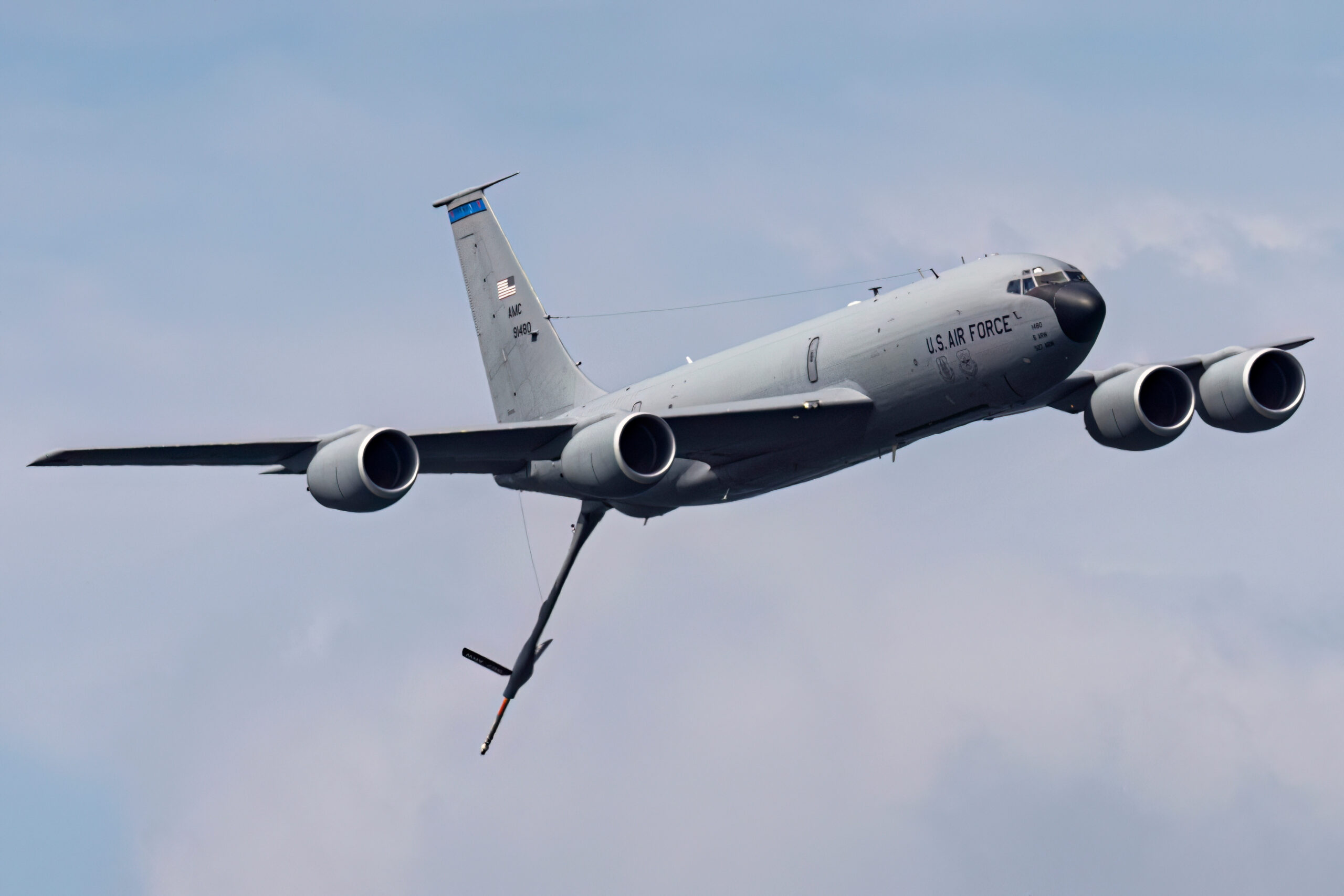


The U.S. Air Force is enlisting the private sector to help devise a blueprint for automating military aircraft.
Merlin Labs—the developer of a platform-agnostic, “takeoff-to-touchdown” aircraft autonomy system—on Wednesday deepened its relationship with the Air Force, which has contracted it to explore the automation of its entire tanker fleet. Under a new agreement, Merlin will lend its expertise to the Air Force’s development of an autonomy government reference architecture (A-GRA)—essentially, a blueprint for automating any military platform.

“This [agreement] will help us build on a common, government-owned architecture for autonomous systems, ensuring interoperability, accelerating innovation, and ultimately, delivering resilient and adaptable capabilities to our warfighters,” said Major Dustin Graves, a program manager for the Air Force Research Laboratory’s AFWERX innovation unit, in a statement.
Air Force Architecture
The Center for Strategic and International Studies describes the A-GRA as a government source that “guide[s] the system design, development, production, and sustainment processes” for autonomy. Basically, it gives the commercial industry a framework to build autonomy systems that are compatible with Air Force platforms and missions.
Through A-GRA, the Air Force can specify which portions of the software architecture are flight-certified and largely unchanged. That way, developers can “plug and play” these systems without jeopardizing the certification of the aircraft itself.
The Air Force in July tapped another autonomy provider, Reliable Robotics, to help it refine the A-GRA. The following month, it purchased the company’s Reliable Autonomy System, which Reliable said will soon be sent on real-world, overseas deployments in the Pacific.
Similarly, Merlin is a logical partner in the effort given its existing relationship with the Air Force. In December, for instance, it landed a 19-month, undisclosed value contract to retrofit Air Force tankers such as the KC-135. The goal is to enable extended crew missions—such as 40-plus-hour flights—and, eventually, fully uncrewed operations.
Merlin in 2024 began testing autonomous controls on the KC-135. Working with GE Aerospace, it aims to integrate an autonomy and pilot-assist platform on the model through the Air Force’s KC-135 Center Console Refresh (CCR) effort. It is also the prime contractor with U.S. Special Operations Command for integrating autonomy on the C-130J Super Hercules.
Adaptable Autonomy
Merlin said its work on the A-GRA will focus on allowing aircraft to respond to unexpected events, system failures, or mission modifications. It will lend its “autonomy architecture, human-machine teaming, and advanced mission software” capabilities to “improve mission assurance, reduce operator workload, and create greater survivability,” the company said.
Specifically, the partners will study autonomous fault detection, recovery, and mission adaptation. The idea is for these capabilities to be common across military aircraft.
“We can align Merlin’s expertise with the USAF’s operational priorities, helping to define autonomy standards that strengthen the entire defense ecosystem,” said Chris Gentile, Merlin’s general manager for tactical autonomy. “This partnership reflects our shared commitment to advancing capabilities that allow collaborative air platforms to operate safely, adapt in real-time, and complete missions even in the most challenging conditions.”
Gentile notably alluded to “collaborative” platforms, such as the Army’s Collaborative Combat Aircraft (CCA). The military envisions fighter jet pilots deploying and orchestrating fleets of smaller, uncrewed CCA aircraft as “loyal wingmen.” Companies such as Boeing and Whisper Aero, meanwhile, are developing uncrewed cargo variants that they bill as Collaborative Logistics Aircraft (CLA) or Rotorcraft (CLR).
Reliable CEO Robert Rose implied in July that its work on the A-GRA will also support autonomous collaborative aircraft. Rather than build or procure autonomous drones, then, the Air Force could retrofit the portions of its flight-proven fleet that see the most downtime, repurposing them as autonomous wingmen.
Before that happens, though, the Air Force will need to prove that its architecture can handle whatever researchers throw at it. The hope is that Merlin’s expertise can accelerate that work.
“Contingency management is essential to achieving the Air Force’s vision of trusted, resilient autonomy,” said Gentile.

