













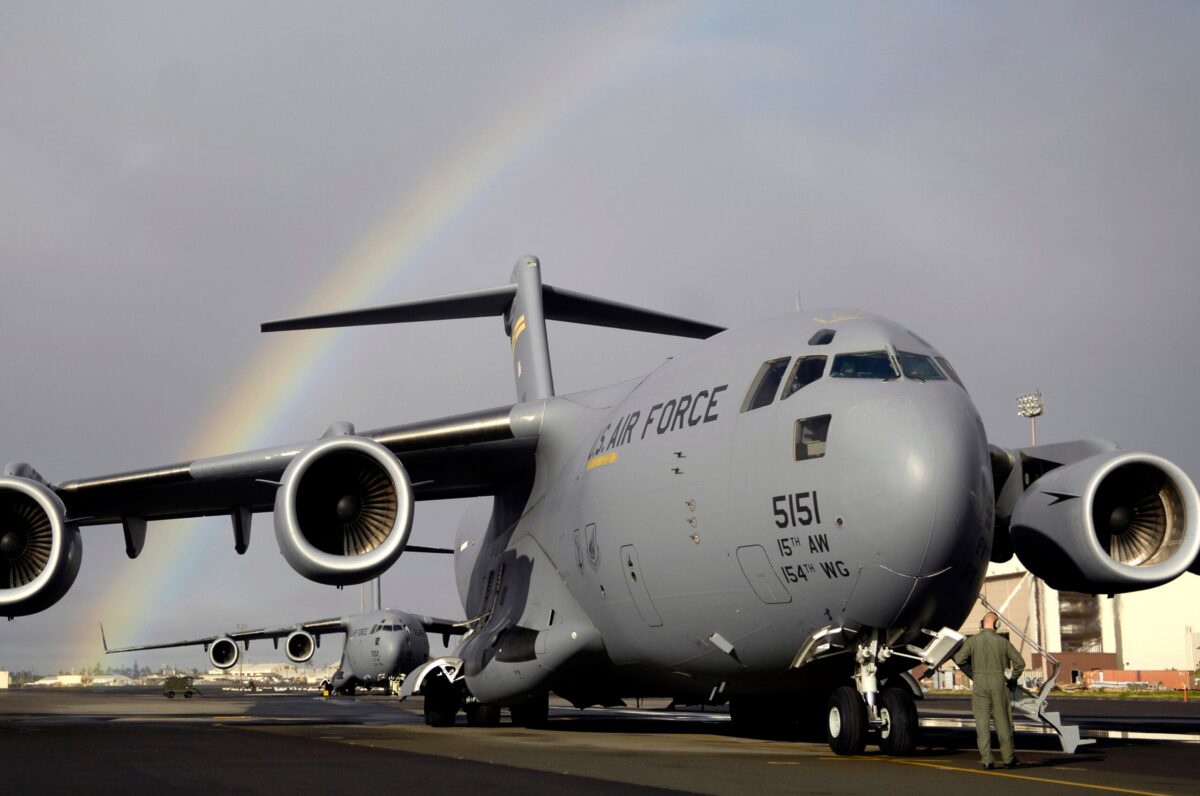


The U.S. Air Force says it could have a next-generation military transport aircraft in service as soon as fiscal year 2041, but it still wants its two main workhorses, the Boeing C-17 Globemaster III and the Lockheed C-5 Galaxy, up and running for decades to come.
If the acquisition process moves smoothly with no breaks in funding, the planned new aircraft, known by the military as the Next Generation Airlift (NGAL), could be in production by fiscal year 2038, with initial operational capability reached about three years later, according to a recent Air Mobility Command (AMC) memo. As the NGAL is phased in, however, the C-17 and the C-5 will have to continue flying missions.

“To mitigate risks associated with acquisition delays, funding uncertainties, or technological challenges, the existing C-5M and C-17A fleets’ operational viability must be maintained until a fully capable replacement is fielded, which may require extending the service life and associated Military Type Certificate (MTC) of each platform,” the AMC memo states.
The C-5 would have to remain viable until at least 2045, while the C-17 would keep flying until 2075. By that time, the C-17 will have been in service for 80 years, though the individual aircraft flying missions will likely be younger.

The AMC memo was first reported on by military news website The War Zone.
The Air Force expects the NGAL to eventually replace the entire C-17 and C-5 fleets.
“One NGAL aircraft will replace one C-5M aircraft until the entire C-5M fleet is retired,” the memo states. “Then, the C-17A fleet will be replaced by NGAL at a one-for-one swap.”
C-5 production ended in 1989, while C-17 production ceased in 2015.
A key analysis-of-alternatives study for the NGAL is set to take place in fiscal year 2027. Air Force officials have released few details about the planned aircraft, though they have said any future design will prioritize speed, agility, and the ability to navigate a heightened threat environment.


