













Register

Adverse Yaw

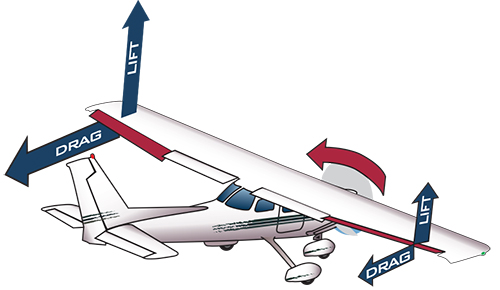
Adverse yaw occurs when baking. Deflecting the left aileron downward in a right bank, changes the left wing's camber, increasing lift to raise the wing. Drag also increases, since its production is proportional to lift. In this instance, as the airplane begins banking to the right, thanks in part to the upward-deflected right aileron, the nose yaws away from the turn due to increased drag.
Gemini Sparkle

Key Takeaways:

  • Adverse yaw is an aerodynamic phenomenon where an aircraft's nose yaws opposite the intended turn direction, caused by increased induced drag on the outside wing, requiring proactive rudder input for coordinated flight.
  • Its effects are more pronounced at lower airspeeds (due to greater aileron deflection) and with longer wingspans, demanding more significant rudder input to counter.
  • Aircraft designers mitigate adverse yaw through innovations like differential and Frise ailerons, which strategically alter drag distribution to balance yaw forces, though it often still interacts with other aerodynamic forces during complex maneuvers.
See a mistake? Contact us.

If you spend much time around old-time pilots, you’ll eventually get around to one of them going off on a rant about how the kids today don’t know what the rudder pedals are for. From their perspective, they’re right. A lot of the airplanes the old-timers grew up with had squirrelly aerodynamics, exemplified by the characteristic known today—probably then, too—as adverse yaw. The FAA defines adverse yaw as a “condition of flight in which the nose of an airplane tends to yaw toward the outside of the turn. This is caused by the higher induced drag on the outside wing, which is also producing more lift. Induced drag is a by-product of the lift associated with the outside wing.” The graphic below explores the behavior exhibited in a right bank.

If we’re doing it right, we use inside rudder to counter the yawing tendency by keeping the ball centered, minimizing any unpleasant sensations and ensuring the airplane is pointed in the direction we want, not what the physics laws force upon us. In part, it is the younger pilots’ failure to understand adverse yaw when banking and proactively address it with appropriate, coordinated rudder input that has the old-timers shaking their heads. They’re not wrong, although newer airplanes are engineered to minimize adverse yaw, so it’s not as noticeable or objectionable. But there’s more.


Ready to Sell Your Aircraft?

List your airplane on AircraftForSale.com and reach qualified buyers.

List Your Aircraft
AircraftForSale Logo | FLYING Logo
Pilot in aircraft
Sign-up for newsletters & special offers!

Get the latest stories & special offers delivered directly to your inbox.

SUBSCRIBE