
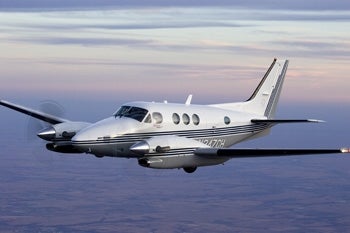


The Beech King Airs owe four decades of success to having the best mix of cabin comfort, performance, excellent flying qualities and famous reliability. The new C90GT keeps the comfort and wonderful flying feel that pilots love and deliversa lot more performance. It can’t catch the light jets, but it has dented their speed advantage without giving up cabin and cockpit room and comfort. The C90GT airframe is the same basic size as the original King Air with four to five passenger seats and the roomy squared-oval cabin shape. What makes it a “GT” are new Pratt & Whitney PT6 engines, and new four-blade propellers, that increase cruise speed by at least 25 knots and improve climb rates by as much as 50 percent at higher altitudes, all without shortening range on the same amount of fuel. The C90GT formula isn’t magic. In fact, there are field modifications that exchange the original for more powerful engines on existing King Airs. But the GT is a new airplane, not just new engines. The PT6A-135A engines on the GT are rated at 550 shaft horsepower just like the Dash 21 engines they replace. But the new Pratts are really 750-shp engines that have been restricted to the lower maximum output for takeoff. That means as the GT climbs, the new engines can keep putting out full-rated horsepower to a much higher altitude. The earlier King Air 90s hit max speed at about 16,000 feet, but the C90GT hits its stride at 25,000 feet, or higher.
I got to fly the first C90GT and the climb performance was unlike a regular King Air 90. It was the prototype and lacked a complete interior, but our takeoff weight was just 600 pounds under maximum with full fuel and some other equipment onboard. Immediately after takeoff the C90GT climbed steadily at 2,200 fpm and held near that rate up to 15,000 feet, and then maintained an 1,800 to 2,000 fpm climb through 18,000 feet. We were still going up at 1,500 fpm when I leveled at 25,000 feet just 15 minutes after takeoff, with that time including a brief leveloff. That’s an easy seven or more minutes less time to climb than the previous model.