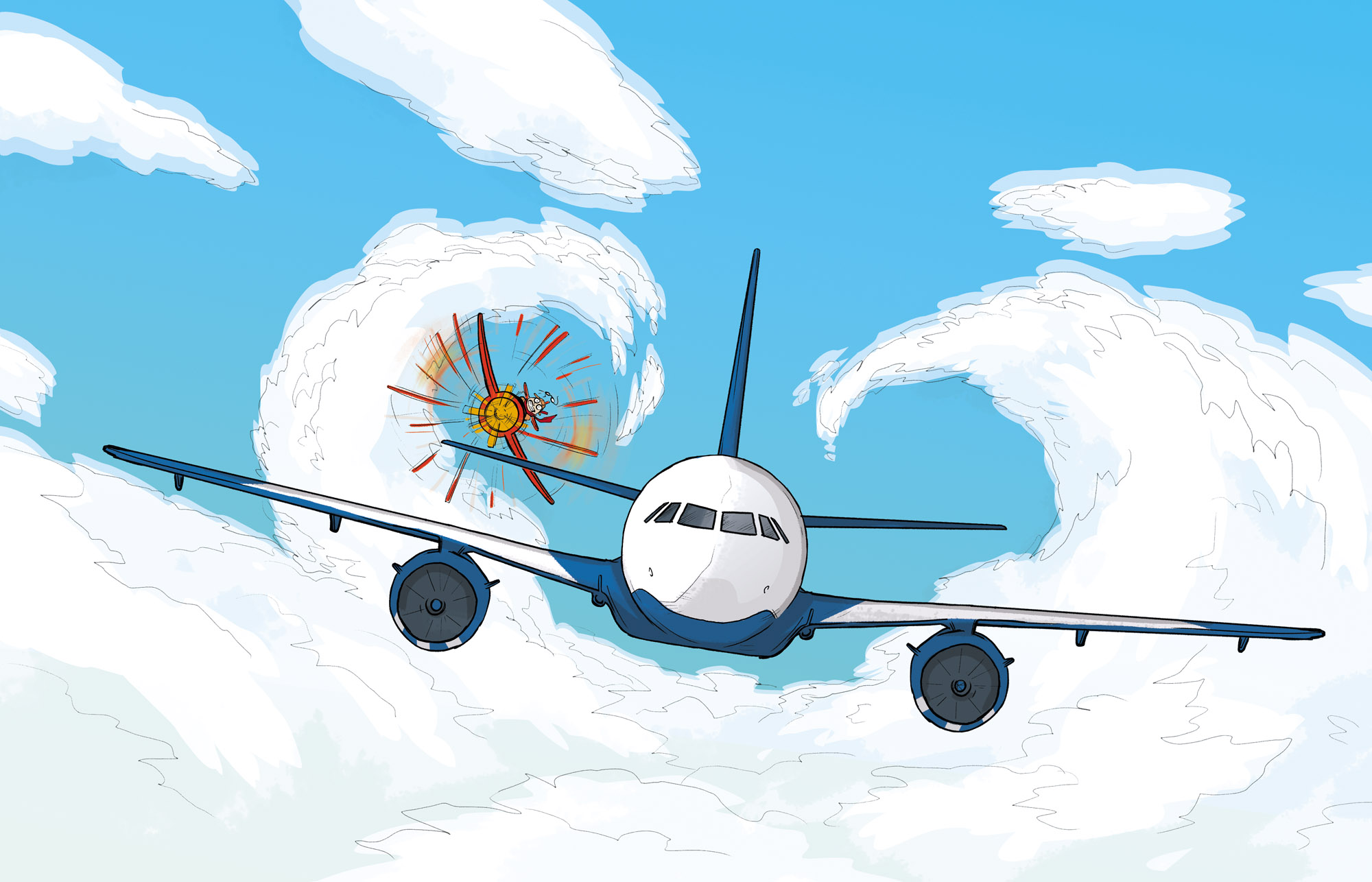
Art by Ben Bishop
Like most things in aviation, prescribed clearance behind a heavier aircraft to avoid the dangers of wake turbulence is mandated. In this case, it’s guidance for air traffic controllers operating in a terminal environment. These guidelines are designed to minimize the likelihood of mishaps both on takeoff and on landing.
Definitions
As pilots are taught in primary training, wake turbulence is created by wingtip vortices when an airplane generates lift. A wake is more pronounced when the aircraft is heavy and slow. Operating behind, you should stay slightly above and upwind of the path of the preceding “heavier than you” airplane.
On departure from a towered airport, ATC might have you wait a bit for wake turbulence behind a heavier aircraft. You should rotate before the preceding aircraft rotated and make a slight turn upwind to avoid the wake.
As noted above, the heavier (and slower) an aircraft, the greater its wake. Consequently, for wake-turbulence purposes, aircraft are divided into weight classes. These are defined as 0-41,000 pounds for small, 41,001-299,999 for large, and 300,000-plus for heavy. A short time ago, 12,500 to 41,000 fell under “small plus” which still requires wake considerations in some places, but is under a new category system called RECAT. Then, the AN-225 (when they rebuilt her) and the Airbus 388 are considered “Super.”
All controllers have some point of reference to use weight classes for wake turbulence, starting on the ground all the way until the aircraft is on approach. These definitions are also in the AIM, 7-4-9, and in the point 65, 5-5-4, and weight classes in the Pilot Controller Glossary under “Aircraft Classes.” Also reference the 7110.126A Appendix A for all the newer categories.
Let’s briefly touch on aircraft categories based partially on weight. I covered this awhile back, but to recap: Aircraft are split into three categories. Category I covers small, single−engine propeller-driven aircraft weighing 12,500 pounds or less, and all helicopters. Category II includes small twin−engine propeller-driven aircraft weighing 12,500 pounds or less. Category III covers all other aircraft. The main reason I mention these are to reflect that Category I and Category II are both considered small aircraft by definition; “less than 12,500 lbs.” Category III is anything, even still a small. There may be a little confusion on “Airplane Categories” and “Weight Classes,” so I wanted to clear any confusion early.
Wake Requirements
If you’ve been a reader since January 2021, I briefly touched on Wake Turbulence in the “ATC Versus Pilot Regs” article, but we’ll go more into it now. While pilots’ responsibility here is to know what wake turbulence is and how to avoid it, our ATC responsibility goes a bit more in depth. As mentioned, every aircraft operating has what we call a “category and weight class.” It’s a definition that sets the standard for how much spacing/separation we need between any given two airplanes. The category is more for runway separation, but the weight classes tie more into wake turbulence. With enough wake-turbulence separation, we indirectly don’t have to worry about runway separation—we wouldn’t land a heavy C17, then have a 172 on short final right behind him, VFR or not. As you’ve all heard before, legal isn’t necessarily safe and might not be a good idea. Yup, good controllers also have to balance legal with safe.
As I teach my trainees, let’s start the whole wake discussion from the runway and work our way out. (All the separations I’ll cite are for wake turbulence unless otherwise stated.) One of the most basic separations we are required to provide is departure/departure (7110.65: 3-9-6, 3-9-7). The most basic form is same runway, same direction, same departure point.
Let’s use a Boeing 747 (heavy), C-130 (large), and a Cessna 172 (small) for these examples. Let’s say a B-747 rolls and either a C-130 or the C-172 wants to go next. ATC will impose a two- minute delay that cannot be waived. ATC will not clear a separate aircraft for takeoff behind a heavy at the same departure point, until two minutes has past (or three behind a super). Now let’s switch it up a tad and consider intersection takeoffs. If a C-130 takes off full length and a 172 wants to go at an intersection, the delay is three minutes, but that can be waived.
Let’s pause to make something very clear: I am in no way pushing pilots to waive wake turbulence. I’m merely saying that they can waive it. That decision should only be done by a competent PIC who has the knowledge of wake turbulence and the skill required to avoid it. A great example of this is a C-130 that is at max weight, it’s a hot day, and the C-130 takes 5000 feet to rotate. The intersection where a 172 wants to depart is 4000 feet behind where the C-130 rotated. Even a C-172 can avoid that wake with ease. Again, this is to be used safely and not if you have “get-there-itis.”
Any other intersection on the same runway or opposite direction is going to require a three-minute waiverable wait. But replace that C-130 with a B-747 and no separation can be waived—it’s two minutes from same departure point, three anywhere else on that runway or a parallel runway separated by less than 2500 feet or intersecting if paths will cross, and up to four minutes if a super departs first.
One last note I’ll add to this, then we move forward. Remember when I mentioned small plus? Those definitions changed, but we still remember small plus by an aircraft that is more than 12,500 up to and including 41,000 lbs. The Point 65 section 3-9-7 states that if we have a small departing from an intersection behind a small plus, the three minutes still stands.
Arrivals
Now let’s talk about arrivals. From a VFR tower perspective, we don’t have any time or distance requirements if the preceding aircraft is VFR (regardless of whether the following aircraft is VFR or IFR). Now does that mean we would put a 172 right behind a B-747? No, of course not. Legal doesn’t always mean safe, right? In that case, the C172 would need to have the 747 in sight (so they can see the path and avoid it).
Now if the following aircraft is IFR, we as VFR tower controllers still have to abide by 5-5-4 and provide IFR wake-turbulence separation. Under section g, we would need four miles if a 172 is following a C-130, and six miles if a 172 is following a 747; all by the time the preceding aircraft crosses the landing threshold. In the Air Force I saw this the most, having F-22’s turn base in front of MU-2’s on instrument approaches. Keywords in that section are “ensuring the following minima will exist at the time the preceding aircraft is over the landing threshold.”
The interpretation on this varies, but this means I could turn a large or heavy in front of an IFR 172 not having that distance initially, but having it by the threshold. In my example, an F-22 can get to the threshold pretty quickly, we would have no problem getting our four miles if an F-22 turned based by the time the MU-2 was at around six-mile final. In the civilian world, I rarely see this, but it’s still a rule that applies. If I were to have a VFR bizjet to the field and an IFR 172 on final, it might not be the best idea to try and fit him in. But, as long as I can get my four miles, I’m okay.
Now what happens when you tie arrivals together with departures? A while ago there was much debate on this topic, as any arrival that is not a full stop—like a low approach or touch and go/stop and go—is considered a departure after crossing the threshold, and is also considered an intersection departure. I should go back to departure separation for intersection departures, right? Well … not exactly.
In the 7110.65, section 3-9-7, b. 3 is our pass on that. “Successive touch-and-go or stop-and-go operations are conducted with any aircraft following an aircraft in the pattern that requires wake turbulence separation, or an aircraft departing the same runway that requires wake turbulence separation in accordance with subparagraphs a1, a2, a3, or a4 (except for super aircraft), provided the pilot is maintaining visual separation/spacing behind the preceding aircraft. Issue a wake turbulence cautionary advisory and the position of the larger aircraft.” I added the emphasis.
This means that if a 172 is conducting a touch and go behind a C-130, I don’t need any time so long as the 172 has the C-130 in sight and can maintain its own visual separation. “Maintain visual, caution wake turbulence, Runway xx, cleared for the option.”
Again, common sense should prevail in this as well. If a controller put me in a 172 behind a heavy doing touch and goes, I’d make a 360 or two. The key there is “touch and goes.” If the heavy is full stop, none of this applies because wake turbulence stops when the preceding large or heavy aircraft is on the ground and no longer generating lift. But with a touch and go, the wings do not stop generating lift, and thus wake turbulence.
Caution Wake Turbulence
Obviously, you don’t need to memorize these rules. But, I want to make sure you know they exist and how they’re applied. Regardless of what ATC wake minimums are for a situation, the PIC is ultimately responsible for the safe operation of that aircraft. So, if a pilot wants more spacing in trail or wants to wait a little longer on the ground, let the controller know what you need. ATC should not rush you to get behind unstable air, but in a busy environment, we sometimes need the reminder. Only accept what you’re comfortable with, even if it means waiting an extra minute … or two … or three …
Elim Hawkins, a tower controller at a busy GA airport, treats wake turbulence like smoking: He stays as far away as possible from it.