













George Doesn’t know

No, we’re not going to beat you up for relying on your GPS. Instead, our concern is overreliance on your autopilot. But not for reasons you might think.

Gemini Sparkle

Key Takeaways:

  • Over-reliance on modern autopilots leads to a critical decline in pilot "anticipation" skills, causing them to be reactive and fall "behind the airplane" during flight.
  • To combat this, pilots should adopt "implementation intentions" – a self-talk method involving systematically planning and verbalizing specific actions for future situations (e.g., "When X happens, I will do Y").
  • This proactive mental engagement builds essential habits, reduces workload and stress, and enhances overall proficiency and safety across all flight phases, particularly complex ones like approaches and missed approaches.
See a mistake? Contact us.

Relax. This isn’t another “children of the magenta” rant. It’ll be something a little different. I absolutely love GPS, modern glass, and modern autopilots! Give me a modern autopilot capable of descending via a STAR that terminates at an approach transition, then flying the IAP to minimums, as well as the missed with me doing little more than hitting buttons, monitoring progress, and managing power, flaps and gear. Yeah baby!

But, as a CFII doing avionics transitions, IFR checkouts, IPCs, and recurrent IFR training, I’m seeing a consistent issue among pilots who “let George do it” too much. It’s so pervasive that I have been hearing from DPEs that they are getting instrument rating applicants who are already autopilot dependent and show the same symptoms.


What Do We Lose?

In hangar discussions about too much autopilot use, both online and in person, most comments surround loss of attitude instrument flying skills—the basic building block of instrument flight. Interestingly, that’s not what I see. Maybe there’s a little rust, but stick, rudder, and scan come back rather quickly, often within minutes. What I do see is much more insidious—the loss of anticipation. Rod Machado famously asked the question, “What are the two most important things in aviation?” His answer is, “the next two.”

So the learned skill of anticipation of what’s next, determining what to do there, and preparing for it, is the piece that goes missing. Staying ahead of the airplane is critical regardless of a glass panel or analog round dials. With a good autopilot, we program our navigators, arm the appropriate modes on our autopilots, and let George fly … often without remaining engaged.

FAA statistics consistently tell us the most common instrument flight deviation is busting altitude. Based on several enforcement actions on which I have consulted or even defended, a significant number are caused simply by preselecting the wrong altitude. We don’t always catch it before ATC prompts us with a friendly “say altitude” as we pass 300 feet above our assignment still at climb power. After all, why monitor the new altitude, count up or down to it, and watch for the beginning of the level-off when we “know” George will take care of it?

Oops. How’d you get so far above the glidepath? Forget something?

It happens in all phases of flight. We forget APR mode when cleared for the approach and miss the failure to capture the glideslope or glidepath until we have to scramble to catch up. We don’t clear the procedure turn that loaded along with the approach so the airplane turns outbound for the hold-in-lieu after we’re cleared straight in. How much we have to catch up depends on the phase of flight and what we are flying. Hopefully, we don’t hear the “possible pilot deviation” language of a Brasher warning. But we have placed ourselves where ATC does not want us to be. More important, we have placed ourselves where we don’t want to be—behind the airplane. The faster the airplane, the “behinder” we get.

Fortunately, most of the time things do go as expected. But not paying attention, not anticipating, becomes our normal and ultimately a habit. Habits are hard to break. And this habit makes itself very visible when we switch the autopilot off. The vertical guidance needle comes and goes while we maintain altitude. We fly right through final after hearing, “fly heading 060, maintain 3000 until established, cleared for the ILS Runway 3 approach.”

Yes, some part of it could be that we’ve lost enough scan to make maintaining current heading, course, and altitude challenging. That, in turn, distracts us from our job to anticipate and monitor. But isn’t that even more reason for us to fix it by creating better habits?

Implementation Intentions.

Psychology literature talks about “implementation intentions.” For those with a scholarly bent, the leading article on the subject is, “Implementation Intentions—Strong Effects of Simple Plans,” by Peter M. Gollwitzer, published in The American Psychologist in 1999. The theory discusses implementation intentions as a way of attaining goals. They are task rather than goal oriented—commitments to do specific things in specific situations in order to meet the overall goal. The form they generally take is a self-talk monologue. “If or when this situation arises, I will take these actions.”

A goal might be to lose 10 pounds. An implementation intention might be making a personal commitment like, “when I park at work, I will take the furthest spot from the building.” The idea is to use the power of self-talk to create triggers to action. We don’t arrive at work and then decide where to park. We’ve identified a stimulus, going to work, and chosen our response, parking far away. The studies indicate this increases the likelihood that we will do it without even thinking about it.

Application to Aviation

Although we don’t call it an implementation intention (too psychobabble sounding), neither self-talk nor the stimulus-response concept—what’s next and what to do when I get there—is a stranger to aviation. We might commit the “bold items” of an emergency checklist to memory, but repeated training has (hopefully) given us an immediate and almost unconscious “if I have an engine failure (in a single), I will pitch to best glide” response.

It’s not only about emergencies or instrument flight. Watch a student pilot fly a standard VFR traffic pattern. The pilot on downwind who is saying or thinking, “When I get abeam the touchdown point, I will…” is much smoother, less hurried, and ultimately more successful than the one whose internal dialog is “I’m abeam the touchdown point. Umm…OMG! What now?”

In instrument procedures, particularly on approach, many of us learned some variation of the Five Ts: Turn, Time, Twist, Throttle, Talk. Modern navigation may have made Time almost superfluous and Twist is far more complex than simply turning a course needle on an HSI or the omni bearing selector on a CDI. But implementation intention is the psychology behind it.

Machado, who happens to have a degree in psychology, devotes an entire chapter to “Self Talk Dialogues” in his Instrument Pilot’s Survival Guide. It’s all about (1) knowing what comes next and (2) being specific about what to do there. At a bare minimum, as soon as you’re stabilized on the now, move your brain to the next. The instrument students and pilots I fly with see a difference immediately, as do I. Many pilots feel rushed on approach where a truly proficient instrument pilot seems to have lots of extra time—in a faster airplane. The difference is knowing what comes next and previewing what to do when you get there.

Like most everything in instrument flight, it takes time to make it natural, but I’ve watched pilots who try the technique immediately relax and make fewer mistakes. Our brains really do want to know what to do next. If we don’t know in advance, it becomes an extra stressor or distraction. If we tell ourselves in advance, that stressor is gone. It even frees mental bandwidth when ATC throws us the inevitable curveball.

LNAV, VNAV, Config, Avionics

The details of what we do at any point depend on our aircraft, its equipment, and our procedures, but our internal dialog comes down to four broad elements: lateral, vertical, aircraft configuration, and avionics. Configuration includes everything from gear and flaps to power settings and checklist items. Avionics depends on what we are flying.

We can pull examples from every phase of flight and every segment of the approach, but let’s look at the missed approach. There are some numbers suggesting it’s a problem area. We don’t often fly them for real and when we practice them, it is usually expected. Some GPS units suspend automatic sequencing and many, although certainly not all, autopilots require disconnection at the MAP. Your autopilot may even prohibit reengagement until 800 feet AGL. Add that this heavy workload phase has two separate paths—continue or go around—and it’s a perfect candidate for advance preparation.

GLD RNAV (GPS) Runway 23

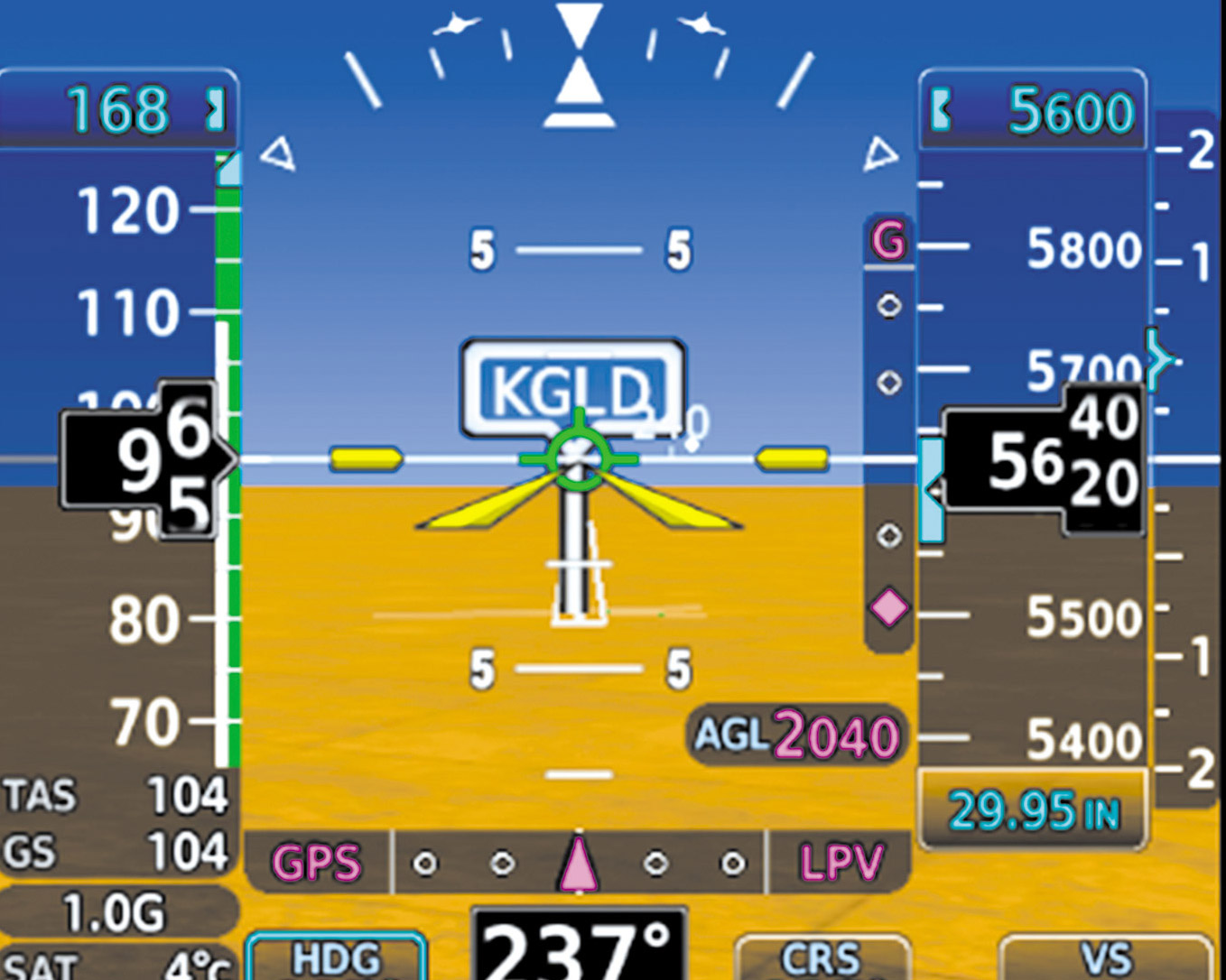
Look at the missed off the RNAV approach into Runway 23 at Renner Field in Goodland, Kansas (GLD). GEREY is our IAF. Our approach briefing shows us the straight ahead segment of the missed approach is short, only 300 feet above LPV minimums. At 4200 feet MSL, we turn left and continue the climb to 5600 feet back to HEGOR for the hold. Although the turn is a course and not a heading, we can see it is northeasterly, close to a reciprocal of the inbound course. A heading of about 050 degrees should get us safely on our way until we get positive course guidance.

The self-talk on the leg from GEREY to HEGOR is fairly simple. Depending on what I was flying, mine might be something like, “when I reach HEGOR, I will turn to a 237-degree course (lateral). The course needle will turn to the inbound course and the FAF at PUMKE will become the active waypoint. The glidepath will appear above me. I won’t descend. Instead, I will hold altitude and intercept the glidepath at 5600 feet. I will reduce power and slow to my final approach speed.”

There may be more tasks you want to brief before that turn. Or fewer. Those first two, what I will do laterally and vertically, are essential because they are triggers and help us avoid the most common errors. The main point is, by briefing what we will do before ever reaching HEGOR, we have created a HEGOR trigger. When we get there, we just do the tasks quickly, smoothly, with no rush. After making the turn and reconfiguring, we have almost six miles of straight and level, freeing our minds to brief, “When the glidepath comes in I will…”

Didja program it right? What’s next? What will you do there?

Decision Time

Skipping ahead, we have intercepted the glidepath and have stabilized our descent. Our job now is to keep the needles centered, countdown altitude to decision altitude, and prepare for what’s next: “When I reach DA, I will…”

The complication here is the two branches for our internal dialog. “If I see the runway environment at 3902 feet (or your personal minimums), I will [the actions we need to take for landing]. If I don’t see the runway environment, I will…” The opposites make the self-talk even more important. The landing sequence is the easy one; we’ll focus on the missed.

“If I don’t see the runway environment at DA, I will go missed. I will continue flying runway heading and add full climb power and assume a climb attitude. I will raise gear and flaps. At 4200 feet, I will turn to 050 and continue climbing to 5600 feet. Once stabilized, I’ll resume/confirm sequencing to the missed on the navigator.”

Reengaging the Autopilot

I haven’t mentioned reengaging the autopilot. Besides the loss of “what’s next” anticipation, a very common autopilot overreliance error I see in both initial and recurrent instrument training is rushing to engage the autopilot on the missed. Aside from the common 800-AGL limitation, the initial workload on the missed approach is too much for the distraction of pushing buttons. When our self-talk for the missed includes a heading, even an approximate one, even unsuspending the GPS and sequencing to the missed can wait.

Yet I see pilot after pilot working the boxes and distracting themselves from the basic climb and clean while maintaining heading and the climb profile, even when it’s a published or an ATC-instructed missed to do nothing more than climb straight ahead. Unless you have something like the TOGA button with a GFC 500 setup that, in addition to keeping the autopilot online, unsuspends the GPS and sequences to the missed, leave the autopilot and even the GPS alone until stabilized in the climb.

Implementation

If a mnemonic like the “Five Ts” or a written approach checklist help, by all means use them. Each of us is different and we need to find a method that works for us. The important thing is to develop a systematic and repeatable way of thinking ahead about what comes next and what to do when you get there.

The other important thing is this is for all flying. We need to do this every time, or it will fail us when we need it. Autopilots are not perfect and even when they are, they are stupid. They only do what we tell them. The fastest and easiest way to correct the autopilot-induced altitude deviation we mentioned earlier is to hit the red button and take over. The best time to hit it is immediately. And the only way to do that is to preview in advance what it should do. That’s what self-talk is all about.

And yes, it takes practice. But the best part is, if we do it consistently, thinking ahead, it becomes our habit. We say or think it far more quickly than the descriptions here. It ends up taking barely any thought at all. When we watch a professional pilot smoothly fly an approach as if they are singing “Anticipation” while waiting for the ketchup to pour, it’s because they have internalized “what’s next” and “what do I do when I get there?” to a degree that it has become unconscious habit.

CFII and retired aviation lawyer Mark Kolber believes that anticipation is the best way of avoiding the need to, um, cetch up.

Ready to Sell Your Aircraft?

List your airplane on AircraftForSale.com and reach qualified buyers.

List Your Aircraft
AircraftForSale Logo | FLYING Logo
Pilot in aircraft
Sign-up for newsletters & special offers!

Get the latest stories & special offers delivered directly to your inbox.

SUBSCRIBE