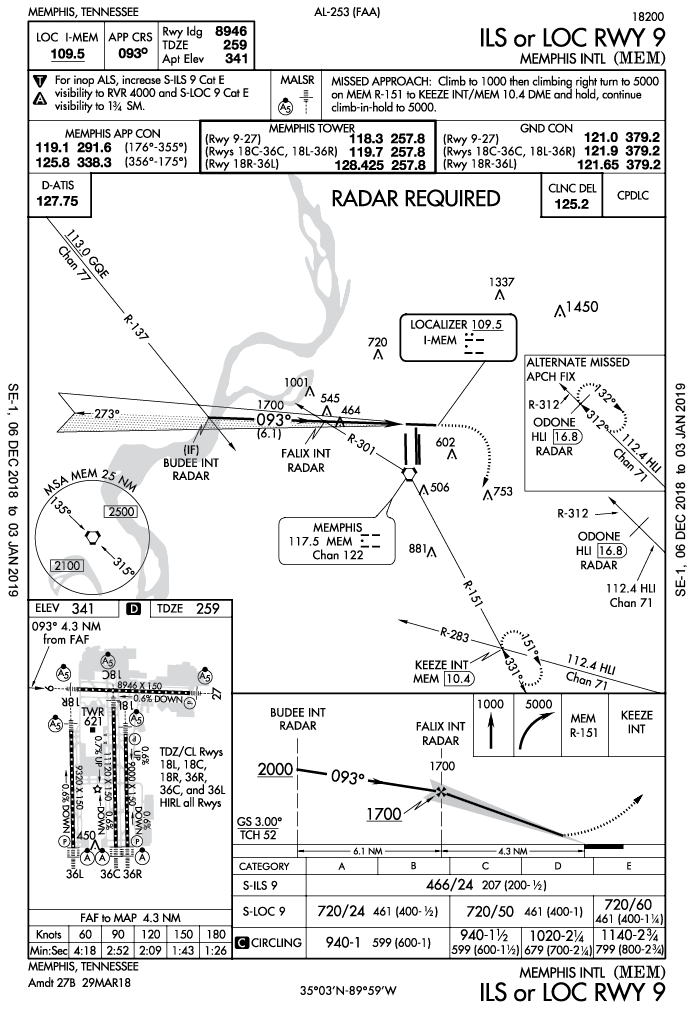
We got a quick response from Garmin. Its actually a bug in the underlying approach data, but that apparently ongoing bug is now handled by the navigators operating software. The reported issue doesnt have anything to do with database capacity. The issue began when some IAPs with LP lines of minima were coded with a Vertical Descent Angle (VDA) of 0 degrees. Software did not expect this as the IAPs are not supposed to be coded with VDA=0. If the IAP has no VDA (noted as Decent Angle NA on the chart), then the navigator can fly the approach as an LNAV-only without vertical guidance. If the IAP is coded with a VDA of zero, Garmin makes the approach unavailable from the database. Later software corrects this anomaly and restores the IAPs with VDA=0. Note that there was a Service Advisory Garmin sent out in 2013 when the issue was identified and they started to filter the affected IAPs from the Navigation database.
Pilots are encouraged to remove "to" and "for" from ATC communications for improved brevity and accuracy, drawing a parallel to the use of "niner."
Some Garmin G1000 units may not display certain valid RNAV approaches due to an underlying software bug related to zero Vertical Descent Angle (VDA) coding; keeping avionics software updated is crucial, though G1000 updates require airframe manufacturer approval.
ATC vectors to final often imply the instruction to intercept and track the localizer, and pilots typically have discretion on the rate of descent when given a "cross at" altitude restriction, provided the restriction is met.
I’d like to see a concerted effort made to remove “to” and “for” from communication. After all the word “nine” was replaced with “niner” to avoid confusion with the German for “no.”
So, instead of saying, “N1234 leaving 4000 feet for 6000 feet,” or “Climbing to 6000.” I’d instead suggest “November 1234 leaving 4000; climbing 6000.”
CREATE A FREE ACCOUNT
Sign up to keep reading
Create a free account to continue. Already a member? Sign in below.