











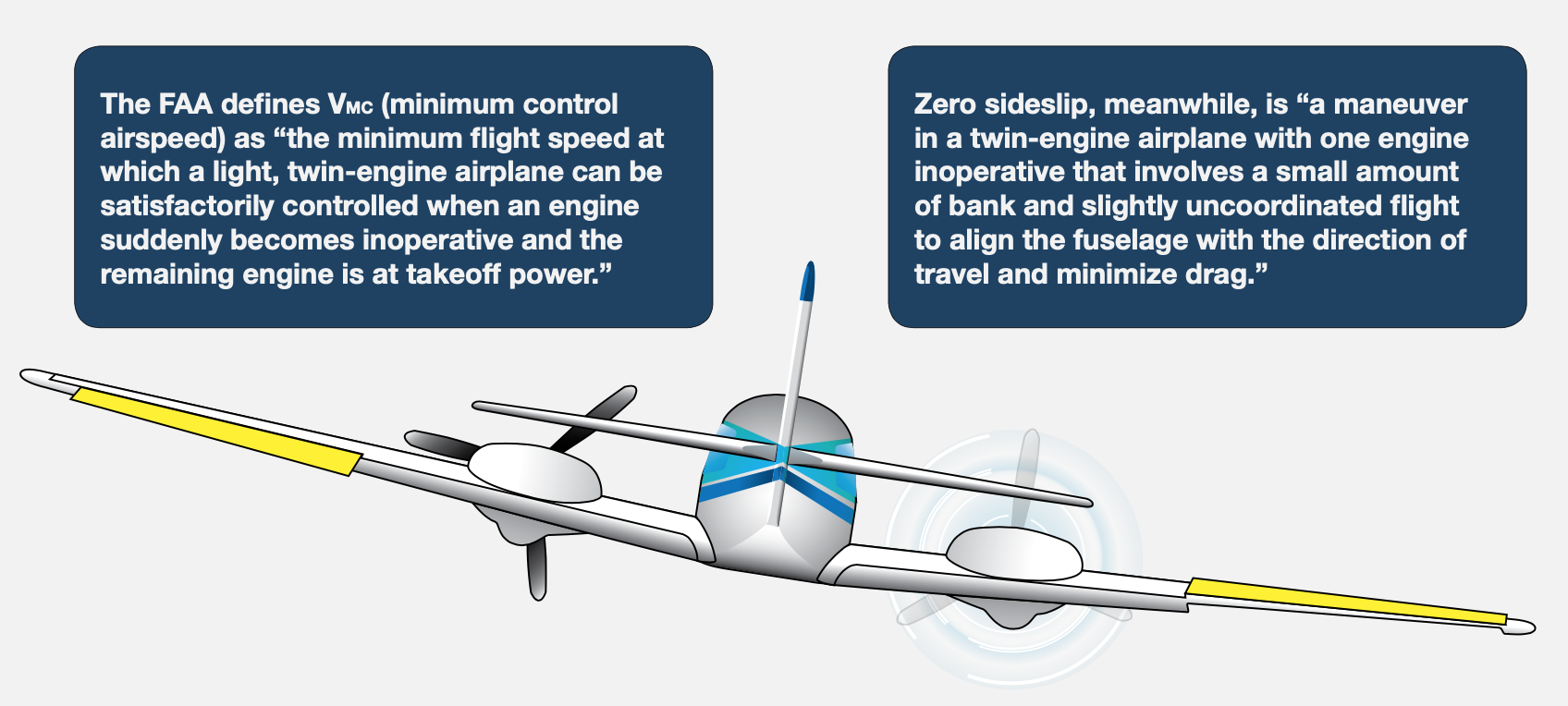


For the most part, flying a multi-engine airplane is just like flying a single. Until an engine fails. When transitioning from a single to a conventional twin, pilots spend most of their training learning to handle engine failures and to eke out what little performance remains. In conventional twins we’re likely to fly, that means understanding the aerodynamics that require zero sideslip, obtaining and maintaining the best single-engine rate of climb speed and demonstrating the minimum control airspeed—shortened to either VMC or VMCA (we’ll use VMC in this discussion). The graphic below provides the FAA-approved definitions for these terms.
One of the things transitioning pilots learn is that the published minimum control airspeed (VMC) is fixed for a specific set of conditions, including airplane weight and atmospheric conditions. It’s represented by the red radial line on the airspeed indicator. But the actual VMC varies with weight and atmospherics, plus other conditions. In practice, the difference between the published and actual VMC for when you lose an engine is critically important. To better understand why, let’s first discuss the published VMC number.

