











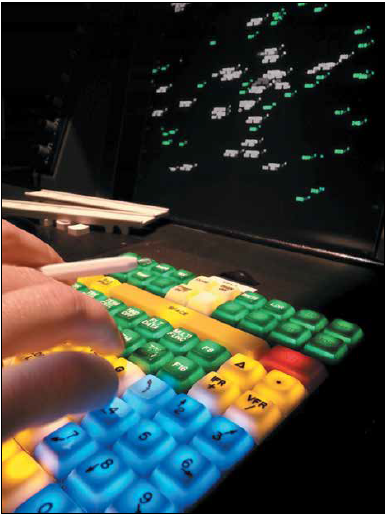


During my high school years, I got a lift home from a friend. Approaching my neighborhood, I said, “Turn left here.” I expected my friend to be a sensible driver, spot the clearly marked street a few hundred feet ahead, decelerate, merge into the designated left-turn lane, look for traffic, and smoothly turn into my neighborhood. My buddy did none of those things. He immediately turned hard left, bolting over a grass and concrete median, and wound up stopped perpendicular to oncoming cars. Clutching the forehead I’d banged on the passenger window, I yelled, “Dude, what the…?” “You said turn left!” he shouted back. I was ticked. “Yeah! I did! I thought you’d look before actually doing it, like a normal person!” While neither us nor his car were permanently damaged, it’s a moment that stuck with me, a reminder how important it is to not blindly follow directions. Now, as an air traffic controller, my mission is to issue accurate, safe instructions to my traffic. However, the responsibility is not just my own. The pilots under my oversight should be thinking before following through with all ATC instructions, creating a safe system of checks and balances. What options are available if they catch something questionable?
That Sinking Feeling
Early in my radar training, I was vectoring some airplanes for approaches, and struggling to make sense of the rules and concepts I’d been getting bashed into my mind. That’s when my trainer did the “instructor shift.” You’ve likely experienced it in flight training. Imagine you’re practicing a landing, instructor beside you. While focused on lining up the runway outside, your scan lapses. You don’t see your airspeed’s bottoming out. Out of the corner of your eye, you notice your instructor’s hands slowly reaching for the yoke and throttle, his feet sliding towards the pedals. This triggers mental alarms. What am I doing wrong? That’s what I’ve termed the “instructor shift”: the subtle movements of someone preparing to take action for a student about to royally foul up. Even in my frazzled state, I noticed my trainer straightening up in his chair, his grip shifting on his radio handset trigger. Alarm bells. What did I mess up? “Hey, Approach?” It was the concerned voice of an IFR Cirrus pilot I’d had on a long downwind vector. “How long are you gonna drive me towards these antennas? I’m about to turn on my own here.” Crap! He was at 2000 feet. Distracted by other aircraft, I’d aimed him directly at an antenna farm that rose up to 2100 feet. The minimum vectoring altitude around those spires was 3100 feet, and he was two miles from popping that bubble. My trainer was poised to turn him if I didn’t catch it … which I hadn’t until the guy spoke up. I sheepishly turned the Cirrus away from the obstruction, and got a good talking-to about scanning my aircraft and obstruction avoidance.

