











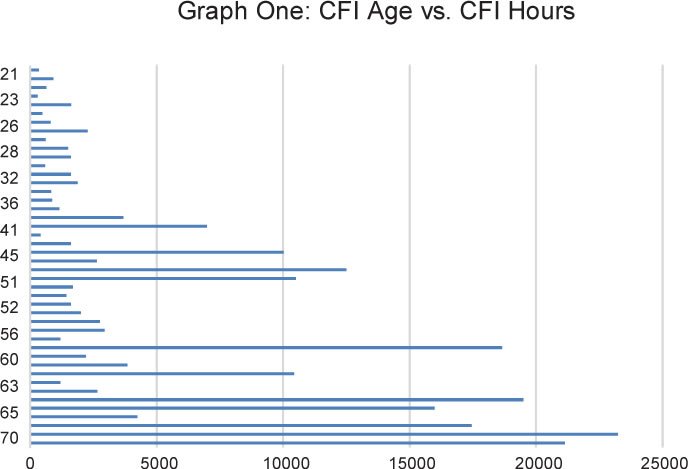


I agree with Clete Knaub’s overall conclusions in “Old? Or Young,” February 2015. I also agree with the comments on page 18 that there could be many other factors involved that could explain what is going on—confounding factors. There are known and unknown factors, and we don’t know how they impact the outcomes or how they might be correlated with each other, nor how they interact among themselves. It’s a classic multicollinearity problem
I found his treatment of confidence intervals (CI) wrong, however. Just to be sure, a CI is a way to bound uncertainty when estimating a population parameter such as a mean by taking a sample and calculating a sample statistic—the sample mean. Assuming that the sample is representative of the population, uncertainty still exists simply because the sample is small relative to the population. Therefore, a 95-percent CI for a sample mean is interpreted that the “real” population mean has a 95-percent probability to be within the interval and a five-percent probability of it being outside the interval. Sometimes CI is called the margin of error. What drives a CI is sample size and overall variation.

