













The International Civil Aviation Organization (ICAO) dwells in the deep recesses of general aviation operations. We now file ICAO flight plans, only vaguely aware that ICAO is some wispy regulatory body that seems to have the pull to make it happen. ICAO does indeed have major chops. Formed in 1947, it is one of the United Nations’ 15 specialized agencies that perform tasks requiring worldwide coordination. The ICAO Assembly has 193 member nations, excluding only countries like Lichtenstein, which have no international airport. ICAO alone is vested with international aviation authority.
Inside ICAO
Headquartered in Montreal, part of ICAO’s charter is to create rules governing international air navigation. Although air transport is its central focus, ICAO is fully aware of GA. Do we have any pull? Yes, we do. More on that later. Thirty-six member countries form ICAO’s political component, the ICAO Council. The U.S. is one of 11 members of “chief importance.” The Council adopts Standards and Recommended Practices (SARPs) for inclusion in one of 19 Annex subjects (see the table). ICAO’s technical body, the Air Navigation Commission, is responsible for 17 of the 19 Annexes. The ANC has 19 technical commissioners, all chosen from member nations. Commissioners are apolitical in the sense that they do not represent their countries. Under their leadership, 17 ICAO Panels develop SARPs. Each panel is mainly in charge of one Annex. Proposed SARPs move up the chain to an ANC commissioner, then the ICAO Council for consultation with member nations before final adoption into Annexes. The process takes about two years. 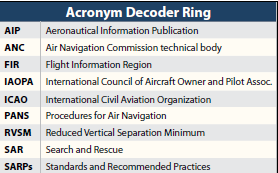 After some heavy-duty research and a few false starts (see the first sidebar), the ICAO Phonetic Language (Alpha, Bravo, Charlie, Delta…) was adopted in 1956, before the Federal Aviation Agency was born in 1958. ICAO flight plans, “Line up and wait” (replacing “Position and hold”), and renaming the Airport/Facility Directory as the “Chart Supplement U.S.” all help make our domestic operations consistent with global practice. Similarly, all ICAO countries must issue the English Proficient endorsement, which applies if the pilot plans to fly outside their home country.

