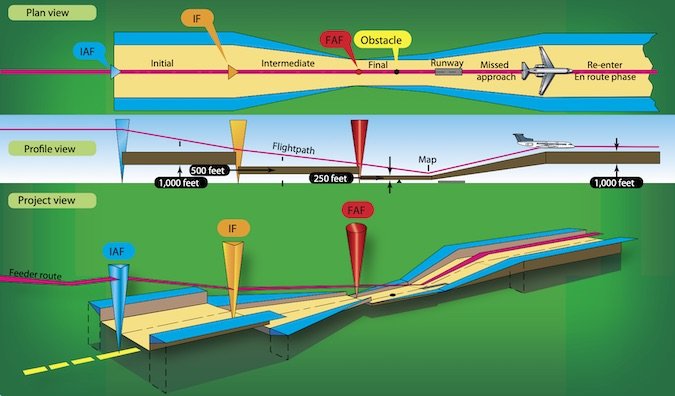
I noted an interesting change to the Instrument Rating ACS released back in June last year. It used to be that per the ACS, a circling approach required a heading change of at least 90 degrees from the final approach course to the landing runway. That requirement is now gone, replaced with the requirement to Visually maneuver to a base or downwind leg appropriate for the landing runway and environmental conditions. Also, new language was added saying the pilot must not bank over 30 degrees.
The instrument rating enhances pilot weather knowledge and caution, emphasizing the critical importance of understanding the underlying reasons for details on approach charts (TERPS).
Recent Instrument Rating ACS changes simplify circling approach requirements by replacing a fixed heading change with visual maneuvering, while introducing a 30-degree bank angle limit.
Approaches may be "Not Authorized" at night due to unlit obstacles, such as trees, penetrating critical visual clearance areas near runways.
Many pilots find Skew-T weather charts challenging to understand, leading the magazine to plan a simplified, multi-part instructional series on their application.
With winter flying in full swing, I wanted to share some thoughts I share with other pilots.
1. If you don’t get IFR (“The magazine for the accomplished pilot”), you should. It keeps the juices flowing and is chock full of insights mainly for instrument flying.
CREATE A FREE ACCOUNT
Sign up to keep reading
Create a free account to continue. Already a member? Sign in below.