














WATCH: First-of-Its-Kind Electric Aircraft Lifts Off in China

Manufacturer AutoFlight says Matrix represents inaugural ‘5-ton class’ eVTOL flight.

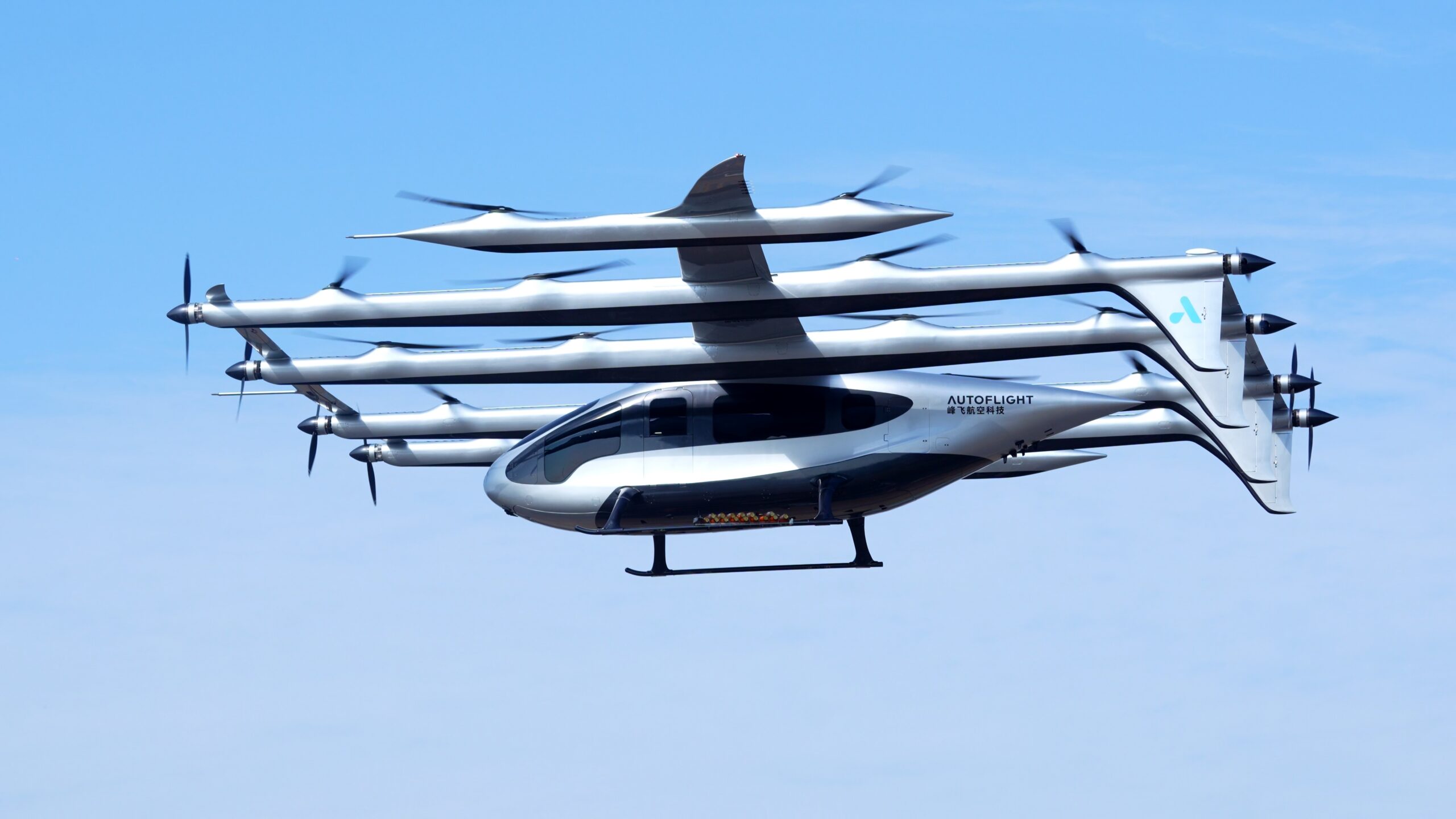
AutoFlight Matrix electric eVTOL aircraft public flight demonstration in China
AutoFlight unveiled its ‘5-ton class’ electric vertical takeoff and landing (eVTOL) Matrix aircraft with a public flight demonstration in China. [Credit: AutoFlight]
Gemini Sparkle

Key Takeaways:

  • Chinese manufacturer AutoFlight publicly demonstrated its Matrix eVTOL, billed as the "world’s first 5-ton class" electric aircraft designed to carry up to 10 passengers or heavy cargo.
  • The Matrix features a distinctive "triplane" configuration and aims to expand eVTOL capabilities beyond short-haul flights to include regional travel, heavy logistics, and emergency response.
  • This demonstration, alongside AutoFlight's already certified CarryAll cargo eVTOL, highlights China's rapid advancements and integration of eVTOL technology compared to other nations.
See a mistake? Contact us.

A Chinese manufacturer this week unveiled one of the most unique-looking aircraft to be developed in recent years—and took it out for a public demonstration flight.

Per developer AutoFlight, the debut sortie of Matrix—which it bills as the “world’s first 5-ton class” electric vertical takeoff and landing (eVTOL) aircraft—lasted about 20 minutes. The full-scale prototype flew alongside the company’s CarryAll cargo eVTOL, which is one of the first of its kind to receive type, production, and airworthiness certification from a regulator, China’s Civil Aviation Authority (CAAC).


AutoFlight’s Matrix and CarryAll eVTOL models lift off for a public demonstration flight in China. [Credit: AutoFlight]

The eVTOL is not a new concept. Several American companies are developing eVTOL air taxis that are designed to ferry four to six passengers between airports and city centers. But AutoFlight says the Matrix is big enough to accommodate as many as 10.

Also unusual is the aircraft’s “triplane” configuration, which places three wings in a horizontal array rather than stacking them vertically like a Sopwith. Connecting them are six arms, creating the look of a grid or warehouse pallet.

AutoFlight’s CarryAll features a unique ‘triplane’ configuration, with six arms linking three sets of wings. [Credit: AutoFlight]

Tian Yu, founder and CEO of AutoFlight, said the Matrix will “break the industry perception” that eVTOL aircraft will forever be limited to short-haul, low-load flights.

“Through economies of scale, it significantly reduces transportation costs per seat-kilometer and ton-kilometer, revolutionizing costs and embracing profitability,” said Yu. “It covers all scenarios from urban commuting to intercity feeder routes.”

The prototype is about 56 feet long with an approximately 65-foot wingspan, making it about as wide as a Bombardier Challenger 650 but about 10 feet shorter. AutoFlight claims it has a maximum takeoff weight north of 12,500 pounds. Propulsion comes from the company’s fifth generation electric motor and controller, comprising 20 motors for vertical lift and eight for forward thrust.

AutoFlight says the Matrix will seat 10 passengers in a business-class configuration or six in a smaller “VIP” arrangement. It will also come in a hybrid-electric cargo variant, with a forward-opening door and cargo hold large enough to accommodate about 3,300 pounds of payload. The company says it could hold two AKE or LD-3 containers, which also fit many Boeing and Airbus models such as the 777, 787, A350, and A380.

The aircraft will have an all-electric range of about 155 miles, rising to about 932 miles with hybrid propulsion. AutoFlight said possible applications include “regional travel, heavy logistics operations, and large-scale emergency response missions.”

Electric Aircraft Liftoff

AutoFlight said the Matrix demonstration at its low-altitude test facility in Kunshan, China, included a vertical takeoff, transition from hover to forward cruise flight, and vertical landing. A company spokesperson told FLYING that the aircraft flew in a large circle with a radius of about one kilometer.

“The achievement validates AutoFlight’s eVTOL technologies across complex aerodynamic systems, high-power electric propulsion, and advanced flight control systems,” the company wrote in a news release.

The Matrix and CarryAll soar over AutoFlight’s test facility in Kunshan, China. [Credit: AutoFlight]

The Matrix was accompanied in the air by AutoFlight’s 2-ton class CarryAll, which is the first eVTOL model in its weight class to obtain CAAC type, production, and airworthiness approvals. In November, AutoFlight said the delivery of 50 CarryAlls to the United Arab Emirates’ Falcon Aviation Services would happen by the end of 2025.

Those are just two of the many eVTOL designs AutoFlight is building. Another, Prosperity, is intended for urban passenger transport. It is designed for a pilot to fly as many as five passengers on routes up to 200 kilometers, cruising at 200 kph. AutoFlight claims a 2024 Prosperity flight between Shenzhen and Zhuhai in China was the first public, intercity eVTOL flight.

The Matrix (left) is significantly larger than AutoFlight’s autonomous CarryAll model. [Credit: AutoFlight]

In addition to the CarryAll, the firm is also developing the Albatross for autonomous cargo missions as long as 270 kilometers. The company’s White Shark is designed for “industrial” applications, with a lower payload (20 kilograms) but much higher range, altitude, and flight endurance—up to six hours.

American eVTOL developers are also conducting plenty of testing, with even more planned under the FAA’s eVTOL Integration Pilot Program—a three-year series of operational demonstrations that could begin this summer. The U.S. government has made promoting the technology a national strategic priority.

China, however, may be integrating these new entrants faster. The CAAC in 2025 reportedly certified the first four-seat electric aircraft for commercial operations, according to the model’s operator Volar Air Mobility.

Like the CarryAll, Chinese manufacturer Ehang’s EH216-S—another autonomous eVTOL model—has received type, production, and airworthiness approvals, with an additional authorization allowing it to conduct limited passenger operations.

Boeing’s Wisk Aero, the leading American developer of autonomous eVTOL aircraft, just started flight testing with a full-scale prototype in December. Others such as Joby Aviation, Archer Aviation, and Beta Technologies are building piloted models, but they too have yet to secure operational privileges.

Jack Daleo

Jack is a staff writer covering advanced air mobility, including everything from drones to unmanned aircraft systems to space travel—and a whole lot more. He spent close to two years reporting on drone delivery for FreightWaves, covering the biggest news and developments in the space and connecting with industry executives and experts. Jack is also a basketball aficionado, a frequent traveler and a lover of all things logistics.

Ready to Sell Your Aircraft?

List your airplane on AircraftForSale.com and reach qualified buyers.

List Your Aircraft
AircraftForSale Logo | FLYING Logo
Pilot in aircraft
Sign-up for newsletters & special offers!

Get the latest stories & special offers delivered directly to your inbox.

SUBSCRIBE
