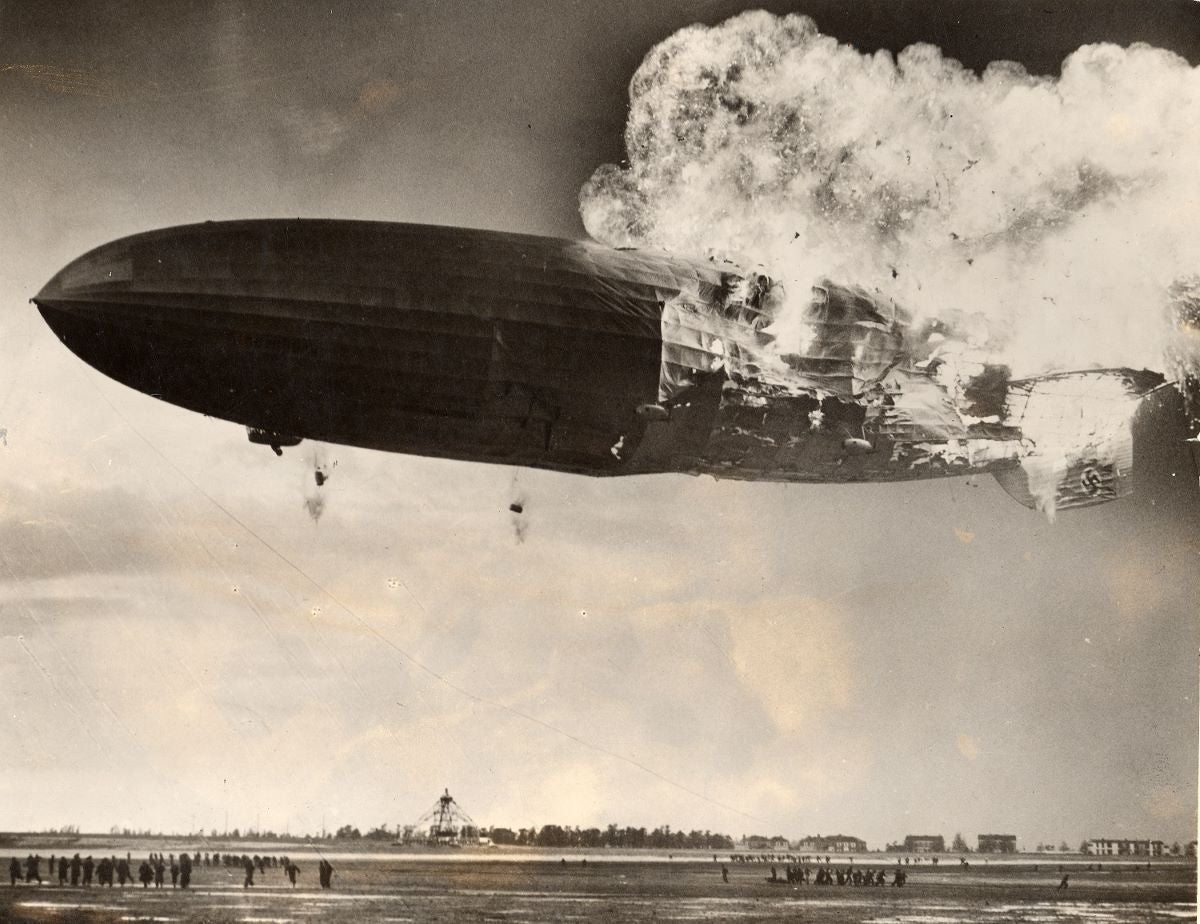
German airship Zeppelin LZ 129 'Hindenburg' burning upon its approach to Naval Air Station Lakehurst, New Jersey, on May 6, 1937. U.S. Navy sailors, preparing to grab for tether lines on the ground, run for safety as they watch the airship fall to the ground with its rear half engulfed in flames. [Courtesy: Smithsonian Institution]
Key Takeaways:
The Hindenburg disaster on May 6, 1937, involving the fiery destruction of the German airship at Lakehurst, New Jersey, killed 35 of the 97 people on board plus one ground crew member, effectively ending the era of rigid airship travel.
The luxurious Hindenburg was compelled to use highly flammable hydrogen (due to the U.S. refusal to export safer helium) and was controversially utilized by the Nazi regime for propaganda purposes despite opposition from its designer.
The U.S. Navy also experienced a series of catastrophic crashes with its own rigid airships, including the USS Akron and USS Macon (which were designed as flying aircraft carriers), leading to the suspension of its rigid airship program before World War II.
On May 6, 1937, the age of airships—the ocean liners of the sky—came to a violent end with the destruction of the Hindenburg in Lakehurst, New Jersey.
Monday marks the 87th anniversary of the event. NBC reporter Herb Morrison was on location to cover what had become almost routine—the docking of the German airship for the newsreels.
CREATE A FREE ACCOUNT
Sign up to keep reading
Create a free account to continue. Already a member? Sign in below.
Meg Godlewski has been an aviation journalist for more than 24 years and a CFI for more than 20 years. If she is not flying or teaching aviation, she is writing about it. Meg is a founding member of the Pilot Proficiency Center at EAA AirVenture and excels at the application of simulation technology to flatten the learning curve. Follow Meg on Twitter @2Lewski.