











Register

Lessons from the Truckee NTSB Case Study

The only good thing to come out of aviation accidents, be they large or small, is that we can often learn from the mistakes of others.

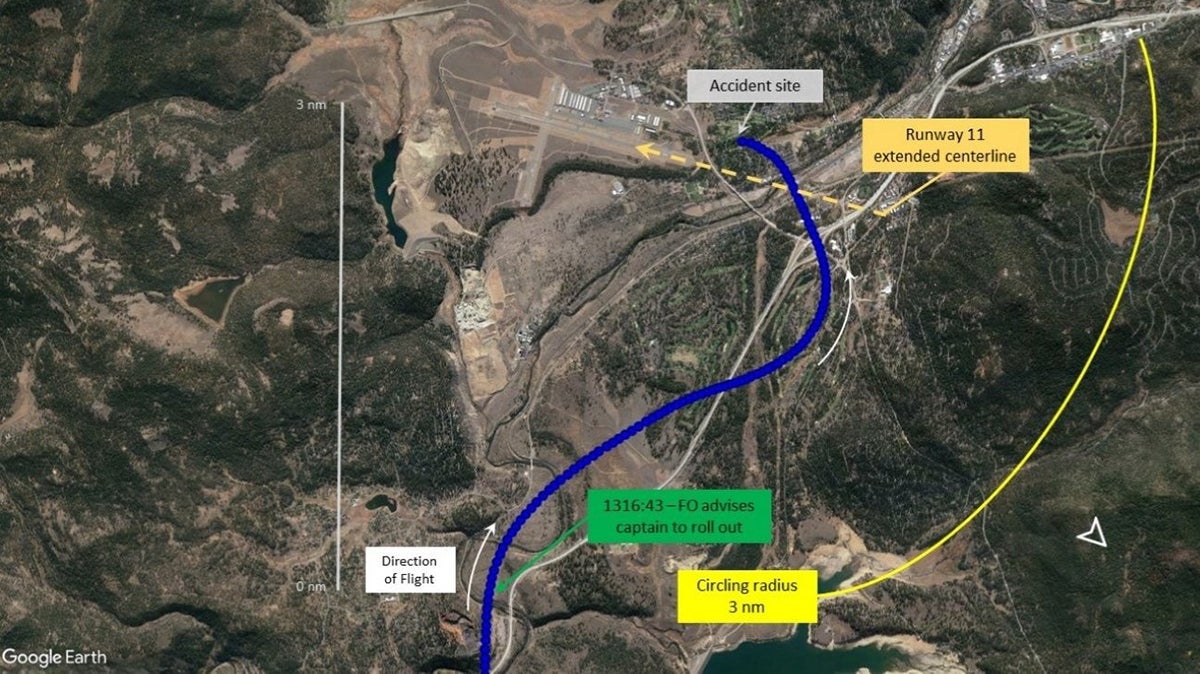
The airplane’s downwind leg and allowed circling radius. [Courtesy: NTSB]
Gemini Sparkle

Key Takeaways:

  • The fatal 2021 Challenger 605 crash in Truckee, California, was caused by an unstabilized approach, failure to brief a changed circle-to-land procedure, and poor crew resource management (CRM).
  • The flight crew—flying together for the first time—suffered from critical communication breakdowns, excessive airspeed, improper aircraft configuration, and the lack of a positive exchange of flight controls, culminating in an aerodynamic stall.
  • Industry experts emphasize that safety must be reinforced from primary flight training onward by strictly enforcing FAA performance standards, conducting disciplined approach briefings, and teaching assertive CRM practices.
See a mistake? Contact us.

The only good thing to come out of aviation accidents, be they large or small, is that we can often learn from the mistakes of others. I adopted this mindset years ago when I was tasked with writing up accident reports from the National Transportation Safety Board (NTSB). In hindsight, the mistakes can be glaring, leaping off the page. How to mitigate the risks and the failures that led to the event takes a little more thought.

The NTSB recently released a video of a panel discussion about the 2021 accident involving a Challenger 605 attempting a circle to land approach at Truckee-Tahoe Airport (KTRK), in Truckee, California, that resulted in the deaths of the flight crew, six passengers, and two dogs. The probable cause of the accident was released in August of this year and listed as a combination of an unstabilized approach and the flight crew’s poor crew resource management and decision making. The panel discussion took the event apart step by step to identify the issues and suggest ways to mitigate these risks.

Meg Godlewski

Meg Godlewski has been an aviation journalist for more than 24 years and a CFI for more than 20 years. If she is not flying or teaching aviation, she is writing about it. Meg is a founding member of the Pilot Proficiency Center at EAA AirVenture and excels at the application of simulation technology to flatten the learning curve. Follow Meg on Twitter @2Lewski.

Ready to Sell Your Aircraft?

List your airplane on AircraftForSale.com and reach qualified buyers.

List Your Aircraft
AircraftForSale Logo | FLYING Logo
Pilot in aircraft
Sign-up for newsletters & special offers!

Get the latest stories & special offers delivered directly to your inbox.

SUBSCRIBE