
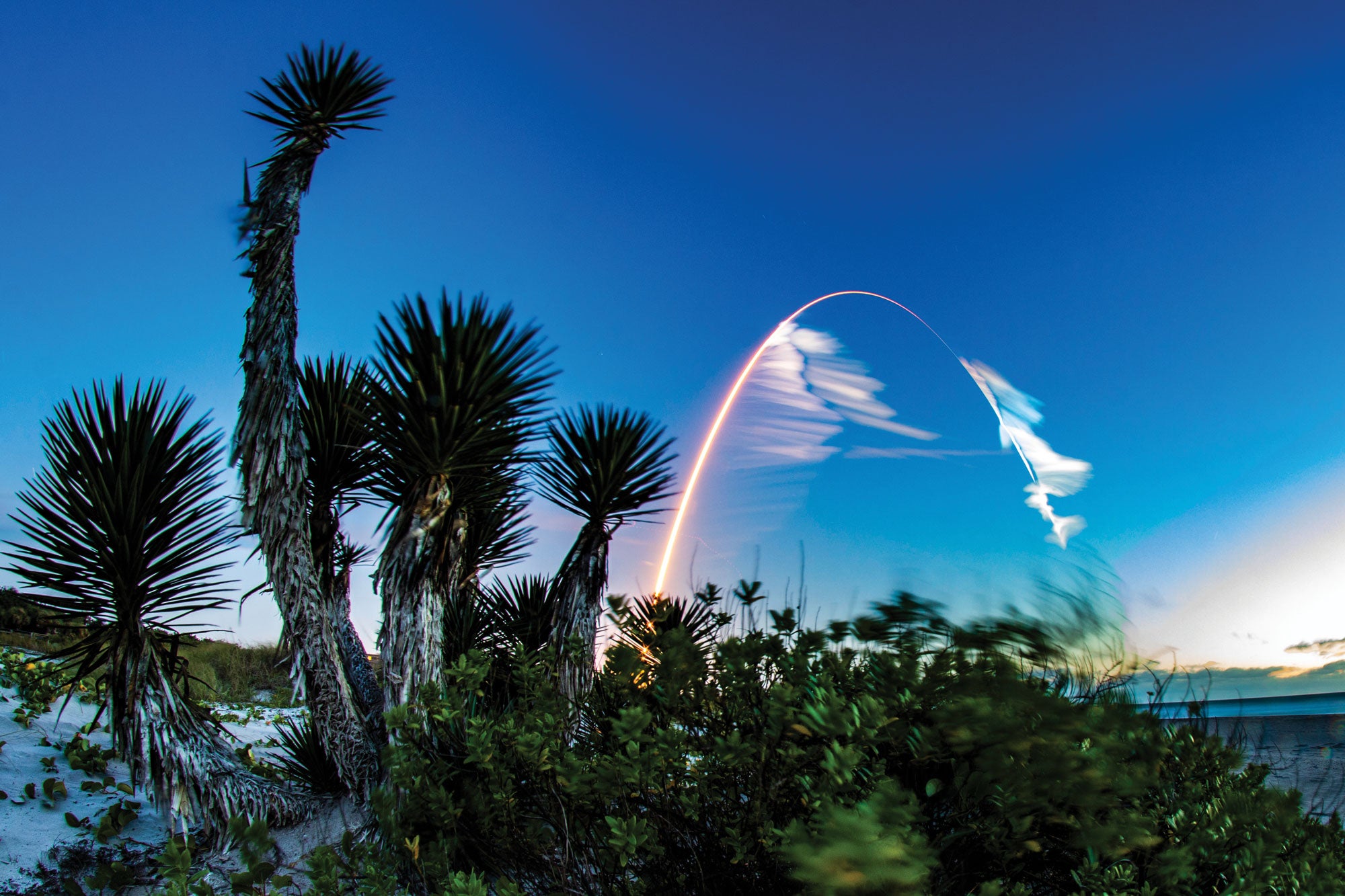


I am driving down a quiet two-lane road through dark, still Florida mangroves, going eastbound toward the sea and a horizon that has barely begun to brighten. It is early—well before my normal rising hour. My younger sister, Sarah, is in the passenger seat, chatting quietly so as to not wake her three kids dozing in the back. We come upon a break in the mangroves, and I pull over, pointing across the marsh. There, a few miles away, is a brilliant white SpaceX Falcon 9 rocket gleaming in the floodlights of Kennedy Space Center’s Launch Complex 39A on Merritt Island. It is an impressive, stirring sight, and I imagine similar early morning views of the Saturn V rockets that launched man to the moon from this very spot.
Falcon 9 is not Saturn nor is it the space shuttle, but it is America’s preeminent space-launch vehicle today. It has revolutionized the space industry by slashing the cost to orbit and making retro-propulsive landings de rigueur, and it has returned crewed spaceflight to our shores. Launches are still impressive events that attract a good number of locals and tourists alike; in two winters here, Dawn and I have been lucky to view more than a dozen (“Snowbirds on the Space Coast,” November 2020) including Falcon 9 test, cargo and crewed missions, as well as Atlas V, Delta IV and Delta IV Heavy shots.